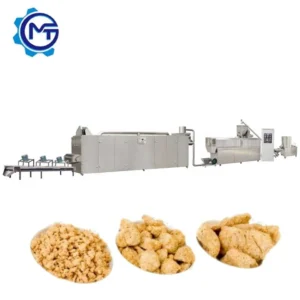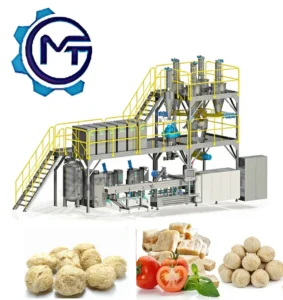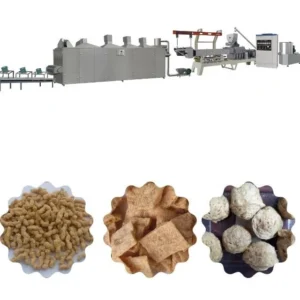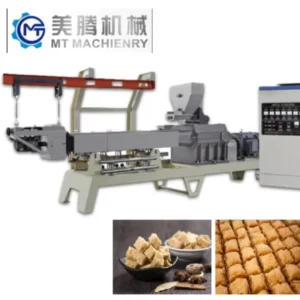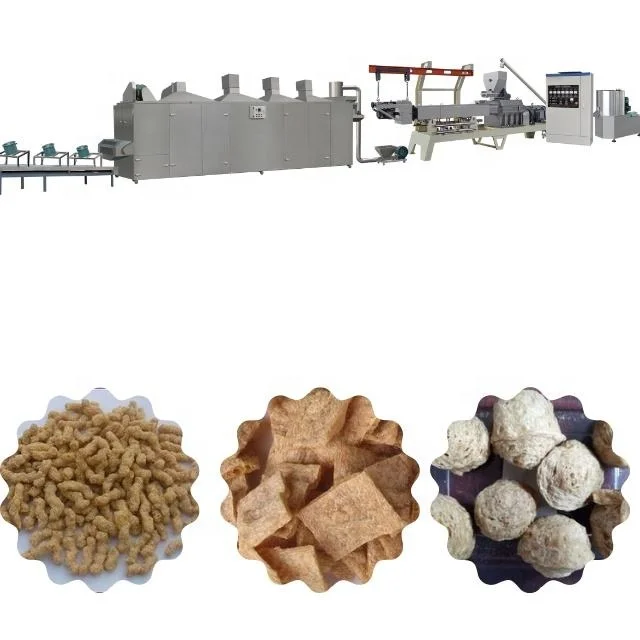
Throughput Matched at Every Station — Every mixer, extruder, dryer and cooler in this line is sized to the same output target, preventing bottleneck failures that plague multi-vendor assemblies.
Technical Specifications
| Parameter | Value |
|---|---|
| Product Type | Textured Vegetable Protein Extrusion Line |
| Model | MT65 / MT70 / MT85 |
| Screw Type | Twin-screw |
| Installed Power | 85 kW (MT65) / 120 kW (MT70) / 195 kW (MT85) |
| Real Power | 65 kW (MT65) / 90 kW (MT70) / 165 kW (MT85) |
| Output Capacity | 150–200 kg/h (MT65) / 200–300 kg/h (MT70) / 600–800 kg/h (MT85) (basis to be confirmed by raw material and moisture) |
| Overall Dimensions | 18000×1300×2300 mm (MT65) / 20000×1500×2400 mm (MT70) / 24000×3500×4300 mm (MT85) |
| Material of Construction | 304 Stainless Steel |
| Line Stations | Preparation, Mixing, Conveying, Extrusion, Drying, Cooling, Packing |
| Mixer Capacity | 300–600 kg/h, 4 kW |
| Dryer Specification | Belt length 3.5 m, far infrared heaters (3.9 kW × 24) |
| Cooling Machine Capacity | 200–300 kg/h |
| Warranty | 1 year complete warranty, lifetime maintenance service |
Application Suitability
| Application | Material or Output |
|---|---|
| Textured Vegetable Protein (TVP) | Low-temperature soybean meal, peanut meal |
| Plant-Based Meat Alternatives | Protein blends for ham, sausage, and canned food analogues |
| Quick-Frozen Food Ingredients | High-moisture extruded protein for fast food and frozen retail |
Why "Capacity Ratings" Fail When Raw Materials Change
A line rated at 300 kg/h on standard soy can fail completely when a buyer switches to pea protein without reconfiguring the screw elements.
Many buyers source a Textured Vegetable Protein Processing Line full equipment range based on a generic capacity number. The problem is that protein behavior under shear and heat varies wildly between soybean meal, peanut meal, and newer blends like pea or fava. If the dryer and cooler are sized for the extruder’s nominal output on one material, a shift to a higher-moisture or denser blend can cause the downstream stations to back up. [NEED_CITE: effects of raw material moisture on extrusion throughput]
Station Sizing Across the Full Equipment Catalogue
When evaluating a Textured Vegetable Protein Processing Line full equipment range, the critical factor is whether every station shares a verified throughput ceiling. A 600 kg/h extruder feeding a dryer rated for only 400 kg/h creates a choke point that forces the entire line to run at the slower speed. This equipment range specifies mixer capacity, dryer belt length, and cooler airflow to align with the chosen extruder model.
Screw Configuration and Die Design for Protein Fibers
The twin-screw extrusion process opens spherical protein molecules into chains, reorganizing them into a fibrous, meat-like structure under high temperature and high shear. The screw configuration must be matched to the specific protein source; what works for low-temperature soybean meal will not necessarily produce the correct fiber alignment for a peanut meal blend. [NEED_CITE: twin-screw extrusion mechanism for protein texturization]
Decoding Power and Footprint for Plant Layout
The installed power versus real power figures indicate the thermal and mechanical energy actually available for extrusion. For instance, the MT85 draws 195 kW installed but runs at 165 kW real power, meaning the electrical infrastructure must support the higher figure for startup and peak load. The overall dimensions, stretching up to 24 meters for the MT85 configuration, dictate the minimum workshop length and the utility routing for steam, water, and three-phase power drops.
The Hidden Cost of Unmatched Downstream Equipment
Sourcing the extruder from one vendor and the dryer from another often leads to integration failures. The dryer’s belt speed and temperature profile may not match the extruder’s discharge rate, resulting in either under-dried product that spoils or over-dried product that fractures during packing. These mismatches are rarely apparent until the first full production run. [NEED_CITE: consequences of mismatched extrusion and drying capacity]
Engineering the Line as a Unified System
This Textured Vegetable Protein Processing Line full equipment range is built under one supplier, ensuring the mixer, extruder, and dryer communicate on throughput. The screw and die configuration is specified to the buyer’s raw material rather than copied from a generic build. An in-house testing workshop allows trial runs on the buyer’s actual formula before shipment. The full 304 stainless steel construction across all stations meets food-grade compliance without selective upgrades.
Documentation & Verification
- Line layout and capacity calculation confirming throughput matching across every station
- Machine specification sheet for each station with rated and real power figures
- Screw and die configuration record matched to buyer’s specific raw material blend
- Factory test record and trial run report on customer raw material before shipment
- CE declaration of conformity and ISO certificate for the complete line assembly
Installation, Commissioning & Support
- Foundation planning for line lengths up to 24 meters with utility trench routing
- Three-phase power supply sizing based on installed power up to 195 kW
- Assembly of modular dryer and cooler sections on-site to match belt alignment
- First-run parameter setting for barrel temperature profile and screw speed
- Operator training on screw element replacement and die cleaning procedures
- Wear parts list including screw segments and die plates for first replacement cycle
Preparing Your Line Configuration
To receive an accurate layout and quotation, provide the specific protein source (soybean meal, peanut meal, or blend), target hourly output, and local voltage and frequency standards. Workshop dimensions and ceiling height are required to verify the dryer and cooling conveyor footprint.
Frequently Asked Questions
Q: How is throughput matched between the extruder, dryer and cooler so no station bottlenecks the line?
A: Every station in this Textured Vegetable Protein Processing Line full equipment range is sized to the same output target. The dryer belt length and heater capacity, along with the cooler airflow, are calculated against the extruder’s real output on your specific raw material, preventing upstream backup or downstream starvation.
Q: What supporting equipment stations are included and where does each fit in the process flow?
A: The line includes a powder mixer for blending, screw conveyors for transfer, the twin-screw extruder for texturization, a far infrared dryer for moisture reduction, a cooling machine for stabilization, and packing interfaces. Each station is positioned to maintain continuous material flow without manual intervention.
Q: How do the three extruder models differ in installed power, real power and footprint?
A: The MT65, MT70, and MT85 models scale from pilot to high-volume production. Installed power ranges from 85 kW to 195 kW, with real power from 65 kW to 165 kW. Footprint length extends from 18 meters to 24 meters, requiring corresponding workshop space and utility infrastructure planning.
Q: Can individual stations be specified independently for an existing extrusion line?
A: Yes, individual stations such as the far infrared dryer or cooling machine can be specified to retrofit an existing line. However, throughput matching requires verifying the existing extruder’s discharge rate and moisture content to ensure the new station does not create a bottleneck.