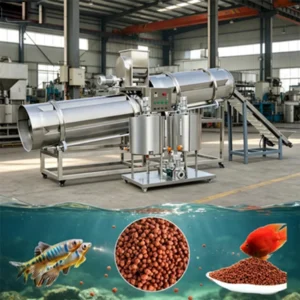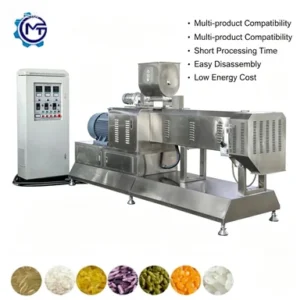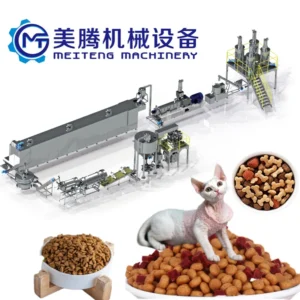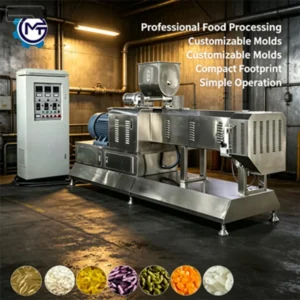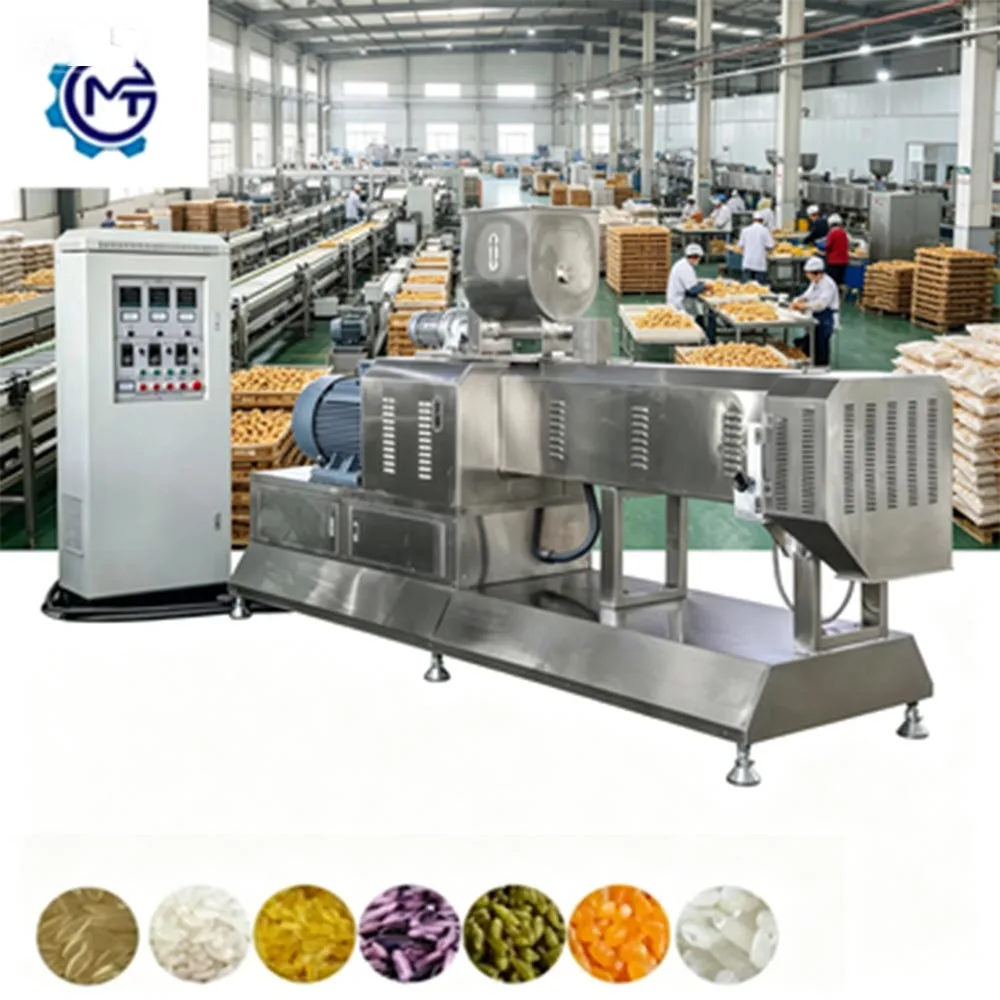
Balanced Station Throughput — Every mixer, extruder, dryer, and coater in this line is sized so no single unit starves or chokes the next station down the flow.
Technical Specifications
| Parameter | Value |
|---|---|
| Product Type | Twin Screw Fish Feed Extruder Production Line |
| Screw Type | Twin-screw |
| Control System | PLC automatic control |
| Contact Material | Food-grade 304 stainless steel |
| Line Stations | Raw material mixer, extruder, dryer, seasoning coating machine, vibrating sieve, conveyor equipment |
| Pellet Adjustment | Size, hardness, buoyancy adjustable |
| Production Mode | Full continuous automatic production |
| Output Capacity | Large stable processing capacity (basis to be confirmed) |
Application Suitability
| Application | Material or Output |
|---|---|
| Floating pellet production for koi and goldfish | Fish meal, corn powder, soybean meal |
| Sinking pellet production for bottom-feeding species | Compound additives, wheat flour, starch binders |
| Tropical fish feed in varied pellet diameters | Mixed protein and carbohydrate formulations |
| Commercial aquaculture mass production | High-protein aquatic formulations with vitamin premixes |
What an Extruder Without a Matched Line Actually Costs You
The quoted throughput is only real when every upstream and downstream station can hold that same pace.
I once walked into a plant in South Asia where a twin-screw extruder sat idle for hours each shift. The problem was not the extruder itself — it was that the mixer batch cycle took twice as long as the extruder feed rate demanded, and the dryer downstream could not keep up with the moisture load. The fish feed extruder production line for sale on paper never performed as a line on the floor [NEED_CITE: line throughput matching across extrusion stations]. When one station bottlenecks, the rest of the capital just waits.
Matching Every Station from Mixer to Sieve
The raw material mixer sets the rhythm. If its batch size and cycle time do not align with the continuous feed demand of the twin-screw extruder, the screw runs partially starved and pellet density drifts. This fish feed extruder production line for sale is specified so that mixer discharge, extruder feed hopper, and conveyor transfer rates form one uninterrupted flow rather than a series of stops and surges.
Dryer Capacity Decides Real Output
The extruder produces wet, hot pellets that must lose moisture before coating or packing. A dryer undersized for the extruder’s actual discharge rate will back up the entire line or force the extruder to slow down. Proper sizing accounts for incoming pellet moisture, target final moisture, ambient humidity at the installation site, and the thermal profile of the specific feed formulation being run [NEED_CITE: moisture removal rates in feed pellet drying]. The dryer in this line is matched to the extruder’s full output, not a derated figure.
Reading the Specifications That Matter
Twin-screw extrusion relies on the intermeshing action of two screws to generate shear, mix ingredients, and build the pressure needed for uniform expansion through the die. This configuration handles a wider range of raw materials — from high-fat fish meal blends to starchy cereal bases — than a single-screw design can manage without surging. The food-grade 304 stainless steel contact parts resist corrosion from salt-bearing aquatic formulations and meet hygiene expectations in feed-grade production. PLC automatic control allows operators to store recipes, lock in barrel temperature profiles, and maintain screw speed setpoints across shifts, which is essential for batch-to-batch pellet consistency. Adjustable pellet parameters — size, hardness, and buoyancy — are achieved by swapping die plates and tuning moisture and temperature rather than replacing hardware. The vibrating sieve downstream removes fines and oversize pellets before they reach the seasoning drum, keeping coating uniformity within spec.
The Hidden Cost of Choosing the Wrong Configuration
When a buyer selects an extruder based on a nominal capacity figure without verifying that figure against their own formulation and pellet size, the real output on day one can fall well short of the production plan. A screw configuration copied from a generic build may produce pellets that are too dense to float or too fragile to survive handling. If the dryer, coater, or conveyor is sourced separately without throughput reconciliation, the line develops choke points that no amount of operator skill can compensate for [NEED_CITE: consequences of mismatched extrusion line components]. These issues do not show up in a quotation — they show up in lost shifts and off-spec product.
Why Source This Line Here
Each station in this fish feed extruder production line is specified under one supplier scope, so throughput calculations span the entire flow from batching to discharge rather than stopping at each machine’s nameplate. Screw configuration and die design are set to the buyer’s actual raw material blend and target pellet geometry, not pulled from a standard library. An in-house testing workshop allows trial runs on the buyer’s formulation before shipment, so product development begins in the factory rather than on the installation floor. PLC and MCC control panels are built with the destination market’s voltage, frequency, and operator language confirmed in advance. Pre-sales engineering covers line layout and utility planning, and on-site support extends through commissioning and operator training.
Documentation & Verification
- Line layout drawing showing capacity calculation across every station from mixer to packing
- Screw and die configuration record matched to your raw material and pellet specification
- Trial run report produced on your actual formulation before the line leaves the factory
- Electrical schematic with voltage, frequency, and control language confirmed for your site
- Operation and maintenance manual covering every station in the line
- Wear parts list identifying screws, dies, and seals with reorder reference numbers
Installation, Commissioning & Support
- Foundation plan sized to the line’s total footprint and dynamic load from the twin-screw extruder
- Power supply specification covering PLC panel requirements and dedicated circuits for each motor
- Modular station delivery allowing phased installation of mixer, extruder, dryer, and coater
- First-run parameter logging on your formulation to establish baseline screw speed and barrel temperatures
- Operator training on PLC recipe recall, die changeover, and buoyancy adjustment procedures
- Spare screw and die sets staged for the first replacement cycle based on your production volume
What to Include in Your Inquiry
To size each station accurately, share your target pellet diameter range, the protein and starch content of your formulation, and whether you need floating, sinking, or both pellet types. Confirm your site voltage and frequency, the control language your operators will use, and any existing upstream or downstream equipment that the new line must integrate with. If you can send a sample of your raw material blend, a trial run in the testing workshop will validate capacity and pellet quality before the quotation is finalised.
Frequently Asked Questions
Q: How is extruder capacity verified against my specific fish feed formulation?
A: Capacity depends on pellet size, moisture content, and raw material composition. A trial run using your actual formulation is conducted in the testing workshop, and the results are documented in a report that confirms achievable throughput before the quotation is finalised.
Q: What voltage and frequency options are available?
A: The PLC panel and all motors are configured to match your site’s electrical supply. Voltage, frequency, and control language are confirmed during the specification stage so the line arrives ready for connection without on-site electrical rework.
Q: How are dryer and seasoning drum capacities matched to the extruder?
A: Each downstream station is sized based on the extruder’s verified discharge rate at your specific formulation. Dryer thermal capacity and coating drum volume are calculated to handle peak output without creating a bottleneck.
Q: Can pellet buoyancy be adjusted between floating and sinking on the same line?
A: Yes. Buoyancy is controlled by adjusting moisture, barrel temperature profile, and die configuration. The same twin-screw extruder can produce both floating and sinking pellets within a single production run by modifying these parameters.
Q: What spare wear parts are included and how are replacements handled?
A: The line ships with a wear parts list identifying screws, dies, and seals. Initial spare sets can be included in the first shipment, and replacement lead times are confirmed at the quotation stage based on your production schedule.