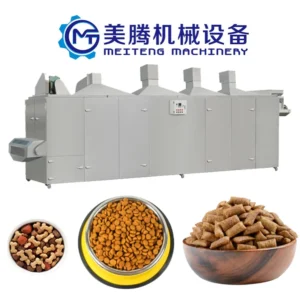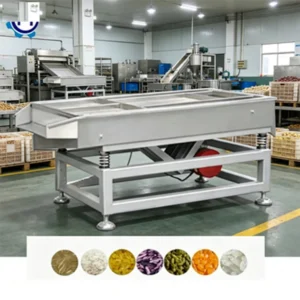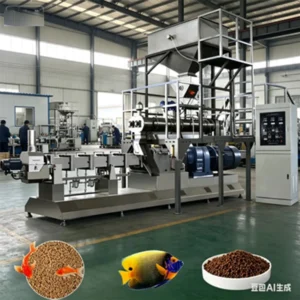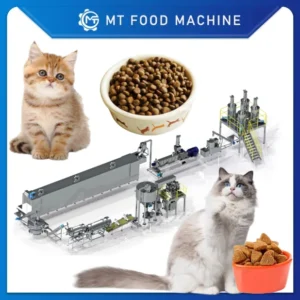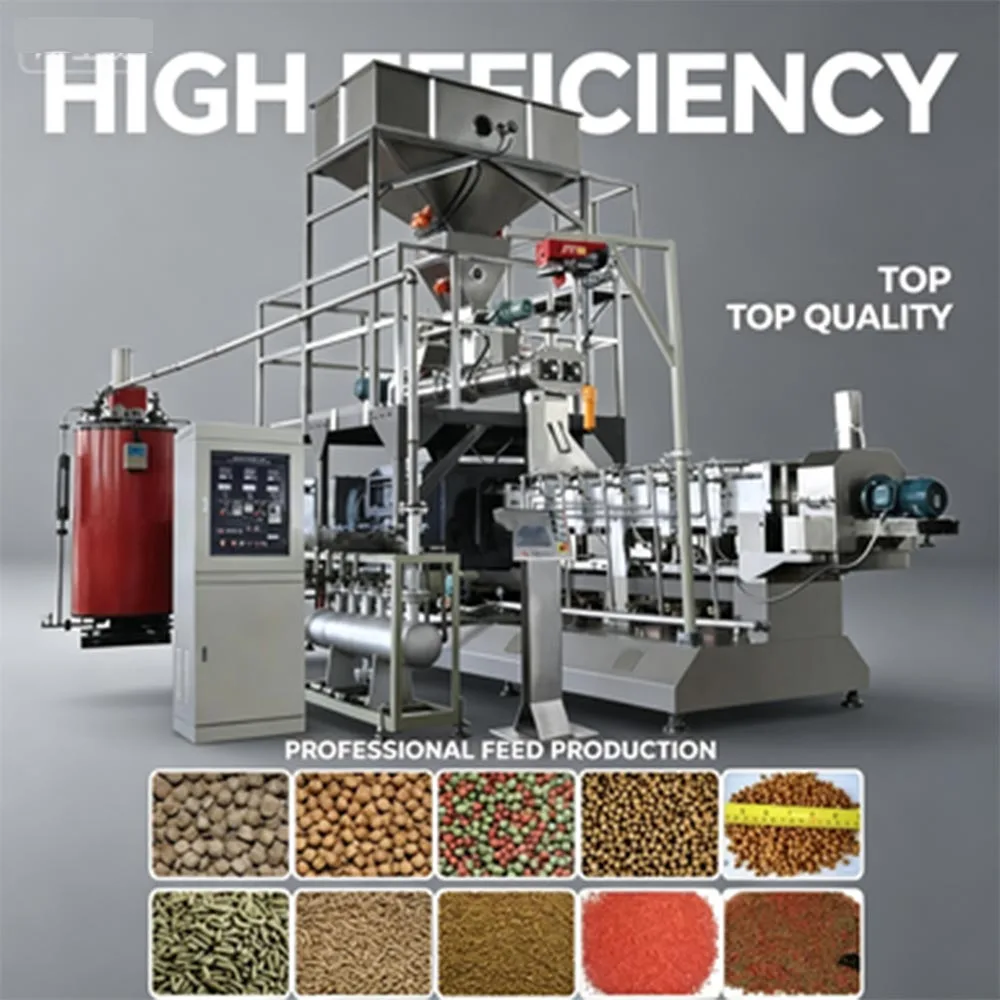
Pre-Matched Line Stations — Every mixer, extruder, dryer, and coating drum is sized together so no single unit chokes the rest of the fish feed production line.
Technical Specifications
| Parameter | Value |
|---|---|
| Product Type | Twin Screw Aquatic Feed Extrusion Production Line |
| Screw Type | Twin screw |
| Control System | Intelligent PLC automatic control system |
| Material Contact Parts | Food-grade 304 stainless steel |
| Output Capacity | Medium to large scale continuous production (basis to be confirmed with raw material formulation, moisture content, pellet diameter, and target density) |
| Pellet Types | Floating and sinking fish feed pellets |
| Pellet Adjustability | Size, hardness, and buoyancy adjustable via die and screw configuration |
| Raw Materials Processed | Fish meal, soybean meal, corn powder, compound additives |
| Line Stations | Raw material mixer, extruder, dryer, seasoning coating machine, vibrating sieve, conveyor equipment |
| Operating Mode | Full continuous automatic production |
| Assembly State | Complete matched production configuration |
| Heating System | Optimized energy-saving transmission structure and heating system |
| Maintenance Design | Humanized operation interface, quick replacement of vulnerable parts |
| Certification | CE, ISO |
Application Suitability
| Application | Material or Output |
|---|---|
| Commercial koi and goldfish feed manufacturing | Floating pellets from fish meal, wheat flour, and vitamin premix |
| Tilapia and catfish aquaculture feed production | Sinking and slow-sinking pellets from soybean meal and corn powder |
| Shrimp and prawn feed processing | Small-diameter sinking pellets from compound aquatic additives |
| Tropical ornamental fish feed lines | Color-enhancing floating micro-pellets with spirulina and astaxanthin |
| Medium to large scale industrial aquatic feed plants | Continuous high-volume runs across multiple pellet size ranges |
Why the Dryer Capacity Matters More Than the Extruder Nameplate
A fish feed production line manufacturer must match every station, or the fastest extruder in the room becomes the most expensive bottleneck on the floor.
I once watched a West African feed plant run a twin-screw extruder at full throughput while the downstream dryer sat overloaded, dumping wet pellets that clumped before they ever reached the coating drum. The owner had chosen the extruder on nameplate capacity alone and never asked what the dryer could actually handle in his humid climate. That mismatch cost him more in spoiled product than the dryer itself would have cost to size correctly [NEED_CITE: drying capacity calculation for extruded aquatic feed in high-humidity environments]. When you evaluate a twin screw aquatic feed extruder for sale, look past the extruder and trace the material flow through every station that follows it.
How the Stations Connect Across the Floor
This configuration places the raw material mixer upstream of the twin-screw extruder, feeding a consistent blend at a controlled rate. The extruder discharges directly onto a conveyor that moves the cut pellets into the dryer, where residence time and temperature are calibrated to the moisture content leaving the die. From the dryer, pellets pass through the vibrating sieve to separate fines and oversize pieces before entering the seasoning coating machine. Every station in this fish feed production line is specified against the others, so the throughput target you set at the mixer is the same throughput you see at the packing end.
What Continuous Automatic Production Actually Requires
Running a full continuous cycle demands that the PLC automatic control system coordinates feed rate, barrel temperature, screw speed, and dryer airflow in real time. If one variable drifts — say the moisture in the corn powder batch is higher than the previous lot — the control system adjusts barrel heating zones and screw speed to hold pellet density within the target window. This is where an intelligent PLC earns its place: it removes the need for an operator to manually chase every formulation shift [NEED_CITE: PLC control logic for twin-screw extrusion moisture compensation]. The result is a fish feed production line manufacturer that hands you a system capable of holding specification across long runs, not just the first twenty minutes after startup.
Reading the Specs That Shape Pellet Quality
The twin-screw configuration gives this line a wider processing window than single-screw alternatives, particularly when formulations include high-fat fish meal or sticky compound additives that would otherwise cause surging. Screw configuration and die selection together determine the shear profile inside the barrel, which directly controls starch gelatinisation and, ultimately, whether the pellet floats or sinks. Food-grade 304 stainless steel on all contact surfaces prevents corrosion from salt-heavy aquatic feed formulations and meets international hygiene standards that buyers in regulated markets require. The optimized heating system lowers the thermal load per kilogram of finished pellet, which matters when you are running multi-shift schedules and energy cost per tonne is a line item your accountant watches closely.
The Hidden Cost of Undersized Supporting Equipment
When the seasoning coating drum cannot keep pace with the extruder output, pellets pile up in intermediate bins, absorb ambient moisture, and lose the buoyancy specification your market demands. I have seen aquaculture feed producers discard entire batches because the coating step fell behind and the pellets sat exposed for too long in a tropical warehouse [NEED_CITE: pellet buoyancy degradation from delayed coating in humid storage]. A line where every station is quoted separately by different vendors almost always has at least one undersized link. That weak link does not show up in the brochure — it shows up on the third day of continuous production when the bottleneck station forces the whole line to throttle back.
What Sets This Equipment Package Apart
The complete production configuration means you receive a mixer, extruder, dryer, coater, sieve, and conveyors from one source, with throughput matched at every hand-off point rather than assembled from disconnected purchase orders. Screw and die configurations are specified against your actual raw material formulation before the machine ships, not copied from a generic build. An in-house testing workshop runs your specific ingredients through the extruder to verify pellet density, buoyancy, and texture, and any parameter adjustments are completed before crating. Food-grade 304 stainless steel contact parts come standard, not as an expensive upgrade you discover after the quote arrives. Pre-sales engineering covers line layout, utility planning, and electrical confirmation so the installation team is not solving voltage questions on the day the containers arrive.
Documentation & Verification
- Line layout drawing showing matched throughput at every station from mixer to packing
- Machine specification sheet with screw and die configuration record for your formulation
- Electrical schematic confirming voltage, frequency, and control language for your market
- Trial run report on your raw material from the in-house testing workshop
- CE declaration of conformity and ISO certificate for export documentation
- Wear parts list with recommended first-replacement intervals for screws and dies
Installation, Commissioning & Support
- Foundation plan specifying floor loading and leveling requirements for the twin-screw extruder and dryer
- Dedicated electrical circuit layout matching the PLC control system power draw and voltage confirmation
- Station-by-station assembly sequence so conveyors align with extruder discharge and dryer infeed
- First-run parameter setting covering barrel temperature zones, screw speed, and dryer residence time
- Operator training on the humanized interface for daily formulation changeovers and cleaning cycles
- Vulnerable parts inventory covering replacement screws, dies, and dryer belt sections
What We Need to Quote Your Line Accurately
Send your target pellet diameter range, the raw material formulation you plan to run, and the daily output volume your market requires. Include your facility voltage and frequency so the electrical schematic matches your local supply before production begins. If you have existing upstream milling or downstream packing equipment, share the interface specifications so the conveyor layout bridges correctly.
Frequently Asked Questions
Q: How is line throughput matched between the extruder, dryer, and coating stations?
A: Each station is sized against the extruder output so material never queues or starves downstream. The dryer capacity accounts for the moisture load leaving the die, and the coating drum volume matches the dried pellet flow rate. This prevents bottlenecks that commonly appear when stations are sourced from separate vendors.
Q: What screw and die configuration is specified for my raw material and target pellet density?
A: The screw profile and die geometry are selected based on your formulation’s starch, protein, and fat content, along with the buoyancy target. A trial run in the testing workshop validates the configuration on your actual ingredients before the machine is cleared for shipment.
Q: Which line stations are included and what is the footprint of the complete configuration?
A: The package covers the raw material mixer, twin-screw extruder, dryer, seasoning coating machine, vibrating sieve, and conveyor equipment. The line layout drawing provided during engineering shows the floor plan, utility connection points, and access clearance for maintenance at each station.
Q: Is a trial run on my actual raw material performed before shipment?
A: Yes. Your ingredients are run through the extruder in the in-house testing workshop to verify pellet size, buoyancy, and texture against your specification. Any adjustments to screw configuration, barrel temperature, or die selection are made and documented before the line is packed for dispatch.