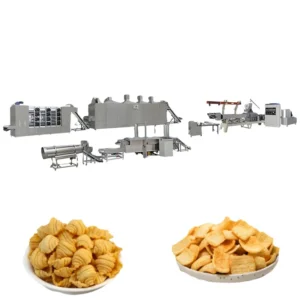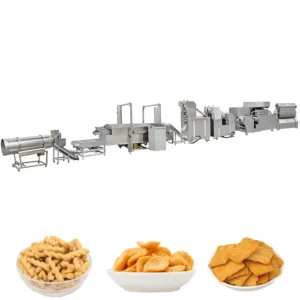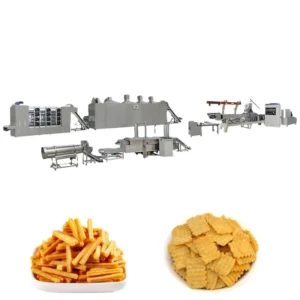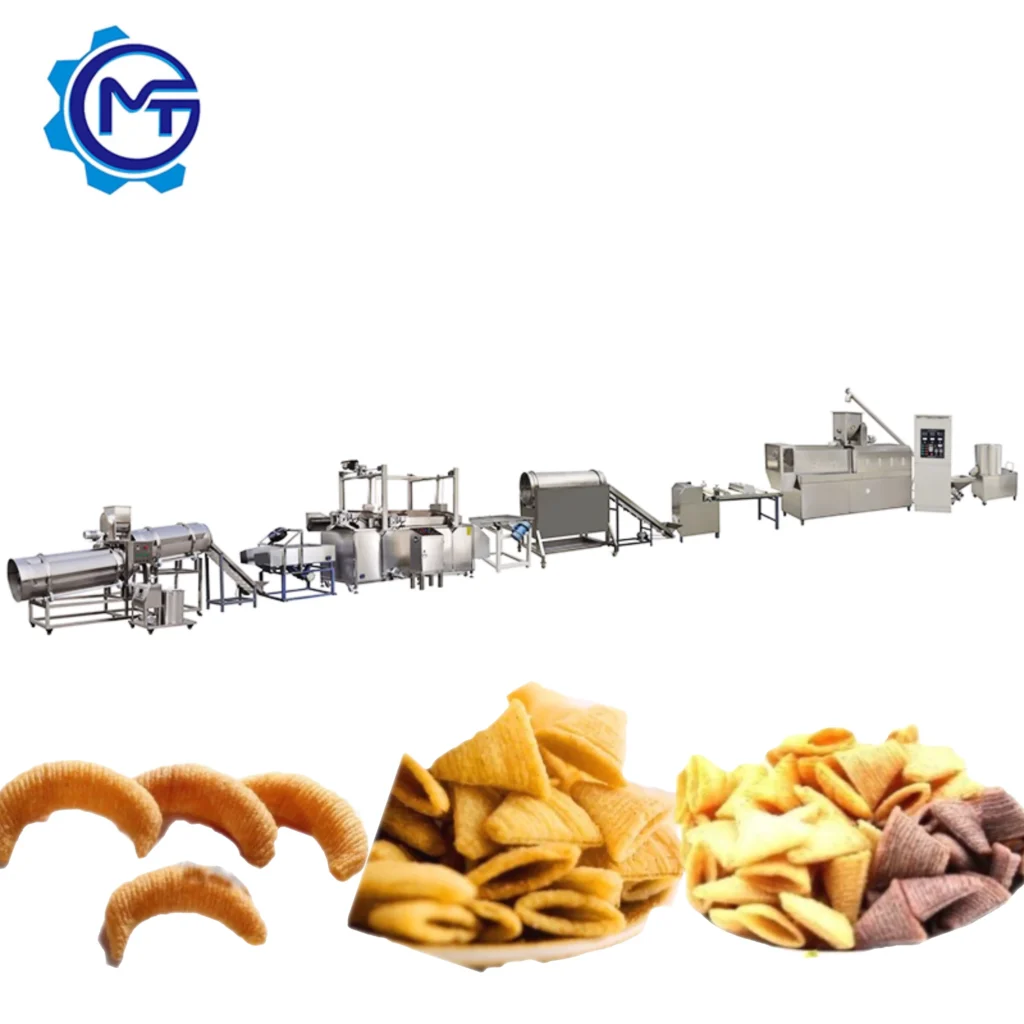
Throughput-Matched Single-Source Lines — every station from mixing to packing is sized to the extruder’s verified output so no downstream bottleneck limits your actual production rate.
Technical Specifications
| Parameter | Value |
|---|---|
| Model | MT100/MT120 |
| Product Type | Single-Screw Leisure Food Extrusion Production Line |
| Extruder Configuration | Single-screw with high- and low-pressure screw setup |
| Raw Material Compatibility | Wheat flour, corn starch, potato starch |
| Output Capacity | 120 kg/h (basis not stated in source — confirm raw material blend, moisture content, and product shape) |
| Total Installed Power | 50–70 kW (electric heating); approx. 100 kW (fully electric); 50–60 kW (gas or diesel heating) |
| Voltage & Frequency | Three-phase 380 V / 50 Hz; Single-phase 220 V / 50 Hz (customizable) |
| Energy Source Options | Electricity, gas, diesel, or steam |
| Overall Dimensions (L×W×H) | 12,000–26,000 × 1,200 × 2,200 mm |
| Construction Material | Food-grade stainless steel 201 / 304 |
| Die Configuration | Interchangeable dies for screw shell, round tube, square tube, ring, cartoon shapes, and custom forms |
| Line Stations | Mixer → Screw conveyor → Single-screw extruder → Pulling and cutting machine → Automatic fryer → Automatic flavoring line → Cooling → Packing |
| Motor & Electrical Components | Siemens (China-made) or equivalent top Chinese brand motors; Delixi or Delta inverters |
| Certification | CE, ISO 9001 |
| Warranty | One year with lifetime technical guidance |
Application Suitability
| Application | Material or Output |
|---|---|
| Rice crust and Bugles-type corn chips | Corn starch and wheat flour blends, secondary-puffed and fried |
| Golgappa / pani puri shells | Wheat flour and potato starch mix, thin-wall hollow shapes |
| Screw shells, tubes, and rings | Starch-based recipes extruded through interchangeable dies |
| Custom-shaped fried or baked snacks | Proprietary die profiles on flour-starch raw material |
Why "120 kg/h" Means Nothing Without the Raw Material Context
The rated output only holds when the extruder is configured for your specific flour-starch blend and moisture level.
Many snack producers receive a quotation stating a capacity figure, only to discover during commissioning that their local corn flour has different starch content and absorption characteristics than the material used during factory testing. Expansion drops, product density shifts outside specification, and the line runs at a fraction of the promised throughput. I have seen this scenario repeat across multiple project sites in the Middle East, where ambient humidity and local grain sourcing change the extrusion behavior significantly. A leisure food extrusion production line for sale should always be validated against the buyer’s actual recipe before the purchase order is signed. [NEED_CITE: starch gelatinisation behaviour across different flour sources]
Screw Pressure Configuration and Raw Material Flexibility
The MT100/MT120 single-screw extruder uses a dual high- and low-pressure screw configuration, which broadens the range of starch-based recipes the machine can process. High-pressure sections generate the shear needed for dense starch blends, while low-pressure zones allow gentler handling of moisture-sensitive materials like potato starch. This flexibility matters when a snack manufacturer sources raw materials locally and cannot guarantee identical flour specifications across every production batch. The leisure food extrusion production line for sale is configured so that operators can adjust the screw profile to match incoming material variation without replacing the entire screw assembly.
Interchangeable Die System for Shape Versatility
A single extruder platform produces screw shells, round tubes, square tubes, rings, and cartoon shapes by swapping die plates at the barrel exit. This means a snack producer can run multiple product formats on the same line without purchasing additional extrusion units. The die change procedure is mechanical — operators loosen the die retainer, exchange the plate, and re-align the cutting head. For buyers entering markets with diverse snack preferences, such as the Middle East where both Bugles-type cones and flat rice crust formats sell well, this versatility reduces capital outlay. Custom die profiles can be manufactured for proprietary shapes, allowing brands to differentiate their product on crowded retail shelves. [NEED_CITE: die design principles for extruded snack shapes]
Power, Heating, and Energy Source Decisions
The installed power ranges from 50–70 kW with electric barrel heating up to approximately 100 kW for a fully electric line, while gas or diesel heating brings the total down to 50–60 kW. For factories in regions where industrial electricity tariffs are high relative to natural gas or diesel, specifying gas-fired fryers and steam-heated dryers can materially alter operating cost. The voltage standard is three-phase 380 V / 50 Hz by default, but this must be confirmed against the buyer’s local supply before the control panel is wired. Mismatched voltage or frequency is one of the most common reasons for delayed commissioning on exported food processing lines. [NEED_CITE: voltage and frequency standards by export market]
The Hidden Cost of an Unmatched Fryer and Flavoring Drum
When the automatic fryer or flavoring drum is undersized relative to the extruder’s actual throughput, product queues upstream and the line must be throttled back. Conversely, an oversized fryer wastes energy and degrades oil quality as product flow fails to maintain the required oil turnover rate. I have observed lines where the extruder was quoted at a nominal capacity, but the downstream fryer could only sustain roughly half that volume, forcing the operator to run intermittent batches. This defeats the purpose of a continuous production line and increases labor cost per kilogram of finished snack. The capacity calculation across every station should be documented and reviewed before production begins. [NEED_CITE: fryer sizing relative to extruder throughput in snack lines]
Why Source the Complete Line Here
Every station — mixer, screw conveyor, extruder, pulling and cutting machine, automatic fryer, flavoring drum, cooling conveyor, and packing — is supplied under a single responsibility, so throughput matching is calculated by one engineering team rather than negotiated across multiple vendors. The screw configuration and die selection are specified to the buyer’s raw material and target product shape, not copied from a generic build. An in-house testing workshop runs trial production on the customer’s actual flour-starch blend before shipment, generating a documented trial report that records output rate, expansion ratio, and product density. The MT100/MT120 platform covers pet food, aquatic feed, snacks, cereals, starch, and protein applications, so technical support draws on cross-category extrusion knowledge. Pre-sales consultation continues through on-site installation, commissioning, operator training, and ongoing maintenance.
Documentation & Verification
- Line layout and capacity calculation showing matched throughput from mixer through packing
- Screw and die configuration record matched to your starch blend and target snack shape
- Trial run report on your actual raw material documenting expansion ratio and output rate
- Electrical schematic with confirmed voltage, frequency, and control language
- Factory test record with photographic evidence before crate sealing
- CE declaration of conformity and ISO 9001 certificate
Installation, Commissioning & Support
- Floor plan requires 12,000–26,000 mm length depending on station configuration and cooling conveyor route
- Three-phase 380 V / 50 Hz supply with dedicated circuit sized to the confirmed 50–100 kW load
- Line ships in modular sections for container loading and on-site reassembly
- First-run commissioning includes screw profile tuning and fryer temperature mapping on your recipe
- Operator training covers die changeover, cutting head alignment, and flavoring drum adjustment
- Wear parts list covering screws, dies, and cutter blades shipped with initial spare set
What to Include in Your Inquiry
To move from a generic quotation to a configured line proposal, share your raw material specification including flour type, starch content, and typical moisture percentage. Confirm your local voltage and frequency, the control panel language your operators require, and the snack shapes you intend to produce. If you have an existing mixing or packing station that the new line must integrate with, provide those equipment dimensions and throughput rates so the layout can accommodate the interface.
Frequently Asked Questions
Q: How is the 120 kg/h capacity verified, and on which raw material blend does it apply?
A: The 120 kg/h figure is a reference value that depends on the specific flour-starch blend, moisture content, and die shape in use. Before shipment, we run a trial on your actual raw material in the testing workshop and document the verified output rate, expansion ratio, and product density in a formal trial report so you know the real capacity you will achieve.
Q: Which voltage and frequency configurations are available, and is the control panel labeled in my language?
A: The standard configuration is three-phase 380 V / 50 Hz with single-phase 220 V / 50 Hz for auxiliary circuits, but both can be customized to match your local supply. Control panel labeling, HMI text, and documentation language are confirmed during the specification review stage before the electrical cabinet is wired, preventing relabeling delays at commissioning.
Q: Can the die set be customized for a proprietary snack shape?
A: Yes, custom die profiles can be manufactured to produce proprietary shapes beyond the standard screw shells, tubes, and rings. The die retainer system accepts non-standard plates as long as the outer diameter matches the barrel flange. The number of die sets included and lead time for custom profiles are confirmed during the quotation stage.
Q: What does the in-house trial run cover, and does it include frying and flavoring?
A: The trial run uses your shipped raw material to extrude the target shape, then passes the product through the fryer and flavoring drum at line speed. We record oil temperature, residence time, seasoning adhesion, and final product weight to confirm that every downstream station performs correctly on your recipe before the line is dismantled for shipping.
Q: How are spare wear parts stocked and shipped for the first replacement cycle?
A: An initial set of spare screws, dies, and cutter blades ships with the line based on the wear parts list in the documentation package. Replacements are manufactured to the same configuration record, and orders can be placed directly using the part numbers from the manual to ensure dimensional consistency with the original tooling.