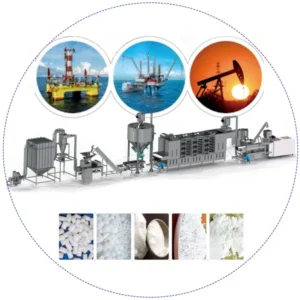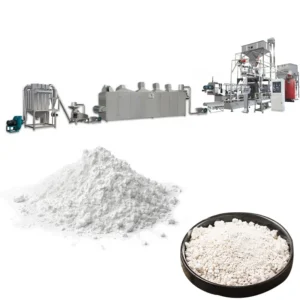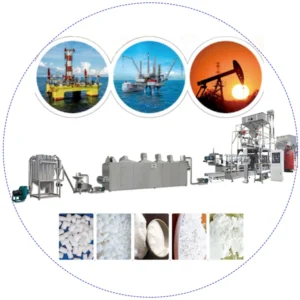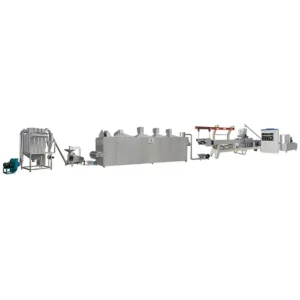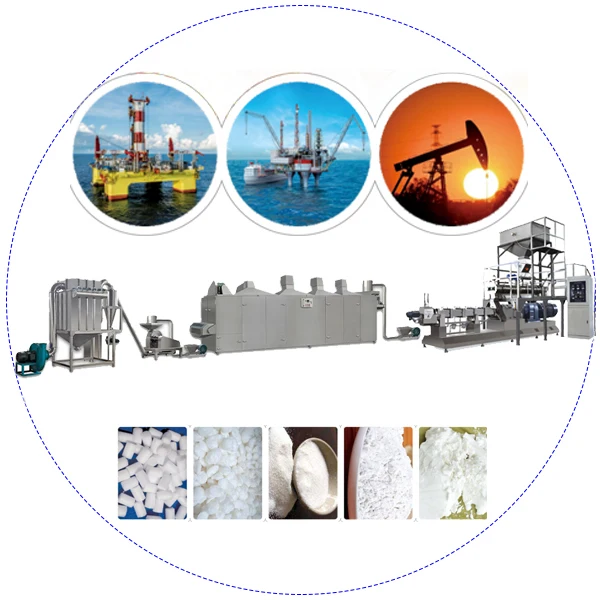
Integrated Line Matching — Every station from flour mixer to belt dryer is configured so throughput stays balanced, preventing the bottleneck that occurs when an extruder is supplied without matched downstream capacity.
Technical Specifications
| Parameter | Value |
|---|---|
| Product Type | Modified Starch Production Line / Pregelatinized Starch Processing Machine |
| Available Models | MT65, MT70, MT85 |
| Extruder Type | Twin-screw, co-rotating, sectional modules |
| MT65 Installed Power | 72 kW |
| MT65 Power Consumption | 50 kW |
| MT65 Capacity | 140-160 kg/h (basis to be confirmed) |
| MT65 Dimensions | 2200 × 1000 × 2300 mm |
| MT70 Installed Power | 92 kW |
| MT70 Power Consumption | 65 kW |
| MT70 Capacity | 240-260 kg/h (basis to be confirmed) |
| MT70 Dimensions | 2600 × 1000 × 2300 mm |
| MT85 Installed Power | 108 kW |
| MT85 Power Consumption | 75 kW |
| MT85 Capacity | 500-600 kg/h (basis to be confirmed) |
| MT85 Dimensions | 4500 × 1000 × 2600 mm |
| Screw Configuration | Sectional modules for transport, mixing, additive feeding, liquid injection, de-gassing, cooking, forming |
| Mixer Contact Materials | Stainless steel with safety interlock on cover and discharge |
| Dryer Type | Net belt with independently controlled speed and temperature |
| Line Stations | Feeding system, extruding system, cutting system, heating system, conveying system, cooling system |
| Warranty | 24 months, lifetime service |
Application Suitability
| Application | Material or Output |
|---|---|
| Pregelatinized starch for food processing | Corn starch, wheat starch, tapioca starch |
| Modified starch for textile sizing | Cassava starch, corn starch |
| Modified starch for paper making | Corn starch, wheat starch |
| Modified starch for building materials | Tapioca starch, cassava starch |
| Modified starch for oil drilling | Corn starch, cassava starch |
| Modified starch for casting binder | Wheat starch, corn starch |
What Capacity Numbers Hide Without Raw Material Context
Nominal output figures mean nothing until the line is tested on the buyer’s actual starch source and moisture level.
I learned this the hard way when a modified starch processing line full equipment range setup that performed perfectly on corn starch during factory trials failed completely once the buyer switched to wheat starch at their facility. The viscosity dropped, the gelatinisation behavior shifted, and the screw combination had to be reworked from scratch on-site. That two-week delay cost everyone time and credibility [NEED_CITE: starch gelatinisation temperature differences across raw material types]. The full equipment range on this page exists so buyers can verify every station — mixer, extruder, dryer — handles their specific feedstock before committing to a configuration.
How Each Station Connects Across the Line
A modified starch processing line full equipment range begins at the flour mixer, where stainless steel contact parts keep contamination risk low and a safety interlock shuts down the unit if the cover or discharge hole is opened mid-cycle. From there, the feedstock moves to the twin-screw extruder, which serves as the core reaction vessel where starch granules undergo gelatinisation under controlled heat, moisture, and shear.
The sectional screw modules allow the process to be broken into distinct zones — transport, mixing, liquid injection, de-gassing, cooking, and forming — each tuned to the behavior of the starch being processed. This modularity means the same extruder family can handle pregelatinization for food-grade applications and modification for industrial uses like textile sizing or paper coating, simply by rearranging the screw elements and adjusting the barrel temperature profile.
Matching Dryer Capacity to Extruder Throughput
The belt dryer downstream is where many lines fail in practice. If the dryer cannot remove moisture fast enough to match the extruder output, the entire modified starch processing line full equipment range backs up, forcing operators to slow the extruder and lose effective capacity [NEED_CITE: drying rate limitations in starch processing lines]. The dryer included in this range has independently controllable net belt speed and temperature, giving operators the ability to adjust residence time and drying intensity based on the specific modified starch being produced.
A slower belt speed with higher temperature suits heavily gelatinized starches that need extended heat exposure, while a faster pass at lower temperature may work for lightly modified products where over-drying would damage functional properties. This independent control prevents the dryer from becoming the limiting station on the line.
Reading the Specification Sheet Against Your Production Target
The MT65 at 72 kW installed power and 2200 × 1000 × 2300 mm footprint suits smaller production environments or pilot-scale modified starch development where flexibility matters more than volume. Its sectional screw configuration allows frequent changeovers between different starch types without major downtime.
Moving to the MT70 at 92 kW installed power and 2600 × 1000 × 2300 mm, the line gains throughput headroom that accommodates higher-moisture formulations requiring longer residence times in the barrel. The MT85 at 108 kW installed power and 4500 × 1000 × 2600 mm is built for continuous production runs where a single starch formulation is processed in large batches, and its longer barrel provides more screw modules for complex reaction sequences. Control system options and voltage configurations should be confirmed against the target facility’s electrical standards before production begins.
The Cost of Skipping Line-Level Throughput Verification
When an extruder is specified in isolation without checking whether the mixer can prepare feedstock fast enough or the dryer can handle the output, the result is a line that never reaches its nameplate capacity. Buyers end up running the extruder at reduced feed rates, which changes the shear profile inside the barrel and produces modified starch with inconsistent gelatinisation [NEED_CITE: extruder starvation effects on starch modification quality]. The flour mixer, conveyor sizing, and dryer belt length all need to be calculated against the chosen extruder model so every station moves product at the same rate.
Why Sourcing the Full Range From One Supplier Matters
Each station in this modified starch line is configured as part of a matched system rather than assembled from separate vendors who have no visibility into each other’s throughput assumptions. The screw configuration and die design are specified against the buyer’s raw material, not copied from a generic template. An in-house testing workshop allows trial runs on the customer’s actual starch before shipment, catching viscosity or gelatinisation issues early. The twin-screw platform covers applications from food-grade pregelatinized starch to industrial modified starch for drilling fluids and building materials. Pre-sales engineering consultation carries through to on-site installation, commissioning, and operator training on the specific line configuration delivered.
Documentation & Verification
- Machine specification sheet listing the exact screw and die configuration matched to your starch type
- Line layout drawing showing capacity calculations across mixer, extruder, and dryer stations
- Factory trial run report conducted on your raw material before shipment authorization
- Electrical schematic confirming voltage and frequency for your target market standard
- CE declaration of conformity covering the complete line assembly
- Operation and maintenance manual specific to the extruder model and screw arrangement delivered
Installation, Commissioning & Support
- MT85 footprint of 4500 × 1000 × 2600 mm requires floor space planning for the full line length including dryer and cooling conveyors
- Installed power up to 108 kW demands dedicated electrical circuits confirmed against local voltage and frequency
- Sectional screw modules allow on-site configuration adjustments during commissioning without replacing the full screw shaft
- Trial run parameters transferred to the buyer’s facility for first-run startup on local raw material
- Operator training covers screw rearrangement procedures for switching between starch types
- Wear parts list provided with recommended spare screw elements and die plates for the specific configuration shipped
What We Need to Configure Your Line
To build a modified starch processing line full equipment range that holds its rated capacity on your material, we need the specific starch source — corn, wheat, cassava, or tapioca — along with the target modification type and end-use application. Share your facility voltage and frequency standard, available floor space with ceiling height, and the daily output target so we can match the extruder model to the supporting stations. If you have an existing mixer or dryer in place, let us know the specifications so we can calculate whether they integrate or create a throughput gap.
Frequently Asked Questions
Q: How is capacity verified on my specific starch raw material and moisture level?
A: We run a trial in our in-house testing workshop using your actual starch source at the moisture content you plan to use in production. The trial records screw speed, barrel temperature profile, and output rate, producing a test report that confirms the configuration before the line ships.
Q: What supporting stations are matched to each extruder model to avoid bottlenecks?
A: Each model — MT65, MT70, MT85 — is paired with a flour mixer and belt dryer sized to handle that extruder’s throughput. The mixer batch cycle time and dryer belt speed are calculated so neither station limits the extruder output during continuous operation.
Q: What dimensional and utility data do I need to plan my factory layout?
A: Each model page lists the extruder footprint, and we provide a full line layout drawing showing every station from mixer through cooling conveyor. Power consumption figures and voltage requirements are confirmed against your facility standard before production starts.
Q: How are screw configuration and die design chosen for different starch applications?
A: The sectional screw modules are arranged based on your target modification — pregelatinization for food use requires a different cooking zone length and shear profile than cross-linking for industrial applications. The die design controls the final product form and expansion behavior.
Q: What customization is available for integrating this line into an existing facility?
A: Conveyor lengths, dryer capacity, and control system language can be adjusted to match your floor layout and operator requirements. We confirm electrical standards, control preferences, and upstream or downstream equipment interfaces during the specification phase before production begins.