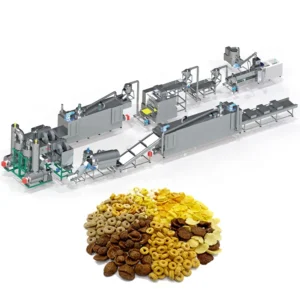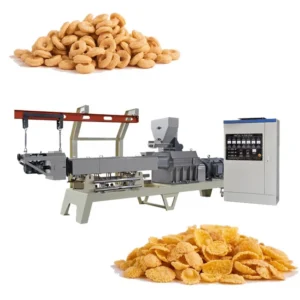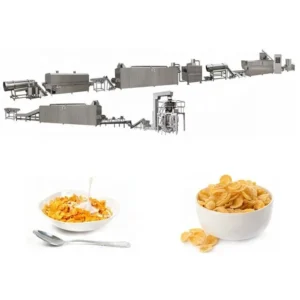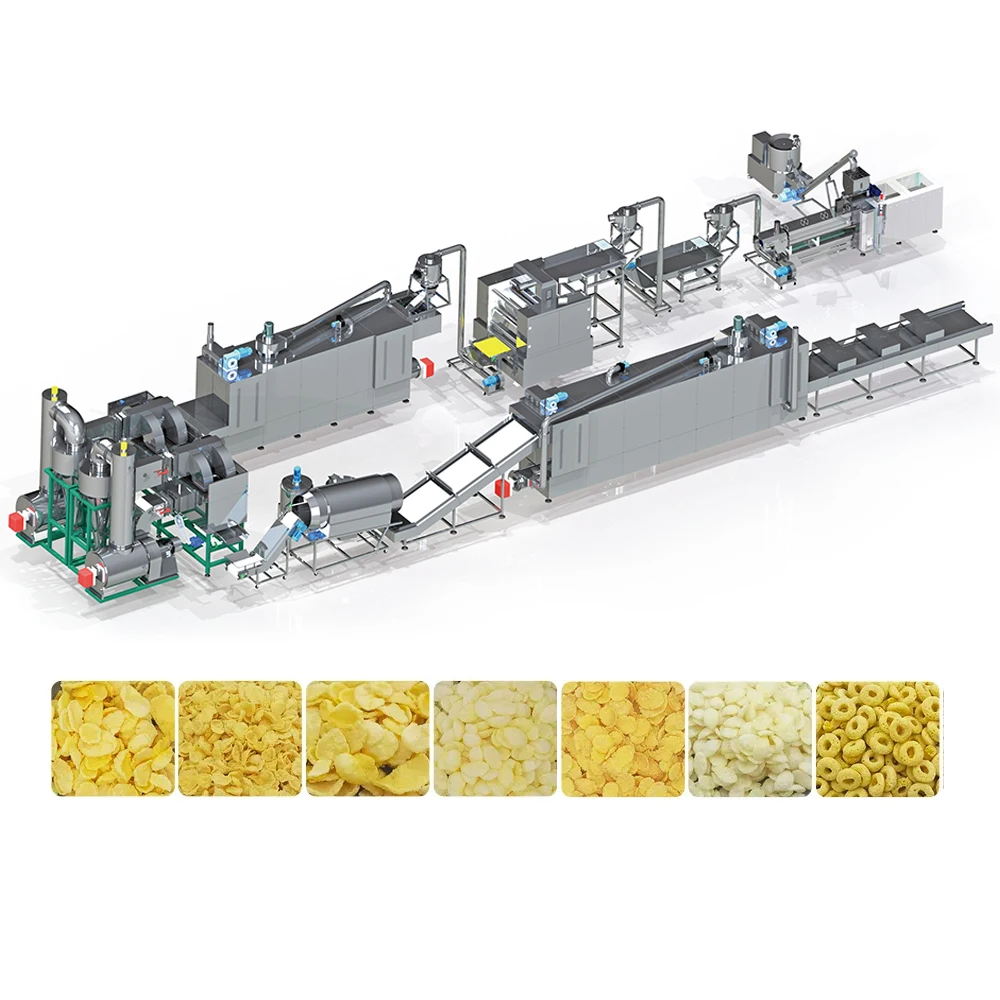
Matched Throughput Across Stations — Every extruder, flaker, and dryer in this line is sized against the others so output stays balanced from batching to packing.
Technical Specifications
| Parameter | Value |
|---|---|
| Product Type | Breakfast Cereal Corn Flake Production Line |
| Extruder Models Available | MT70, MT85, MT75 |
| Extruder Type | Twin Screw |
| Installed Power | 160 kW (MT70) / 190 kW (MT85) / 210 kW (MT75) |
| Power Consumption | 120 kW (MT70) / 140 kW (MT85) / 150 kW (MT75) |
| Output Capacity | 150–200 kg/hr (MT70, basis not stated in source) / 300–400 kg/hr (MT85, basis not stated in source) / 300–500 kg/hr (MT75, basis not stated in source) |
| Overall Dimensions | 41 × 1.5 × 2.2 m (MT70) / 43 × 1.5 × 3.2 m (MT85) / 45 × 1.5 × 3.5 m (MT75) |
| Control System | PLC for flaking machinery; MCC for extruder line control |
| Basic Raw Materials | Corn, rice, wheat, oat, barley powder |
| Flaking System | Hydraulic double rollers with separate motor drives and infrared temperature control |
| Dryer Heating Source | Gas or Electric |
| Roasting Oven | Vibrating pan, high-temperature spraying tubes, conciliation burner, dual circulating fans, cyclone dust removal |
| Coating System | Double tumble for sugar melting, elevator, coating drum, spraying nozzle |
| Final Product Shapes | Ball, tube, stick, ring, fruit loop, star, wheel, flower, heart |
| Screw Feature | Wear-resistant manufacturing technology with automatic lubrication and cooling |
| Certification | CE (since 2014), ISO certified |
Application Suitability
| Application | Material or Output |
|---|---|
| Natural corn flake continuous production | Corn grits processed through extrusion, flaking, roasting, and cooling |
| Sugar-coated corn flake variants | Corn or rice base with sugar spraying, coating drum, and secondary drying |
| Shaped breakfast cereal snacks | Wheat, oat, or barley powder formed into rings, loops, stars, and wheels via die adjustment |
| Fortified cereal and nutrition programme supply | Blended grain and micronutrient powders processed into consistent flake or pellet formats |
Why the Dryer Matters More Than the Extruder You Chose
A breakfast cereal corn flake machine full equipment range only performs when every station holds the same throughput under real production conditions.
When buyers focus on extruder capacity and leave the downstream equipment to be matched later, the dryer or roasting oven becomes the choke point within the first week of operation. I have watched lines sit half-loaded because the hot air roaster could not keep pace with what the twin screw was pushing through [NEED_CITE: throughput matching principles in continuous food processing lines]. The result is not just lost output — it is inconsistent moisture in the finished flake, uneven blistering on the surface, and product that fails the crunch test the market expects. Sizing the dryer and roaster to the extruder from the start removes that bottleneck entirely.
How Twin-Screw Configuration Shapes the Flake
The twin screw extruder in this line handles corn, rice, wheat, oat, and barley powders with adjustable screw elements that control shear, residence time, and gelatinisation inside the barrel. Automatic lubrication and cooling keep the screw assembly stable across long production runs, which matters when starch behaviour shifts as barrel temperature climbs. The die design is specified to the buyer’s target shape — whether flat flake feedstock or formed rings and loops — so expansion at the die face stays consistent batch after batch.
What the Flaking and Roasting Stations Actually Do
After extrusion, the cooked dough passes through the hydraulic double-roller flaking system where separate motor drives and infrared temperature pipe control govern flake thickness and surface condition. Uniform thickness here determines how evenly the flakes roast downstream. The roasting oven uses a vibrating pan with high-temperature spraying tubes, a conciliation burner, and two independent circulating fans with cyclone dust removal to deliver consistent surface blistering. This is where the breakfast cereal corn flake machine full equipment range earns its output — the roaster must move product at the same rate the flaker delivers it [NEED_CITE: corn flake roasting temperature and dwell time parameters].
Reading the Power and Capacity Figures
Installed power ranges from 160 kW on the MT70 to 210 kW on the MT75, while actual power consumption sits noticeably lower at 120 kW to 150 kW across the three models. This gap reflects motor sizing for peak startup load versus steady-state running conditions, which is standard in extrusion drive design. The capacity figures listed for each model should be confirmed against your specific raw material blend and target moisture content before treating them as guaranteed output. Overall line length extends from 41 metres to 45 metres depending on model selection and whether the sugar-coating variant is included, which adds a second drying stage to the layout.
What Happens When Stations Are Mismatched
An extruder running at full output into an undersized dryer forces the operator to either slow the line down or accept wet product that clumps in the packing station. I have seen this exact scenario on a wheat flake line where the roasting oven was rated below the extruder’s real throughput — the factory ran two shifts instead of one just to hit the same daily volume [NEED_CITE: consequences of capacity mismatch in cereal processing lines]. The wear parts burn through faster because the extruder cycles on and off rather than running continuously, and spare screws that should last months need replacing in weeks.
What You Get From a Matched-Line Supplier
Every station from the mixing and batching system through the extruder, flaker, dryer, roaster, coating drum, cooler, and packing conveyor is selected and sized under one supply scope, so throughput calculations are done across the entire chain rather than per machine. Screw configuration and die design are specified against the buyer’s raw material and target product before the build begins. The in-house testing workshop runs trial production on your actual corn, rice, or wheat formulation before shipment, so product development does not start for the first time on your factory floor. MCC and PLC control systems are configured to your local voltage, frequency, and operator language requirements. Pre-sales engineering covers line layout and utility planning through to on-site commissioning and operator training.
Documentation & Verification
- Line layout showing throughput calculation across every station in your selected model
- Screw and die configuration record matched to your corn, wheat, or oat formulation
- Trial run report on your raw material produced in the testing workshop before dispatch
- Electrical schematic confirming voltage, frequency, and control language for your market
- Factory test record documenting performance on the specific extruder model you ordered
- Wear parts list specifying screws, dies, and roller surfaces included with initial shipment
Installation, Commissioning & Support
- Foundation and floor space planning based on the 41–45 metre line length of your chosen model
- Dedicated power circuit sized to the 120–150 kW running consumption of the selected extruder
- MCC and PLC panels configured and labelled in your operator’s language before shipment
- First-run commissioning with screw speed, barrel temperature, and flaking pressure set to your formulation
- Operator training covering extruder die changes, roller gap adjustment, and roaster fan balancing
- Spare wear parts inventory — screws, dies, roller surfaces — matched to your maintenance cycle
What We Need to Configure Your Line
Share your primary grain material and whether you plan to run natural flakes, sugar-coated variants, or shaped cereal formats like rings and loops. Your target daily output and the shift pattern you intend to run will determine which extruder model and downstream equipment sizing makes sense. Confirm your facility’s available floor length and ceiling height, along with local voltage and frequency standards. If you have existing upstream batching or downstream packing equipment that needs to tie into this breakfast cereal corn flake machine full equipment range, send the interface details so the layout accounts for those connections.
Frequently Asked Questions
Q: How is line capacity confirmed on my actual raw material before the equipment ships?
A: We run a trial production in our in-house testing workshop using your specific corn, wheat, or oat formulation. This confirms that the extruder output, flake thickness, and roasting result match your target product specification before the line leaves our factory, so you know what to expect on day one of your own production.
Q: How do I make sure the dryer and roaster can keep up with the extruder I select?
A: Every station in this breakfast cereal corn flake machine full equipment range is throughput-matched during the line layout stage. The dryer capacity and roaster pan area are calculated against your chosen extruder model’s confirmed output on your raw material, so no single station becomes a bottleneck once production starts.
Q: What voltage, frequency, and control language options are supported?
A: The MCC and PLC control systems are configured to your local electrical standards before production. Voltage, frequency, and the operator interface language are all confirmed during the specification stage so the line powers up correctly on arrival without requiring local electrical modifications.
Q: Can this line produce both natural and sugar-coated corn flakes?
A: Yes. The base configuration produces natural corn flakes through mixing, extrusion, flaking, drying, roasting, and cooling. Adding the sugar spraying, coating drum, and second drying station converts the line to produce sugar-coated variants. Both configurations run on the same extruder platform.
Q: What spare wear parts should I order with the initial shipment?
A: The wear parts list covers screws, dies, and flaking roller surfaces specific to your extruder model. Based on a production line I installed in Mexico, I now include these spares with the initial order rather than waiting for the first replacement request — a three-week parts delay can shut down an entire factory.