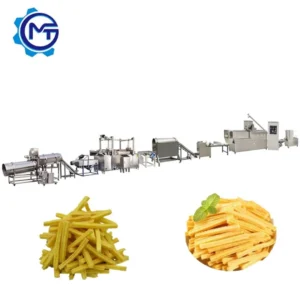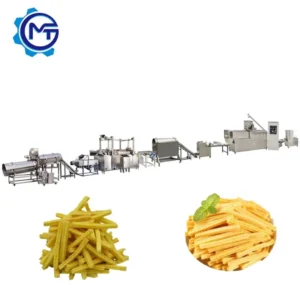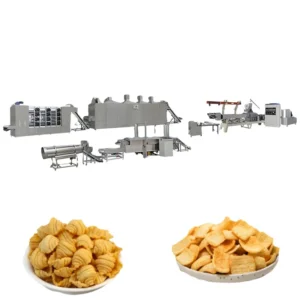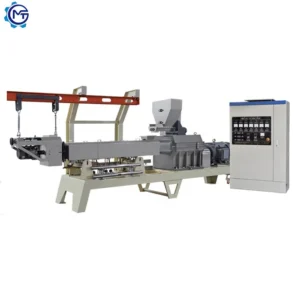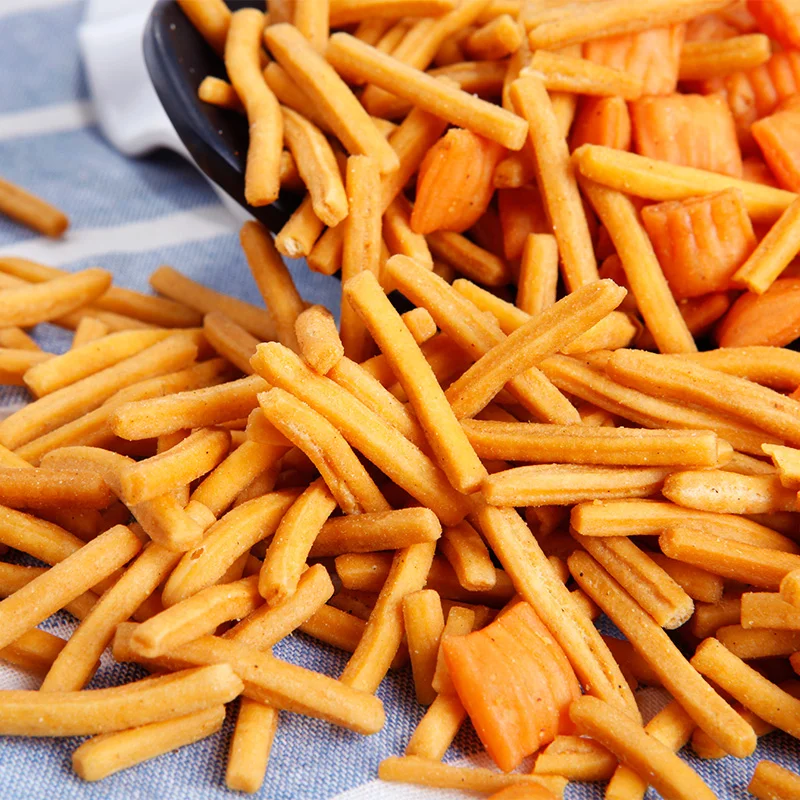
Complete Line Integration — Sizing the frying station to actual product throughput rather than a generic catalog rating prevents the extruder-fryer bottleneck that stalls snack lines.
Technical Specifications
| Parameter | Value |
|---|---|
| Product Type | Automatic Continuous Deep Fryer |
| Power Source | Electric / Gas (configurable) |
| Voltage | 380V / 50Hz (basis to be confirmed) |
| Heating Power | 60 kW (electric heating tube) |
| Oil Capacity | 320 L |
| Overall Dimensions (L×W×H) | 6700 × 2200 × 1200 mm |
| Net Weight | 2000 kg |
| Capacity | 100–1000 kg/h (basis to be confirmed) |
| Control System | PLC |
| Material | Food-grade 304 Stainless Steel |
| Belt Type | Upper and lower double-layer mesh belt |
| Speed Control | Frequency conversion stepless speed regulation |
| Oil Filtration | Oil circulation filtration system |
| Slag Discharge | Bottom slag discharge system |
| Lifting System | Automatic lifting for upper hood and mesh belt |
| Warranty | 1 Year |
| Assembly State | Complete unit |
Application Suitability
| Application | Material or Output |
|---|---|
| Corn-based fried snack lines | Extruded corn pellets and curls |
| Pellet chip production | 2D/3D starch-based pellets |
| Extruded snack finishing | Core-filled and co-extruded snack pieces |
| Breakfast cereal processing | Fried corn flakes and granola clusters |
What "100 to 1000 kg/h" Leaves Out About Frying Capacity
A fryer rated without product context is just a number on a plate.
When a snack manufacturer quotes a Continuous Frying Machine for sale based on a headline capacity figure, the real question is whether that throughput holds on the actual raw material and extruder output feeding it. High-moisture pellets absorb oil differently than dry corn grits, and a line that runs smoothly on one recipe may choke or surge on another [NEED_CITE: continuous fryer sizing methodology for snack food applications]. I have seen producers add a fryer to an existing extrusion line only to discover that the belt speed needed for proper color and texture cuts effective throughput well below the catalog rating. The Industrial Deep Fryer manufacturer you choose should verify capacity against your specific product formulation before the machine ships, not after it arrives.
Double-Layer Mesh Belt and Oil Contact Uniformity
The upper and lower mesh belt arrangement keeps floating products submerged throughout the frying zone, which is critical for extruded pellets and lightweight corn snacks that would otherwise ride the oil surface. Stepless frequency conversion on the belt drive lets operators fine-tune residence time without stopping the Continuous Frying Machine for sale, so a line can shift between a lighter crisp and a deeper fry without mechanical adjustments. This level of control matters when a buyer runs multiple SKUs on one fryer.
Oil Circulation Filtration and Acid Value Management
Continuous oil circulation filtration removes fine particulate and carbonized fragments before they degrade oil quality, extending the interval between full oil changes. In a high-volume snack line, oil that stays within specification longer means less frequent shutdowns for oil replacement and more consistent product color batch after batch [NEED_CITE: industrial frying oil degradation factors in continuous operations]. The bottom slag discharge system works in tandem with filtration, pulling heavier sediment away from the heating zone so heating tubes stay clean and transfer efficiency holds.
Interpreting Heating Power, Belt Speed, and Dimensions
The 60 kW electric heating element bank must bring 320 L of oil to frying temperature and hold it there under continuous product loading; if a buyer switches to gas heating, the burner specification changes the utility planning entirely. Stepless belt speed regulation directly governs residence time, which in turn determines moisture removal and final product texture — a few seconds of difference on the belt can shift a pellet chip from undercooked to over-browned. The 6700 mm length of the fryer body sets the footprint requirement on the factory floor, and buyers should verify that their line layout accounts for oil piping, filtration access, and exhaust ducting around the unit. The 2000 kg net weight means the floor must support a concentrated load, particularly when the 320 L oil tank is full and the fryer is running.
The Cost of Undersizing Your Fryer Station
When the fryer cannot keep pace with upstream extrusion, the extruder must idle or the product queues and cools before entering the oil, causing uneven frying and off-color output. A mismatched station also forces operators to run the belt faster than the optimal speed, producing under-fried product that fails shelf-life testing [NEED_CITE: snack food moisture content and shelf stability]. Replacing a fryer after installation is far more disruptive than specifying the correct capacity during line design.
Why Source the Frying Station From the Same Supplier
Matching the fryer throughput to the extruder and downstream cooler under one supplier eliminates the finger-pointing that happens when separate vendors blame each other for a bottleneck. The PLC control language and interface can be configured before shipment to match the rest of the line, so operators see one consistent system rather than a patchwork of screens. Screw configuration records from the extruder trial inform the frying parameters, giving the buyer a documented starting point on day one. In-house testing on the buyer’s actual raw material confirms that the selected belt speed and oil temperature produce the target color and crunch. The machine ships as a complete unit, reducing on-site assembly time and alignment errors.
Documentation & Verification
- Line layout showing fryer position and throughput match to upstream extruder
- Machine specification sheet confirming heating method and voltage for target market
- Trial run report on customer raw material documenting belt speed and oil temperature
- Electrical schematic with confirmed PLC I/O map and control language
- Operation and maintenance manual covering oil filtration and belt tensioning
- Wear parts list identifying mesh belt sections, heating tubes, and filter elements
Installation, Commissioning & Support
- Verify floor load capacity for the 2000 kg unit plus 320 L of oil at operating temperature
- Confirm 380V / 50Hz dedicated circuit with isolation switch rated for 60 kW heating load
- Unit ships complete; position and level on anchor bolts, then connect oil and exhaust lines
- PLC commissioning includes belt speed calibration and temperature PID tuning on-site
- Operator training covers oil filtration cycle, slag discharge timing, and belt cleaning
- Spare mesh belt sections and replacement heating tubes listed in wear parts schedule
Before You Request a Quote
To size the Continuous Frying Machine correctly, share your extruded product type, raw material formulation, and the output rate of your upstream extruder. Confirm your local voltage, frequency, and whether electric or gas heating suits your facility. Let us know if you need the fryer integrated into an existing cooling and packing line or configured as part of a new complete snack production project.
Frequently Asked Questions
Q: How is frying capacity verified against my actual product and upstream extruder output?
A: We run a trial on your raw material in our testing workshop, recording belt speed, oil temperature, and output rate. The resulting trial report shows the achievable throughput on your specific product, so the Continuous Frying Machine for sale is quoted on verified capacity rather than a generic rating.
Q: What voltage, frequency, and heating method options are available for my market?
A: The unit is configurable for electric or gas heating, and the electrical system is built to match your local voltage and frequency. We confirm these parameters before production so the Industrial Deep Fryer manufacturer builds the correct configuration from the start.
Q: How does the PLC control language and interface get configured before shipment?
A: We program the PLC screen labels, alarms, and parameter names in your preferred language during factory assembly. The interface is tested with the full control panel before dispatch, so operators can begin training immediately on arrival.
Q: Can this fryer be integrated into my existing extrusion and cooling line without bottlenecking?
A: Yes. We calculate the required belt speed and oil recovery rate based on your upstream extruder output and downstream cooling capacity. The line layout document shows how the fryer fits between stations at matched throughput.
Q: What spare parts are included and how are replacements supplied?
A: The shipment includes a wear parts list covering mesh belt sections, heating tubes, and filter elements. Replacement parts are available directly from the factory, and the maintenance manual specifies change intervals for each component.