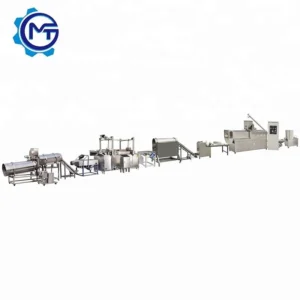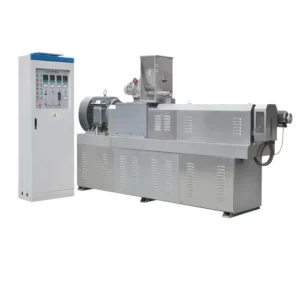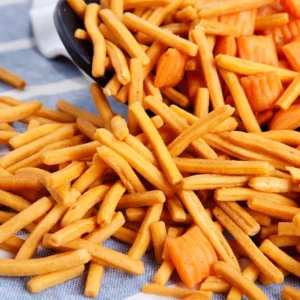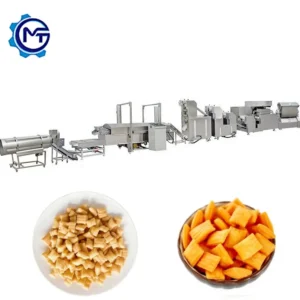
Throughput-Matched Line Design — Every fryer is sized against the actual upstream extruder and downstream cooler so the snack line runs without station bottlenecks.
Technical Specifications
| Parameter | Value |
|---|---|
| Product Type | Automatic Continuous Deep Fryer |
| Power Source | Electric / Gas (configurable) |
| Voltage & Frequency | 380V / 50HZ |
| Heating Tube Power | 60 kW |
| Oil Capacity | 320 L |
| Drive Power | 2.6 kW |
| Net Weight | 2000 KG |
| Overall Dimensions (L×W×H) | 6700×2200×1200 mm |
| Output Capacity | 100–1000 kg/h (basis not stated in source — confirm product type, moisture and frying time) |
| Control System | PLC |
| Material | Food-grade 304 Stainless Steel |
| Mesh Belt | Upper and lower double-layer |
| Speed Regulation | Frequency conversion stepless speed control |
| Oil Filtration | Continuous circulation filtration system |
| Slag Discharge | Bottom discharge system |
| Lifting System | Automatic lifting of upper hood and mesh belt |
| Certification | CE, ISO |
Application Suitability
| Application | Material or Output |
|---|---|
| Fried corn chip lines | Extruded corn masa sheets cut into triangles or rounds |
| Bugle and horn snack production | Formed corn-based dough shapes requiring even oil contact |
| Puff snack deep frying | Extruded pellet or direct-expanded pieces |
| Maize chip processing | Sheeted maize dough cut into chip formats |
| Snack line integration | Positioned downstream of extruder and dryer, upstream of flavouring and cooling |
Why the Frying Station Is Where Most Snack Lines Lose Pace
A fryer undersized to the extruder will choke the entire line within the first production hour.
I once watched a customer run a corn chip line where the extruder was pushing out product faster than the fryer could handle it. The mesh belt backed up, oil temperature dropped every time a cold batch overloaded the tank, and the chips came out unevenly coloured. The crew kept adjusting the extruder speed down, which then starved the downstream flavouring drum. The problem was never the machines themselves — it was that the frying station had been quoted on a nominal number that ignored the actual product density and frying dwell time. When the automatic continuous frying machine for snack production line stations is specified, the throughput must be calculated against the real recipe, oil absorption rate, and belt loading, not a generic catalogue figure. [NEED_CITE: thermal recovery rate of frying oil under continuous product loading]
How the Double-Layer Belt Controls Fry Uniformity
Snack pieces like corn chips and bugles tend to float when they first hit hot oil. The upper and lower double-layer mesh belt sandwiches the product and holds it below the oil surface throughout the fry cycle. This means every piece receives the same thermal exposure regardless of shape or density, which is the reason why the automatic continuous frying machine for snack production line configurations can handle both flat chips and three-dimensional forms on the same equipment. Frequency conversion stepless speed control lets the operator adjust belt travel speed from the PLC panel, changing frying dwell time without stopping the line.
Oil Filtration That Keeps the Line Running Past the First Shift
Continuous circulation filtration pulls oil from the fryer tank, passes it through a filter bed, and returns it at a controlled rate. The system captures fine particulate and carbonised crumbs that would otherwise accumulate and raise the acid value of the oil. Over a long production run, this means oil colour stays within acceptable limits and off-flavours do not transfer to later batches. The bottom discharge system clears heavier sediment without requiring a full oil drain. For buyers surveying the full equipment range, matching this filtration capacity to the product’s crumb generation rate is part of station-by-station line balancing. [NEED_CITE: oil degradation factors in continuous industrial deep frying]
What the Specifications Mean on the Factory Floor
The 320 L oil capacity determines the thermal mass of the system — a larger volume holds temperature more steadily when cold product enters the tank, but it also means longer heat-up time from a cold start. The 60 kW heating tube power defines the recovery rate, or how quickly the oil returns to setpoint after each batch load. For gas-heated configurations, the burner rating must be checked against the facility’s gas supply pressure and pipe sizing. The 6700 mm overall length includes the infeed and discharge zones, so floor planning must account for product transfer conveyors on both ends. The food-grade 304 stainless steel construction meets hygiene expectations for snack production environments and withstands repeated washdown cycles. The PLC control panel centralises temperature setpoint, belt speed, and filtration cycle parameters in one interface, which reduces operator error during shift changes.
The Cost of a Frying Station That Doesn’t Fit the Line
When a fryer is sourced as a standalone unit without checking upstream and downstream throughput, the consequences show up quickly. An undersized fryer forces the extruder to idle, wasting energy and cooling the barrel profile. An oversized fryer runs with a half-empty belt, which wastes oil volume and increases per-unit energy cost. Oil filtration that cannot keep pace with crumb generation leads to darker product and more frequent oil changes. Electrical voltage mismatches delay commissioning for weeks while transformers are sourced locally. These are not theoretical concerns — they are the reasons snack lines miss their first-month output targets. [NEED_CITE: common causes of downtime in snack food processing lines]
Why Buyers Spec the Full Equipment Range Here
Complete line matching from mixing through extrusion, frying, flavouring, and packing means every station is calculated against the same throughput baseline rather than assembled from separate vendor catalogues. Screw and die configuration upstream of the fryer is specified to produce the exact product density and moisture content that the frying station is designed to handle. The in-house testing workshop allows trial runs on the buyer’s actual raw material before the line ships, confirming that frying results match the target specification. Electrical schematics and voltage confirmation are finalised before production, not discovered during commissioning. The PLC control language is set to the operator’s working language so that the team can run the automatic continuous frying machine for snack production line from day one without translation delays.
Documentation & Verification
- Line layout drawing showing fryer station throughput matched to extruder and cooler capacities
- Machine specification sheet with confirmed voltage, frequency, and heating method for target market
- Trial run report on buyer’s actual snack product verifying fry colour, oil absorption, and texture
- Screw and die configuration record linking upstream extrusion settings to frying performance
- CE declaration of conformity and ISO certificate for import documentation
- Electrical schematic with PLC I/O map and control language confirmation
Installation, Commissioning & Support
- Floor space of 6700×2200 mm requires level concrete slab with oil containment drainage
- 60 kW electric heating requires dedicated three-phase circuit with correct breaker sizing
- Automatic lifting hood and mesh belt arrive pre-assembled; rigging plan needed for 2000 kg unit
- PLC parameters set during commissioning include temperature profile and belt speed for target product
- Operator training covers filtration cycle timing, oil top-up procedure, and emergency stop sequence
- Wear parts list includes mesh belt segments, heating tubes, and filtration media with replacement intervals
Preparing a Frying Station Enquiry
When requesting a proposal, provide the specific snack product type and target hourly output so the fryer can be sized against the extruder. Include your facility voltage, frequency, and whether electric or gas heating is preferred for utility planning. Confirm the PLC operating language and any local certification requirements for your import market.
Frequently Asked Questions
Q: How is the fryer output capacity verified against the actual snack product and recipe?
A: Capacity is confirmed through a trial run in the testing workshop using the buyer’s raw material. The test measures oil absorption, frying dwell time, and product colour at different belt speeds. Results are documented in a trial run report that accompanies the machine at shipment.
Q: What voltage, frequency, and PLC language options are available for the target market?
A: The standard configuration is 380V/50HZ, but voltage and frequency are confirmed during the specification stage to match the buyer’s facility supply. The PLC interface language is set before production based on the operator’s working language requirement.
Q: How is the fryer throughput matched to the upstream extruder and downstream stations?
A: The line layout calculation starts with the extruder’s confirmed output on the buyer’s recipe, then sizes the fryer belt speed and oil volume to match. Downstream cooling and flavouring stations are calculated using the same throughput baseline so no station creates a bottleneck.
Q: What heating method options are available and how do they affect line utility planning?
A: Electric and gas heating are both available. Electric heating requires a dedicated high-capacity three-phase circuit, while gas heating requires confirmed supply pressure and pipe sizing. The choice affects both utility infrastructure cost and ongoing energy expense for the facility.