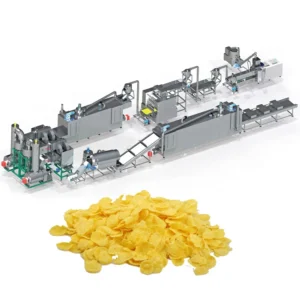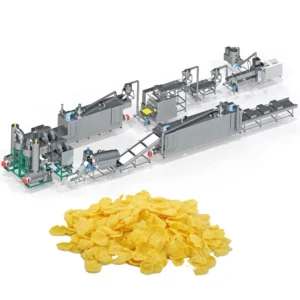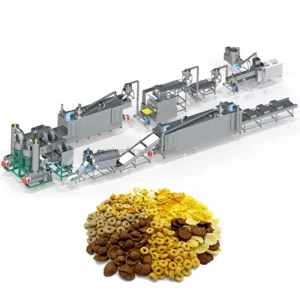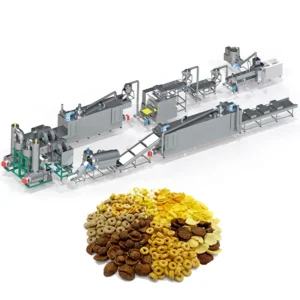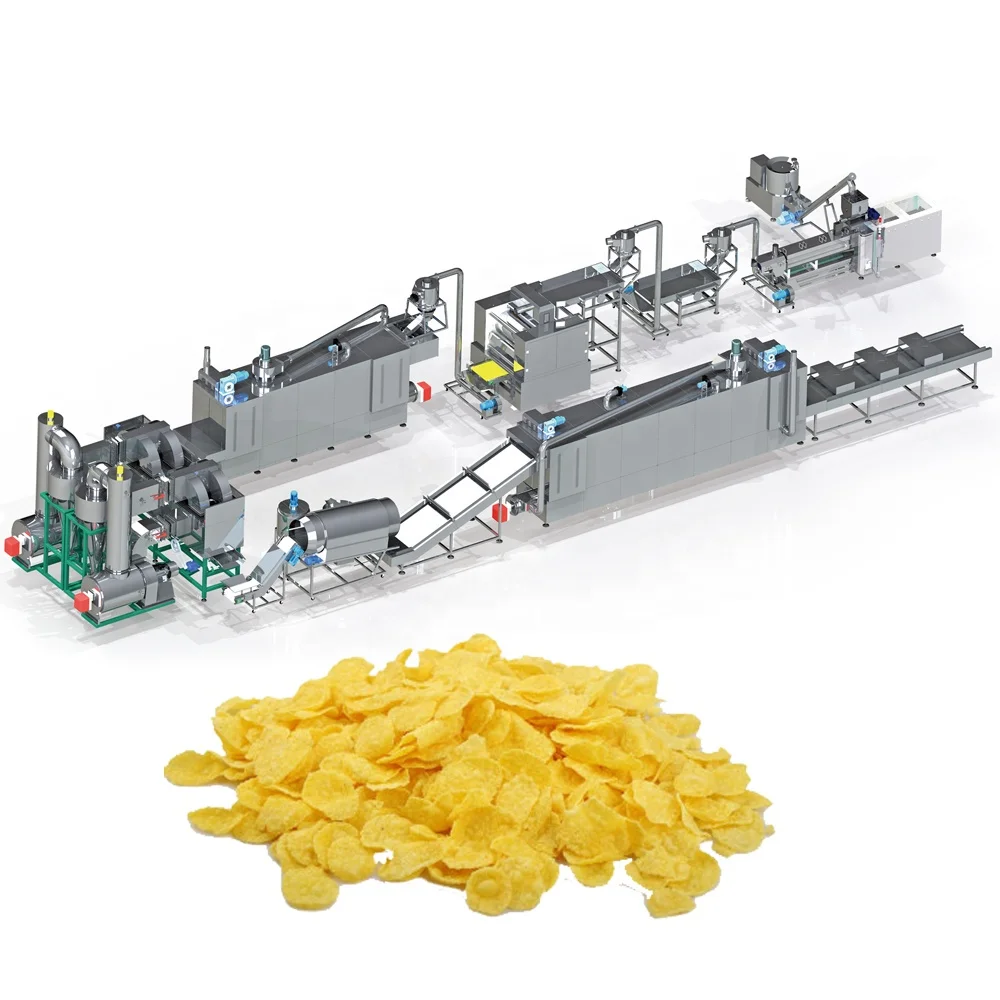
Capacity-Matched Line Design — Every station from the twin-screw extruder to the sugar coating drum is sized so throughput stays balanced across the full corn flakes sequence.
Technical Specifications
| Parameter | Value |
|---|---|
| Product Type | Corn Flakes Production Line |
| Models Available | MT70 / MT85 / MT75 |
| Extruder Screw Type | Twin screw |
| MT70 Installed Power | 160 kW |
| MT70 Power Consumption | 120 kW |
| MT70 Capacity | 150–200 kg/h (basis not stated in source — confirm raw material and moisture content) |
| MT70 Overall Dimensions | 41 × 1.5 × 2.2 m |
| MT85 Installed Power | 190 kW |
| MT85 Power Consumption | 140 kW |
| MT85 Capacity | 300–400 kg/h (basis not stated in source — confirm raw material and moisture content) |
| MT85 Overall Dimensions | 43 × 1.5 × 3.2 m |
| MT75 Installed Power | 210 kW |
| MT75 Power Consumption | 150 kW |
| MT75 Capacity | 300–500 kg/h (basis not stated in source — confirm raw material and moisture content) |
| MT75 Overall Dimensions | 45 × 1.5 × 3.5 m |
| Control System | PLC control on flaking machinery; MCC and PLC control line-wide |
| Dryer Heating Source | Gas or Electric (configurable) |
| Flaking Machinery Drive | Double motors for separate roller driving, hydraulic system for double rollers |
| Flaking Temperature Control | Infrared sensor for even pipe temperature |
| Hot Air Roasting Oven | Vibrating pan, conciliation burner combustion chamber, dual circulating fans, cyclone dust removal |
| Coating System | Double tumble for sugar melting, elevator, coating drum, spraying nozzle |
| Key Features | Automatic lubricating and cooling on extruder; wear-resistant screws; CE and ISO certified |
Application Suitability
| Application | Material or Output |
|---|---|
| Plain corn flakes for breakfast cereal retail packs | Corn grits or corn flour, expanded and flaked without sugar coating |
| Sugar-coated corn flakes for supermarket shelves | Corn-based extrudate passed through sugar tumble coating after roasting |
| Fortified breakfast cereal flakes | Corn blended with vitamin and mineral premix before extrusion |
| Extruded cereal shapes beyond standard flakes | Corn or multi-grain dough formed through die, then dried and roasted |
| Nutritional cereal bar base material | Flaked or puffed cereal output collected for downstream bar pressing |
Why Extruder Moisture and Flaker Gap Must Agree on a Corn Flakes Machine Full Equipment Range
If extruder discharge moisture and flaking roll gap are set independently, the flakes will either crack at the edges or stay too thick to dry through.
I spent years assembling and testing food extrusion lines in the Pearl River Delta before moving into field support. One call that stays with me involved a Middle East corn flakes installation where the extruder output moisture had never been reconciled with the flaker gap setting. The flakes came out far too thick, went into the dryer looking normal, and emerged still wet in the core. The entire batch was scrapped and the customer shut the line down until we flew out and reworked the parameter set from scratch. When you source a breakfast cereal production line for sale from separate vendors, each supplier optimises their own machine in isolation, and nobody owns the interface between stations. That gap is where product loss hides. [NEED_CITE: starch gelatinisation and moisture window for flaked cereal production]
Matching the Extruder Discharge to the Flaking Station
The twin-screw extruder on this line is equipped with automatic lubrication and cooling, which matters when running high-moisture corn dough for extended shifts. Consistent barrel temperature keeps the gelatinisation degree steady from the first kilogram to the last. The corn flakes machine full equipment range approach means the extruder output rate is calculated against the flaking roller width and speed, so dough does not pile up at the nip or starve the rolls.
How Flaking Hydraulics Control Final Flake Density
The flaking machinery uses a hydraulic system on the double rollers with separate motors driving each roll. This arrangement lets the operator set the gap precisely and hold it under load. An infrared sensor monitors roller surface temperature across the barrel width, preventing uneven flake thickness that would later cause some pieces to over-roast while others remain underdone. Consistent flake geometry is the foundation of a uniform bowl-life, which is the property end consumers notice first.
Reading the Spec Sheet Against Your Actual Raw Material
Installed power and overall dimensions tell you whether the line fits your facility, but the figures that govern daily output are the ones tied to your specific corn variety and incoming moisture. The MT70, MT85, and MT75 models span different throughput bands, yet the effective capacity on your corn grits at your local ambient humidity can differ meaningfully from the nominal range. A screw configuration built for medium-fat corn meal will behave differently on a degenerated low-fat grit, and the die aperture must be matched accordingly. [NEED_CITE: influence of corn particle size distribution on twin-screw extrusion stability] Requesting a trial run on your own raw material before shipment is the only way to collapse that uncertainty.
What a Mismatched Line Costs You on the First Week
When the dryer is sized smaller than the extruder can feed, wet flakes queue up on the belt and stick together, creating clumps that jam the roasting oven feed. I have walked into plants where the roaster ran below capacity because the flaking station upstream could not keep up, so operators were manually shovelling flakes to close the gap. These are not equipment failures — they are interface failures that no single-vendor warranty covers. The cost shows up as scrap, unplanned overtime, and delayed shipment to your retail customer. [NEED_CITE: throughput bottleneck analysis in multi-station cereal processing lines]
Why Sourcing the Entire Range from One Builder Matters Here
MT Machinery supplies every station in this corn flakes sequence — mixing, extrusion, flaking, drying, hot air roasting, sugar coating, cooling, and packing — under one line configuration, so the throughput at each hand-off is calculated before metal is cut. Screw configuration and die design are specified to the buyer’s raw material rather than copied from a generic build. An in-house testing workshop is available for trial runs on your corn source before the equipment leaves the factory, which is where moisture-to-gap reconciliation actually happens. Documentation arrives with the line layout, capacity calculation sheet, and trial run report, so your local installation contractor is not guessing at utility hook-ups. Voltage, frequency, and control panel language are confirmed in writing before production begins, preventing commissioning delays on site. [NEED_CITE: CE machinery directive documentation requirements for food processing equipment exports]
Documentation & Verification
- Line layout showing every station from mixer to packing with matched throughput
- Screw and die configuration record tied to your specific corn variety
- Trial run report from in-house testing on your raw material before dispatch
- Electrical schematic confirming voltage, frequency, and control language
- Factory test record with photo documentation of each station running under load
- CE declaration of conformity and ISO certificate for customs and regulatory clearance
Installation, Commissioning & Support
- Foundation plan accounts for the 45 m line length and vibrating roasting pan load
- Dedicated power circuit sized for up to 210 kW installed load on the MT75 model
- Extruder arrives with barrel segments pre-assembled; flaker rolls installed on site
- First-run parameter set established using your corn source during commissioning
- Operator training covers PLC interface language and MCC panel lockout procedures
- Wear parts list identifies screw elements and die plates with reorder intervals
- Maintenance schedule tied to extruder automatic lubrication and dryer fan bearing inspection
What to Share Before Requesting a Quotation
To size the corn flakes machine full equipment range correctly, we need your target daily output in finished kilograms, the corn variety and incoming moisture you will run, and whether sugar coating is part of the SKU mix. Share your workshop length, ceiling height, and available voltage and frequency so the layout fits without rework. If you already run a packing machine upstream or downstream, let us know the interface specification so the cooling conveyor terminates at the right elevation and speed.
Frequently Asked Questions
Q: How do you make sure the dryer and coater never become the bottleneck on this breakfast cereal production line for sale?
A: Every station’s throughput is calculated from the same base capacity figure before the line is laid out. The dryer belt width, roasting oven pan area, and coating drum volume are each sized to handle the extruder’s peak output with a margin, so no single machine holds back the rest.
Q: Which screw configuration and die design suit my corn variety?
A: That depends on your corn grits particle size, fat content, and incoming moisture. We specify the screw element sequence and die aperture to match, then run a trial on your actual raw material in our testing workshop before the extruder ships, so the configuration is proven rather than assumed.
Q: Can the same line run plain and sugar-coated corn flakes without a full changeover?
A: Yes. The sugar coating system — double tumble melter, elevator, coating drum, and spraying nozzle — sits after the roasting oven and can be bypassed when plain flakes are the production run. Changeover involves cleaning the coating drum and adjusting the elevator diversion gate.
Q: What voltage, frequency, and control language options do you support?
A: Voltage and frequency are configured to your site supply, and the PLC and MCC panels can carry your preferred operator language. These details are confirmed in writing before production starts, so there is no rework on the electrical cabinet when the line arrives.
Q: What does the in-house trial run cover, and what do I receive?
A: The trial runs your raw material through the extruder and flaker at production-relevant settings. You receive a trial run report documenting moisture at discharge, flake thickness, gelatinisation degree, and the confirmed screw and die configuration, so you can begin commercial production immediately after on-site commissioning.