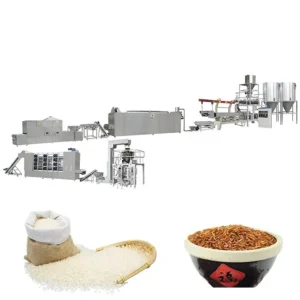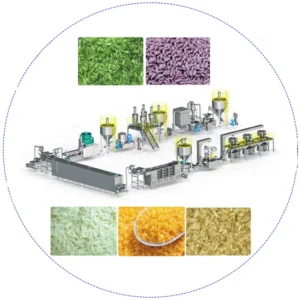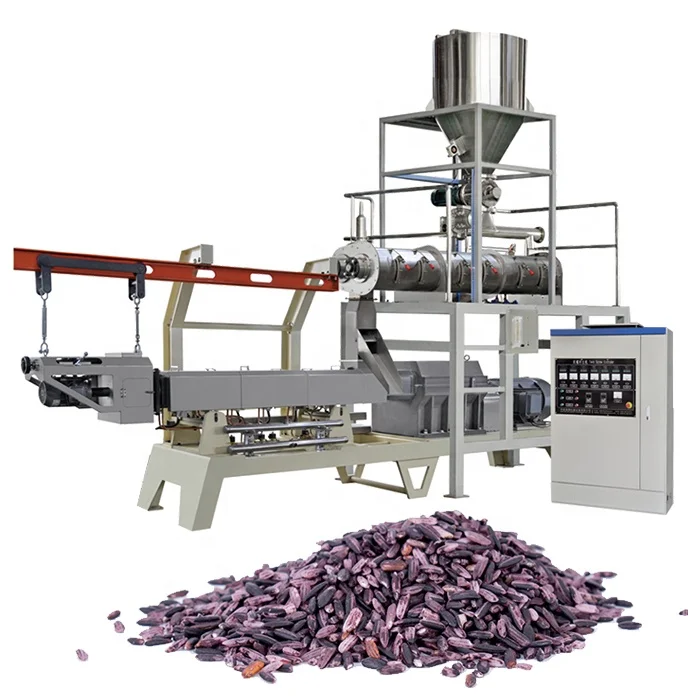
Capacity-matched line design — Every station in this fortified rice kernel extrusion line is sized against the extruder’s real throughput on your grain formulation, eliminating the bottleneck that appears when machines are sourced separately.
Technical Specifications
| Parameter | Value |
|---|---|
| Model | MT65 / MT70 / MT85 / MT75 / MT95 |
| Product Type | Fortified Rice Kernel Extrusion Production Line |
| Screw Type | Twin-screw |
| Installed Power | 85 kW (MT65), 120 kW (MT70), 235 kW (MT85), 180 kW (MT75), 260 kW (MT95) |
| Power Consumption | 60 kW (MT65), 85 kW (MT70), 165 kW (MT85), 135 kW (MT75), 195 kW (MT95) |
| Output Capacity | 80–100 kg/h (MT65), 100–120 kg/h (MT70), 200–300 kg/h (MT85), 300–500 kg/h (MT75), 800–1000 kg/h (MT95) (basis not stated in source — confirm raw material formulation / moisture content) |
| Overall Dimensions | 28 × 1.2 × 2.2 m (MT65), 30 × 1.5 × 2.2 m (MT70), 34 × 3.5 × 4.3 m (MT85), 32 × 3.5 × 4.3 m (MT75), 36 × 3.5 × 4.3 m (MT95) |
| Control System | Frequency speed control, high automation |
| Lubrication | Automatic lubricating and cooling |
| Feeding System | Single or double screw feeding, selectable by material |
| Drying Oven Heating Source | Electric or gas |
| Drying Oven Control | Frequency motor for mesh belt speed |
| Production Procedure | Mixing → Extruding → Vibrating → Low temperature drying → Cooling → High temperature roasting → Cooling → Packing |
| Basic Materials | Broken rice, rice, corn, millet, wheat, oats, buckwheat, bean, starch, vitamin and mineral additives |
| Certification | CE |
Application Suitability
| Application | Material or Output |
|---|---|
| Fortified rice kernel production | Broken rice and rice bran blended with vitamin and mineral additives |
| Artificial rice manufacturing | Mixed grain and starch formulations shaped into rice-like kernels |
| Nutritional rice for aid programmes | Rice flour with micro-nutrient solidification into stable kernel form |
| Multigrain rice products | Millet, buckwheat, oats, corn and bean blends extruded into uniform kernels |
| Value-added rice from waste streams | Broken rice and bran residue converted into saleable fortified kernels |
Why the Dryer Spec Matters More Than the Extruder Nameplate
A rated extruder output means nothing if the downstream dryer cannot remove moisture at the same rate.
I have walked into plants where the twin-screw extruder was running at full capacity, but the drying oven was undersized for that throughput. Wet kernels piled up on the conveyor, sticking together and deforming before they reached the roaster. The operators slowed the extruder to match the dryer, which meant the line never hit the output the buyer originally paid for. This is a recurring problem when equipment is assembled from separate vendors who each quote their machine in isolation. When you evaluate a fortified rice extrusion machine full equipment range, the dryer mesh belt length, heating capacity and air circulation volume must be calculated against the extruder’s real output on your specific grain blend [NEED_CITE: matching dryer capacity to extruder throughput in grain processing lines].
Feeding System Configuration and Material Behaviour
The feeding system on this line is available with single or double screw options, and the choice depends on how your raw material flows. Rice flour with added vitamin premix tends to bridge in hoppers if the feed screw is not matched to the bulk density. A double screw feeder handles materials that are prone to rat-holing, while a single screw is sufficient for free-flowing broken rice grits. Selecting the wrong feeder type causes intermittent starvation at the extruder barrel, which shows up as inconsistent kernel density further down the line.
Drying and Roasting Stages in Sequence
The production procedure moves through low temperature drying first, then cooling, then high temperature roasting, and a second cooling pass before packing. This staged approach is deliberate. The low temperature dryer removes the bulk of the moisture without case-hardening the kernel surface, which would trap steam inside and cause cracking during roasting. The frequency motor on the mesh belt lets the operator adjust residence time to account for seasonal humidity changes in the workshop [NEED_CITE: staged drying protocols for extruded grain products].
Reading the Power and Capacity Figures
The installed power ranges from 85 kW on the MT65 to 260 kW on the MT95, while actual power consumption sits lower, between 60 kW and 195 kW across the model range. The gap between installed and consumed power reflects the peak torque needed during start-up and when the barrel is full of cold material. The five model options cover output from 80–100 kg/h on the MT65 up to 800–1000 kg/h on the MT95, though these figures require confirmation against your raw material formulation and moisture content. The twin-screw configuration generates the shear and mixing action needed to fully gelatinise the starch in rice and grain blends, which is what gives the final kernel its structural integrity during cooking.
What Happens When Stations Are Mismatched
When the vibrating conveyor or cooling belt is narrower than the extruder die output, kernels stack on top of each other and fuse together before they can be separated. I have seen lines where the roaster was specified for a lower throughput than the extruder, forcing the entire line to run below capacity or producing scorched kernels from excessive residence time. These problems do not appear during a factory acceptance test with clean water and empty barrels — they only surface once your actual material is running through every station [NEED_CITE: bottleneck diagnosis in multi-stage food extrusion lines].
Why Procurement Through a Single Line Supplier Changes the Outcome
Every station in this fortified rice extrusion machine full equipment range is configured under one supplier, meaning the mixer batch size, extruder output, dryer belt length, roaster volume and packing speed are calculated together before the layout is drawn. Screw configuration and die design are specified against your target kernel shape and raw material blend, not copied from a generic build. The in-house testing workshop runs your actual material before shipment, so product development begins before installation rather than after. Electrical schematics are confirmed for your destination voltage and frequency, and the control language is set before the panel is wired. CE-certified construction is standard across the range.
Documentation & Verification
- Line layout drawing showing matched throughput at every station from mixer to packer
- Trial run report produced on your rice or grain formulation before the line ships
- Screw and die configuration record matched to your target kernel dimensions
- Electrical schematic with voltage, frequency and control language confirmed for your market
- Machine specification sheet covering all five model options with power and dimension data
- Operation and maintenance manual with wear parts list and replacement intervals
Installation, Commissioning & Support
- Foundation plan provided based on the selected model footprint, up to 36 × 3.5 × 4.3 m for the MT95
- Dedicated power circuit required, sized to the installed power of the chosen model up to 260 kW
- Line arrives in modular sections for assembly and alignment on your workshop floor
- First run commissioning includes extruder barrel temperature profiling and dryer belt speed calibration
- Operator training covers feeding system changeover between single and double screw configurations
- Wear parts list details screw and die replacement schedules based on your material abrasiveness
Before You Request a Quote
To size the line correctly, share your raw material formulation including the percentage of broken rice, starch and micro-nutrient premix, along with your target daily output and the voltage and frequency standard at your facility. If you have an existing packing system or upstream milling equipment, note the interface points so the line layout can accommodate them.
Frequently Asked Questions
Q: How is the real output capacity verified on my specific raw material formulation?
A: The testing workshop runs your actual grain blend through the extruder and downstream stations before shipment. The trial run report documents the achievable throughput, kernel density and moisture content at each stage, so the capacity figure you receive is tied to your material rather than a generic benchmark.
Q: What voltage, frequency and control language options are confirmed before shipment?
A: The electrical schematic is prepared after you confirm your local supply standard. The control panel labels, PLC interface language and motor ratings are all set to match your facility before the line is wired and tested, avoiding rewiring delays during commissioning.
Q: Is the drying and roasting capacity matched to the extruder model I select?
A: Yes. The dryer belt length, heating source rating and roaster volume are calculated against the extruder output for your chosen model. This prevents the common problem where wet kernels accumulate between stations because the downstream equipment cannot keep pace.
Q: Can I run a trial with my raw material before the line ships?
A: The in-house testing workshop is available for trial runs using your shipped raw material. You receive a report covering extrusion behaviour, kernel shape, drying curve and final product quality, allowing formulation adjustments before the line leaves the factory.
Q: What wear parts are included and what is the replacement schedule for screws and dies?
A: The line ships with a documented wear parts list identifying screws, dies and feeder components subject to abrasion. Replacement intervals depend on your material composition, and the initial spare set is specified to cover your first production cycle before reorder.