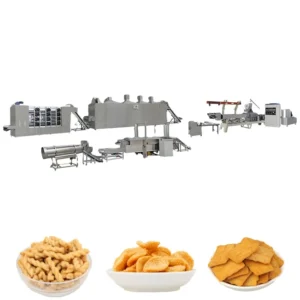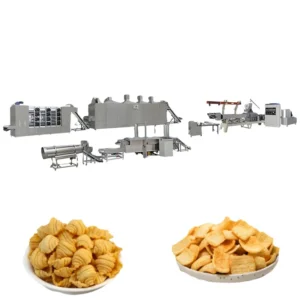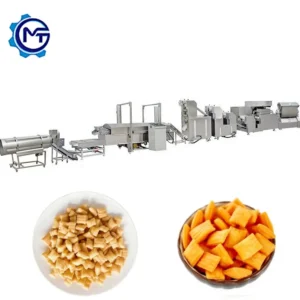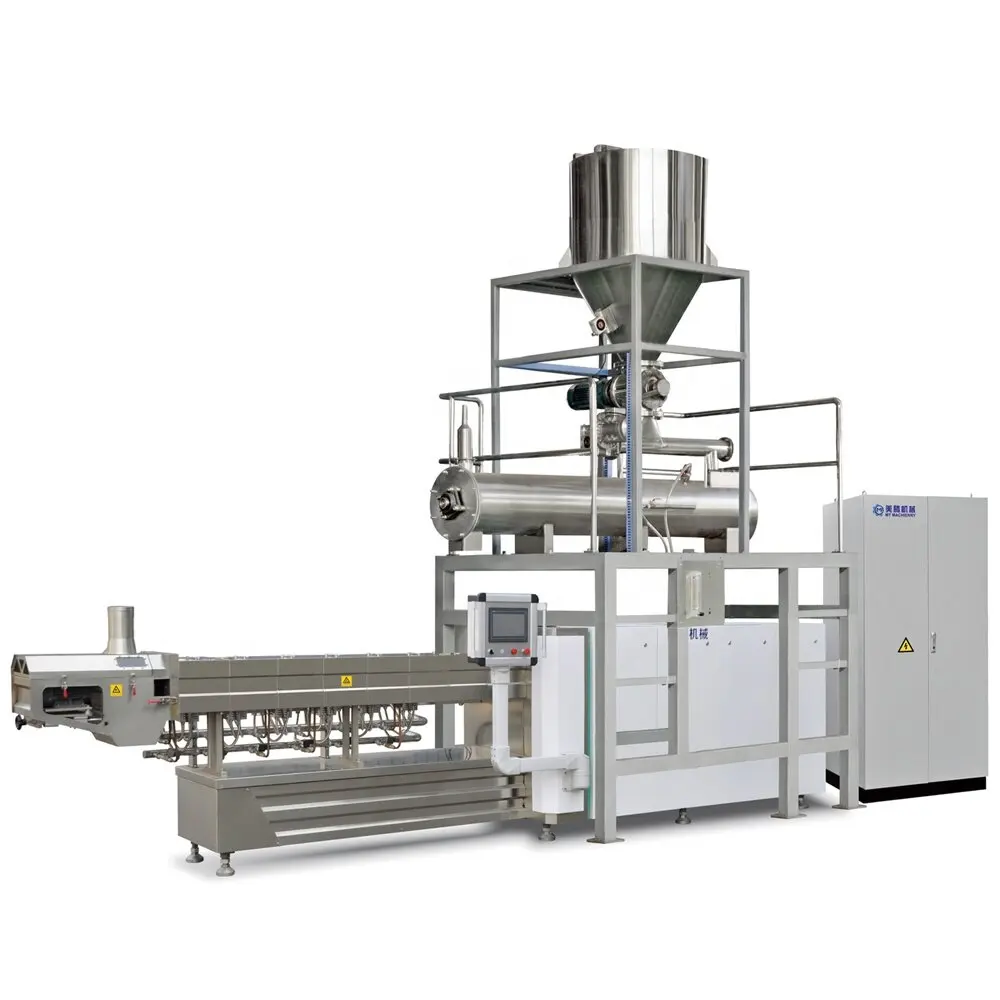
Integrated Line Stations — Every module from automatic feeding through extrusion, molding and conveying is mapped to its role in the production flow, letting buyers verify where this fried pasta snacks making machine full equipment range fits before specifying a complete line.
Technical Specifications
| Parameter | Value |
|---|---|
| Product Type | Fried Pasta Snacks & Kurkure Extrusion Line |
| Output Capacity | 150–200 kg/h (basis not stated in source — confirm raw material, moisture content, product format) |
| Screw Type | Professional screw extrusion structure (twin-screw or single-screw to be confirmed) |
| Contact Material | Food-grade stainless steel |
| Control System | Automatic integrated control panel (PLC or MCC to be confirmed) |
| Line Stations | Automatic feeding, extruding, molding, conveying |
| Assembly State | Integrated line layout |
| Operation Mode | Fully automatic |
| Heating Configuration | Optimized heating (rated power kW not stated in source) |
| Voltage & Frequency | Not stated in source — confirm before order |
| Certification | Not stated in source for this listing |
Application Suitability
| Application | Material or Output |
|---|---|
| Kurkure-style extruded fried snacks | Corn grits, corn flour, spice-seasoned dough |
| Nimko crispy snack formats | Chickpea flour, lentil flour, blended grain bases |
| Fried pasta snack shapes | Semolina, durum wheat flour, wheat flour blends |
| Extruded crispy pellet formats | Rice flour, tapioca starch, multi-grain recipes |
What the Quoted Capacity Figure Actually Means on a Fried Pasta Snacks Making Machine
Output numbers are only meaningful when matched to your raw material, moisture content and target product density.
A fried pasta snacks making machine full equipment range listed at a nominal throughput can behave very differently once your local flour or grits hit the barrel. I once spent four days on-site stabilizing a fried snack line because the trial had run on standard flour while the buyer’s local high-gluten variant changed both expansion rate and oil absorption after frying. Without confirming the actual recipe beforehand, the extruder and downstream fryer can fall out of sync, leaving you with a line that cannot sustain its quoted rhythm [NEED_CITE: raw material variability in extrusion throughput].
Station-by-Station Flow for Surveying Buyers
When you evaluate a fried pasta snacks making machine full equipment range, the first step is understanding which modules are included and where each sits in the sequence. This line integrates automatic feeding, a professional screw extrusion unit, a molding stage and conveying — giving you a clear view of the upstream and mid-line architecture before you add frying, flavouring and packing.
Matching Downstream Capacity to Avoid Bottlenecks
An extruder that outpaces its dryer or fryer creates a pile-up that operators cannot clear without stopping the line. Because this catalogue entry shows the station lineup explicitly, buyers can cross-check whether the conveying speed, frying dwell time and coating drum volume will keep pace with the extrusion output at the target capacity range [NEED_CITE: throughput matching across extrusion line stations].
Reading the Specs That Matter for Snack Extrusion
The professional screw extrusion structure governs how uniformly dough is mixed, sheared and pushed through the die — directly shaping the consistency of each snack piece. Food-grade stainless steel across contact surfaces resists corrosion from salty or acidic dough blends common in Nimko and Kurkure recipes. The automatic integrated control panel centralizes barrel temperature, screw speed and feed rate so operators can adjust parameters without manual intervention at each station. Voltage and frequency remain unspecified in the source documentation, so confirming your site’s electrical standard before production begins prevents commissioning delays that can stretch into weeks.
The Hidden Cost of Skipping a Raw-Material Trial
Shipping an extrusion line without a prior trial on the buyer’s actual flour, semolina or grain blend is one of the most common causes of extended on-site debugging. When the screw configuration and die geometry are set for a generic recipe, the first production run often reveals unexpected density, texture or oil-uptake issues. Correcting those variables after installation means lost raw material, delayed market launches and extra engineering visits — costs that a pre-shipment trial run on your specific ingredients would have largely prevented [NEED_CITE: pre-shipment testing value in food extrusion projects].
Why Buyers Source This Line Through Our Equipment Range
Complete station mapping lets you see every module’s position in the layout, so throughput is verified across each station rather than left to chance. Screw configuration and die design can be specified to your raw material and target product format before the line is built. An in-house testing workshop allows trial runs on your actual ingredients before dispatch, reducing on-site commissioning time. Electrical schematics and voltage confirmation are finalized to your destination market’s standards, avoiding rewiring after arrival. Pre-sales consultation, installation guidance and ongoing maintenance support extend well beyond the shipment date.
Documentation & Verification
- Line layout and capacity calculation matched to your snack format and recipe
- Machine specification sheet with screw and die configuration record
- Electrical schematic with voltage and frequency confirmation for your market
- Trial run report on your raw material before shipment
- Operation and maintenance manual covering each station
Installation, Commissioning & Support
- Floor plan and utility requirements provided for the integrated line footprint
- Power supply specifications confirmed to local voltage and frequency before wiring
- Modular station design allows staged assembly and alignment on-site
- First-run parameter tuning covers barrel temperature, screw speed and feed rate
- Operator training addresses control panel language and daily maintenance routines
- Wear parts list includes screw segments and die inserts for initial stocking
Before You Send an Inquiry
Share your target snack format — Kurkure, Nimko, fried pasta or a custom shape — along with the primary raw material and any local ingredient substitutions. Include your site’s voltage, frequency and preferred control-panel language so the electrical package can be scoped correctly. If you have existing downstream frying or packing equipment, note the model and throughput so the new extrusion section can be matched to your current line speed.
Frequently Asked Questions
Q: Which stations are included and which must be sourced separately?
A: This listing covers automatic feeding, extrusion, molding and conveying. Frying, flavouring, cooling and packing stations are not explicitly included, so buyers should confirm the full downstream scope when specifying a complete fried pasta snacks making machine full equipment range for their facility.
Q: How do I confirm output capacity against my own recipe?
A: Provide your raw material type, moisture content and target product density. A trial run in the testing workshop using your actual ingredients will establish the realistic throughput before the line ships, preventing on-site surprises.
Q: What screw and die configuration fits Kurkure versus Nimko formats?
A: Kurkure typically needs a die and screw profile that produce an irregular, twisted shape with high surface area for seasoning adhesion, while Nimko requires a denser, compact form. Die geometry and screw pitch are selected based on the target texture and frying behavior.
Q: Can the control panel language match my operators?
A: The automatic integrated control panel supports language configuration, but the specific HMI options and PLC or MCC architecture must be confirmed before production to ensure operators can navigate parameters confidently on day one.