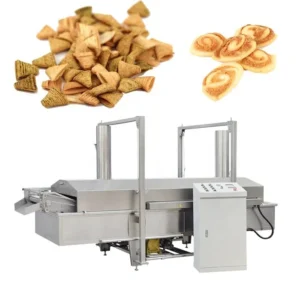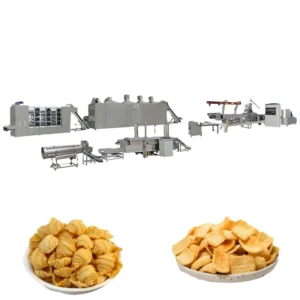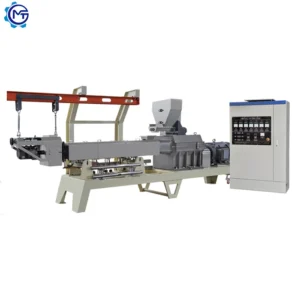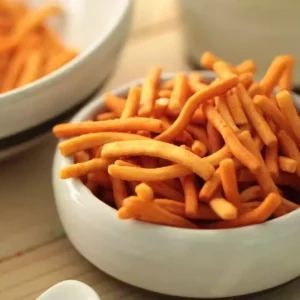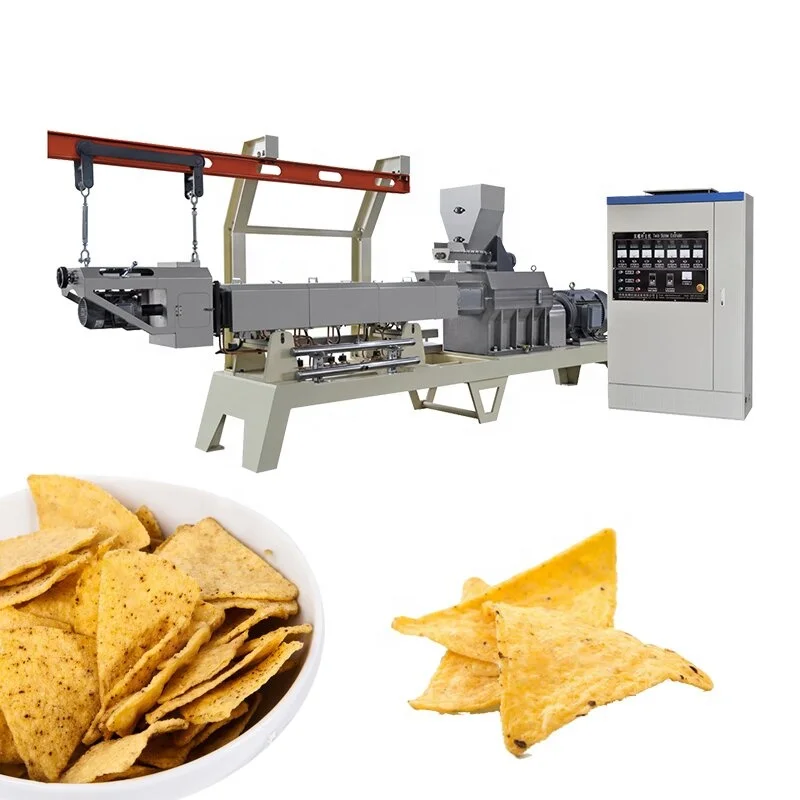
Balanced Line Throughput — every station from mixing to cooling is sized against the extruder’s actual output on your raw material, preventing the fryer or flavoring drum from becoming a production bottleneck.
Technical Specifications
| Parameter | Value |
|---|---|
| Model | MT100/MT120 |
| Product Type | Fried Potato Chips Production Line |
| Extruder Type | Single Screw Extruder |
| Output Capacity | 120 kg/h (basis not stated in source — confirm raw material type and moisture content) |
| Rated Power | 50-70 kW (electric heating) / 50-60 kW (gas or diesel heating) |
| Voltage & Frequency | Three phases 380V/50Hz, Single phase 220V/50Hz (customizable to local voltage) |
| Energy Options | Electricity, gas, diesel, or steam |
| Overall Dimensions | 12000-26000 × 1200 × 2200 mm |
| Contact Material | Food grade stainless steel 201/304 |
| Motor Brand | Siemens (made in China) or China top brand; Delixi or Delta inverter |
| Standards | CE, ISO 9001 |
| Warranty | One year warranty and lifetime technical guidance |
Application Suitability
| Application | Material or Output |
|---|---|
| Secondary puffing snack production | Potato starch, corn starch, wheat flour formulations |
| Fried extruded snack formats | Screw shell, round tube, square tube, ring, cartoon shapes via interchangeable dies |
| Street food and savory snack lines | Golgappa, pani puri, and regional fried pellet-style snacks |
| Seasoned snack finishing | Products requiring post-fry flavoring with powder or oil-based coatings |
What "120 kg/h" Actually Means for Your Raw Material
A rated capacity figure is only valid on the exact formulation and moisture level used to establish it.
I once spent weeks on a fried snack line in South Asia where the nameplate promised steady output, but the buyer’s local starch blend absorbed water differently than the test material. The extruder kept pace, but the fryer could not drive moisture down fast enough — chips left the belt pliable, and effective throughput dropped by half. Before committing to a Fried Potato Chips Production Line manufacturer, verify which raw material recipe and moisture percentage the stated capacity refers to, and insist on a trial run using your own ingredients [NEED_CITE: raw material moisture impact on fryer dwell time].
Die Geometry and Snack Expansion Behavior
The single screw extruder in this line accepts interchangeable dies that shape the extrudate before cutting. Each geometry — screw shell, ring, round tube, square tube — alters how the pellet expands when it hits hot oil. Thicker-walled shapes need longer fryer dwell time to achieve the target crunch without surface scorching. Matching die selection to fryer belt speed is where a Fried Potato Chips Production Line either runs smoothly or generates waste.
Energy Source Selection for the Frying Station
The fryer station supports electric, gas, diesel, or steam heating. In regions where industrial electricity carries a demand charge, gas or diesel firing often lowers the cost per kilogram of finished product. Steam integration makes sense when the buyer already operates a boiler for other process lines. The choice affects not just operating cost but also the temperature recovery rate after product enters the oil, which directly influences color and texture consistency [NEED_CITE: industrial fryer energy source comparison].
Reading the Power and Dimension Figures
The 50-70 kW electric heating rating covers the extruder barrel zones and fryer elements combined. Facilities with limited transformer headroom should confirm whether gas-fired frying can shift a portion of that load off the electrical panel. The 12 to 26-meter line length reflects station count and conveyor runs — buyers planning installation need to allow clearance around the flavoring drum for access and cleaning, plus space for the cooling conveyor before packing.
When the Flavoring Drum Becomes the Chokepoint
An undersized flavoring drum forces the entire upstream line to slow down. Fried product piles up, oil temperature drops between batches, and texture becomes inconsistent across the run. I have walked into facilities where a well-chosen extruder sat idle because the seasoning station could not tumble product fast enough to match extruder output. Throughput balance across every station, not just the extruder nameplate, determines what actually ends up in the bag [NEED_CITE: line balancing principles for snack processing].
Why Sourcing the Full Line from One Supplier Matters
Specifying mixing, extrusion, frying, flavoring, and cooling from separate vendors introduces interface risk. Conveyor heights misalign, motor speeds conflict, and no single party owns the throughput guarantee. This line is engineered as a continuous system where each station’s capacity is calculated against the extruder’s output on your specific formulation. Screw and die configurations are documented against the buyer’s raw material, not copied from a generic build. An in-house testing workshop runs trial production before shipment, so product development begins in the factory rather than on the buyer’s floor. Electrical schematics and voltage are confirmed against the target site before production starts, avoiding commissioning delays caused by mismatched power supply.
Documentation & Verification
- Line layout drawing showing station spacing and total footprint for your facility
- Screw and die configuration record matched to your starch or flour formulation
- Electrical schematic with voltage and frequency confirmed for your local grid
- Trial run report produced on your raw material before machine dispatch
- CE declaration of conformity and ISO 9001 certificate for customs clearance
- Wear parts list covering screws, dies, and cutting blades with part numbers
Installation, Commissioning & Support
- Foundation must support the 12 to 26-meter line length on level concrete with drainage near the fryer station
- Dedicated three-phase 380V/50Hz circuit sized for the 50-70 kW heating load, or gas line for dual-energy fryer
- Stations ship as modular assemblies requiring on-site alignment of conveyor transfer points
- First-run commissioning includes barrel temperature profiling and fryer oil temperature calibration
- Operator training covers die changeover procedure and cutting blade replacement
- Spare screws, dies, and blades included at shipment; reorder lead time confirmed in the wear parts list
- Stainless steel 201/304 contact surfaces require scheduled cleaning to prevent oil residue buildup
Before You Request a Quotation
Share the exact starch or flour blend you plan to run, including supplier data sheets if available. Specify your local voltage, frequency, and whether gas or electric heating is preferred for the fryer. Indicate the snack shapes you need and any custom die profiles beyond the standard range. If you operate existing upstream or downstream equipment that this line must integrate with, provide those interface details so station heights and conveyor speeds can be matched.
Frequently Asked Questions
Q: How is the 120 kg/h capacity verified, and on which raw material formulation is it based?
A: That figure is a source value that requires confirmation against your specific raw material. Capacity varies with starch type, moisture content, and the target snack geometry. We run a trial in the testing workshop using your actual ingredients to establish a verified output figure before the line is finalized.
Q: What voltage and frequency configurations are available, and is the control panel labeled in our language?
A: The standard supply is three-phase 380V/50Hz or single-phase 220V/50Hz, but configurations are customizable to match your local grid. Panel labeling language is confirmed during the specification stage so operators can read controls without translation at commissioning.
Q: Can the die configuration be customized for shapes beyond the standard range?
A: Standard dies produce screw shell, round tube, square tube, ring, and cartoon shapes. Custom profiles are possible with new die tooling designed to your drawing or sample. The die change procedure involves loosening the die plate bolts and swapping inserts, typically completed within one shift break.
Q: What spare wear parts are included at shipment, and what is the reorder lead time?
A: Initial spare screws, dies, and cutting blades ship with the line. The wear parts list documents every replaceable component with part numbers. Reorder lead time is confirmed during the quotation stage and depends on die complexity and current production scheduling.
Q: How is throughput balanced between the extruder, fryer, and flavoring stations to prevent bottlenecks?
A: Each station’s capacity is calculated against the extruder’s verified output on your raw material. The fryer belt speed, oil volume, and drum diameter are sized so no single station forces the upstream line to slow down, keeping actual throughput aligned with the rated figure.