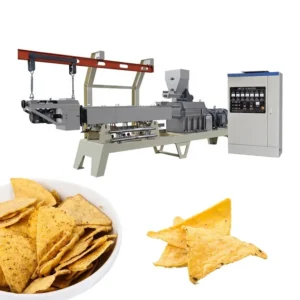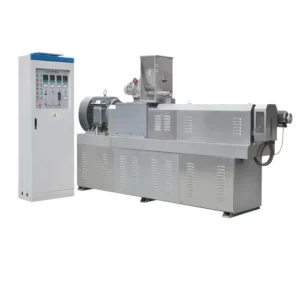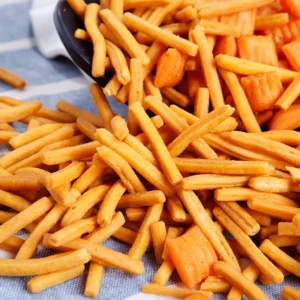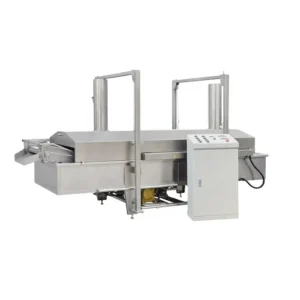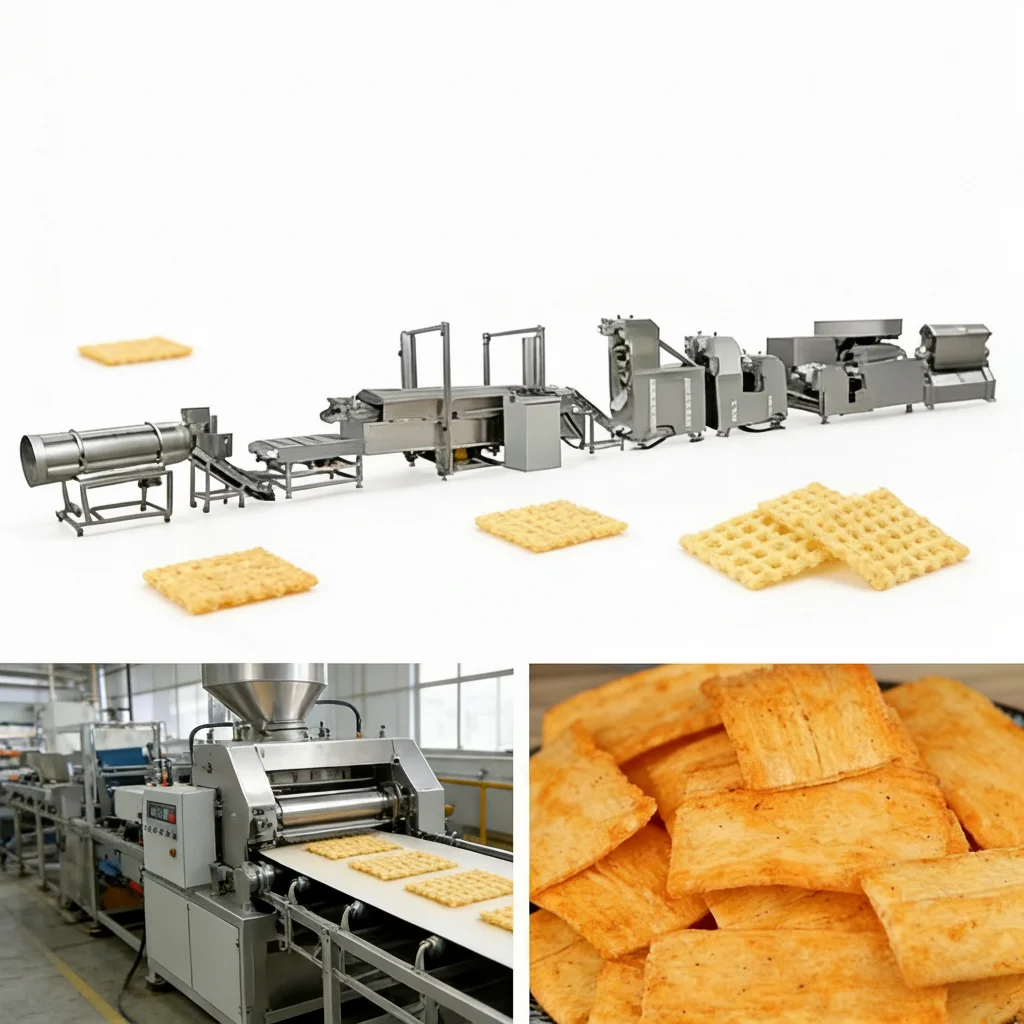
Single-screw extrusion expertise — screw configurations and die designs matched to each raw material and target snack shape before the line is built.
Technical Specifications
| Parameter | Value |
|---|---|
| Product Type | Single Screw Extruded Snack Production Line |
| Extruder Type | Single Screw Extruder |
| Capacity | 120 kg/h (basis not stated in source — confirm raw material / moisture content / product shape) |
| Rated Power | 50–70 kW (electric heating); 50–60 kW (gas or diesel heating) |
| Voltage & Frequency | 380V/50Hz (3-phase); 220V/50Hz (1-phase); customizable to local voltage |
| Overall Dimensions (L×W×H) | 12,000–26,000 × 1,200 × 2,200 mm |
| Construction Material | Food-grade stainless steel 201/304 |
| Energy Options | Electricity / Gas / Diesel / Steam |
| Motor & Electrical Components | Siemens (China-made) or top Chinese brand motors; Delixi or Delta inverters |
| Line Stations | Mixer → Screw Conveyor → Single Screw Extruder → Pulling and Cutting Machine → Automatic Fryer → Automatic Flavoring Line → Cooling |
| Assembly State | Complete production line |
| Certification | CE / ISO 9001 |
| Warranty | 1 year with lifetime technical guidance |
Application Suitability
| Application | Material or Output |
|---|---|
| Golgappa / pani puri production | Wheat flour, corn starch, potato starch base dough |
| Screw shell and round tube snacks | Potato starch and corn starch blends |
| Ring and cartoon-shaped puffed snacks | Wheat flour and starch mixtures |
| Square tube and secondary puffing formats | Corn starch and potato starch combinations |
Why Your Line Capacity Depends on the Station You Ignore First
A fryer that cannot keep pace with the extruder creates the bottleneck that wastes the most raw material.
I spent years on factory floors watching lines that looked perfect on paper fall apart in practice. One producer installed a high-output extruder but paired it with an undersized fryer. The snack pieces piled up in the oil bath, overcooked, and were discarded by the kilogram. The rated capacity of the extruder meant nothing because the automatic fryer station dictated the real throughput. When you evaluate a snack extrusion machine manufacturer, the question is never just what one machine can do — it is whether every station from the mixer to the cooling conveyor is calculated against the same target output [NEED_CITE: line throughput matching principles for extruded snack production].
How Each Station Connects to the Next
This line runs through seven defined stations: mixer, screw conveyor, single screw extruder, pulling and cutting machine, automatic fryer, automatic flavoring line, and cooling. Each station is sized so that the material flow from the extruder die matches the fryer belt speed and the flavoring drum residence time. When a snack extrusion machine manufacturer supplies the full sequence under one configuration, the throughput calculation starts at the end — the packing rate — and works backward to define the extruder screw speed and cutter frequency.
Why the Fryer and Flavoring Drum Sizing Matters for Snack Format
Secondary puffing snacks like golgappa and pani puri require precise oil temperature and dwell time to achieve the target expansion without scorching. The automatic fryer in this line supports electricity, gas, diesel, or steam heating, letting producers match the energy source to their facility. After frying, the flavoring drum must tumble the pieces long enough for seasoning adhesion without breaking the fragile expanded structure. A mismatch here means either under-seasoned product or excessive breakage reaching the packing stage [NEED_CITE: frying temperature profiles for starch-based expanded snacks].
Reading the Specs That Actually Affect Your Output
The single screw extruder at the core of this line handles wheat flour, corn starch, and potato starch — each requiring different barrel temperature profiles and screw pitches. The rated power range of 50–70 kW for electric heating reflects the thermal load needed to gelatinise starch inside the barrel before the die. Die configuration determines whether you produce screw shells, rings, or cartoon shapes, and each die geometry changes the back-pressure and therefore the motor load. The overall line length of 12,000 to 26,000 mm accounts for the fryer, cooling conveyor, and flavoring drum footprint, which buyers often underestimate when planning floor space. Voltage is configurable between 380V three-phase and 220V single-phase, and the control components use Delixi or Delta inverters to manage motor speed across stations. Food-grade stainless steel 201 or 304 construction on contact surfaces meets hygiene expectations for direct food processing environments.
What Happens When the Line Stations Are Sourced Separately
When a buyer assembles an extruder from one vendor, a fryer from another, and a flavoring drum from a third, no single supplier owns the throughput calculation. The extruder pushes product faster than the fryer can process it, oil temperature drops under the overload, and the snack pieces absorb excess oil or burn at the edges. The flavoring drum then receives irregular product, and seasoning coverage becomes inconsistent. I have watched this exact pattern force producers to shut down, recalculate belt speeds, and sometimes replace entire stations — all after commissioning was supposed to be complete [NEED_CITE: consequences of unmatched line station capacities in snack processing].
Why Buyers Source This Line from One Equipment Range
The full equipment catalogue approach means the mixer capacity, screw conveyor transfer rate, extruder output, fryer belt speed, and flavoring drum volume are all defined in a single layout document. The in-house testing workshop runs trial production on the buyer’s actual raw material before shipment, so die configuration and screw pitch are validated rather than assumed. Electrical schematics and voltage specifications are confirmed against the target market before production begins. The single screw extrusion technology covers everything from starch-based pellet snacks to secondary puffing formats, giving buyers one technical team to work with across the entire process. CE and ISO 9001 certification applies to the line as a complete assembly, not just individual machines.
Documentation & Verification
- Line layout and capacity calculation showing throughput at every station from mixer to cooling
- Screw and die configuration record matched to your specific starch or flour raw material
- Electrical schematic and voltage confirmation document for your local power grid standard
- Trial run report produced on your raw material in the testing workshop before dispatch
- CE declaration of conformity and ISO 9001 certificate covering the complete line assembly
- Wear parts list identifying screws, dies, and cutter blades with replacement part numbers
Installation, Commissioning & Support
- Floor space planning based on the 12,000–26,000 mm line length with utility connection points marked
- Power supply verification for 380V three-phase or 220V single-phase with dedicated circuit requirements
- Station-by-station assembly and alignment from mixer through cooling conveyor on your factory floor
- First-run parameter setting including barrel temperature profile, cutter speed, and fryer dwell time
- Operator training covering die changes for different snack shapes and routine screw inspection
- Spare wear parts supply for screws, dies, and cutter blades with ongoing technical guidance
What to Include in Your Inquiry
Provide the specific raw material blend you intend to run — wheat flour, corn starch, potato starch, or a combination — along with the target snack shape such as golgappa, screw shell, or ring. Share your local voltage and frequency standard so the electrical configuration is confirmed before production. If you have existing upstream or downstream equipment, describe the interface points so the line layout accounts for your facility constraints.
Frequently Asked Questions
Q: What capacity can this line hold on my specific raw material, and what is the basis for the stated output?
A: The stated 120 kg/h figure requires confirmation against your exact raw material blend, moisture content, and target snack shape. A trial run in the testing workshop on your actual flour or starch is the reliable way to establish real throughput. Capacity varies significantly between corn starch and wheat flour due to differences in gelatinisation behaviour inside the single screw extruder barrel.
Q: How is each station matched to avoid bottlenecks in the line?
A: The mixer batch size, screw conveyor transfer rate, extruder output, fryer belt speed, and flavoring drum volume are calculated together in one line layout document. Throughput is matched backward from the packing target so no single station accumulates material. This prevents the pile-up in the fryer or flavoring drum that causes product waste.
Q: Which voltage and frequency configurations are available, and how is the control language confirmed?
A: The line supports 380V/50Hz three-phase and 220V/50Hz single-phase configurations, with custom voltage available for specific markets. Electrical schematics and voltage confirmation are reviewed with the buyer before production starts. Control language and interface settings are defined during the specification stage to match the operator team at the installation site.
Q: What die shapes and screw configurations are available for different snack formats?
A: The single screw extruder accepts interchangeable dies for screw shell, round tube, square tube, ring, and cartoon shapes. Screw pitch and barrel configuration are adjusted to match the raw material and target expansion. The die and screw combination is recorded in the configuration document and validated during the pre-shipment trial run.
Q: What spare wear parts are included, and how are replacements sourced?
A: The wear parts list identifies screws, dies, and cutter blades specific to your line configuration. Replacement parts are available through the supplier with part numbers recorded in the documentation package. Having the correct spare set on hand before the first scheduled replacement avoids unplanned downtime during peak production periods.