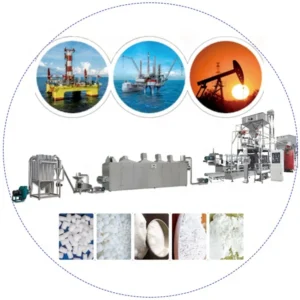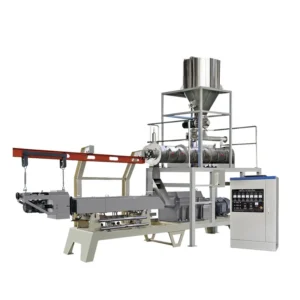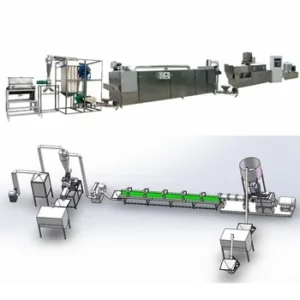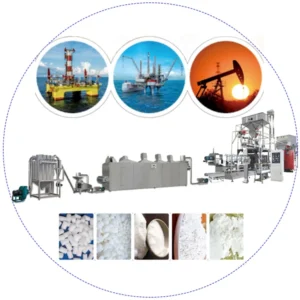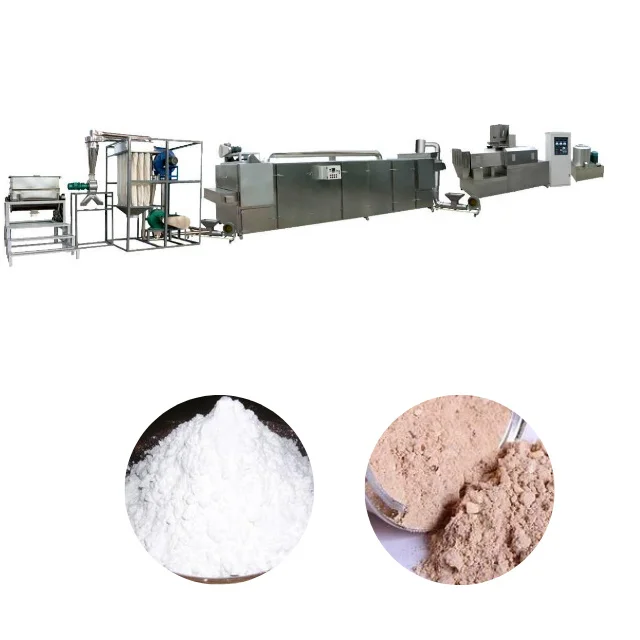
Integrated Line Engineering — throughput across mixing, extrusion, drying, grinding and packing is calculated as one system so no single station chokes the modified starch processing line full equipment range.
Technical Specifications
| Parameter | Value |
|---|---|
| Product Type | Modified Starch Processing Line |
| Model Options | MT85 / MT100 / MT110 / MT135 |
| Installed Power | 90 kW (MT85) / 180 kW (MT100) / 200 kW (MT110) / 240 kW (MT135) |
| Real Consumption | 63 kW (MT85) / 120 kW (MT100) / 150 kW (MT110) / 165 kW (MT135) |
| Capacity | 100–200 kg/hr (MT85) / 500–600 kg/hr (MT100) / 500–600 kg/hr (MT110) / 1000–1500 kg/hr (MT135) (basis not stated in source — confirm raw material type and moisture content) |
| Raw Material Compatibility | Corn starch, tapioca starch, potato starch |
| Screw Type | Twin screw |
| Control System | Frequency speed controlling system, high automation |
| Heating Source (Dryer/Roasting Machine) | Electric / steam / gas, configurable to local utility conditions |
| Grinding Machine Particle Fineness | Less than 10 mm |
| Grinding Machine Construction | Food contact parts in stainless steel 304 |
| Grinding Machine Discharge | Bottom butterfly valve discharge |
| Processing Flow | Materials preparation → Material blending → Mixing → Extruding → Drying → Grinding → Packing |
| Lubrication | Automatic lubricating and cooling system |
| Assembly State | Complete turnkey production line |
| Warranty | 1 year free warranty |
| Delivery Time | 30 working days (small capacity) / 50 working days (big capacity) (source value — verify against manufacturer catalog) |
| Certification | CE |
Application Suitability
| Application | Material or Output |
|---|---|
| Pre-gelatinized starch for food processing | Corn starch and tapioca starch with controlled gelatinization degree |
| Modified starch for textile sizing | Corn starch and potato starch targeting specific viscosity profiles |
| Industrial starch for oil drilling fluids | Corn starch processed to precise particle fineness below 10 mm |
| Modified starch for paper and construction | Blended starch formulations requiring consistent extrusion shear and drying |
What "Rated Capacity" Leaves Out About Modified Starch Lines
A capacity number quoted without specifying raw material moisture and type tells you nothing about what the line will actually produce on your starch.
I once stood in a humid workshop outside Jakarta watching a newly installed modified starch processing line full equipment range fail to hit its rated output. The trial had been run on standard corn starch, but the buyer sourced local tapioca with a different amylose-to-amylopectin ratio and higher incoming moisture. The gelatinization degree fell short of specification, the dryer could not keep pace, and the grinder produced inconsistent particle size. The screw combination had to be pulled and reconfigured overnight. [NEED_CITE: starch gelatinization requirements for modified starch production] That experience shaped how every line configuration now starts with a raw material sample from the buyer’s actual supply chain before a single machine is specified.
Matching Every Station From Blending to Packing
When sourcing a modified starch processing line full equipment range, the extruder tends to receive the most attention, yet a bottleneck at the dryer or grinder cancels any throughput advantage at the screw. Each station in this line is sized against the others so that material flows continuously from blending through mixing, extrusion, drying, grinding, and finally packing. The dryer and roasting machine can be configured with electric, steam, or gas heating to match whatever utility is available at the installation site, preventing a situation where the extruder outpaces the drying stage and wet starch accumulates upstream.
Starch Source Dictates the Entire Screw and Die Setup
Corn starch, tapioca starch, and potato starch each respond differently to shear, barrel temperature, and moisture inside a twin-screw extruder. Tapioca tends to gelatinize at a lower temperature but produces a stickier melt that can clog dies not designed for it. Potato starch carries more inherent moisture and demands a different barrel temperature profile. The screw configuration and die design are specified to the buyer’s exact raw material so that the target gelatinization degree and expansion are achieved on the first production run rather than after weeks of trial and error on-site. [NEED_CITE: twin-screw extrusion parameter differences across starch types]
Reading the Power and Capacity Specs Correctly
The four models span installed power from 90 kW on the MT85 to 240 kW on the MT135, with real consumption figures notably lower — 63 kW to 165 kW respectively — reflecting actual running load rather than peak motor draw. Capacity ranges from 100–200 kg/hr up to 1000–1500 kg/hr, though those figures carry no stated raw material or moisture basis and must be confirmed against the buyer’s specific starch source. The automatic lubricating and cooling system keeps the twin-screw assembly stable during continuous shifts, reducing unplanned stops. The frequency speed controlling system allows operators to fine-tune throughput when switching between corn, tapioca, and potato formulations without mechanical changeovers. The grinding station delivers particle fineness below 10 mm with stainless steel 304 on all food-contact surfaces and a bottom butterfly valve for controlled discharge into the packing station.
The Cost of Mismatched Stations Downstream
When the dryer is undersized relative to the extruder, partially dried starch enters the grinder carrying excess moisture, and the resulting particle size scatters across a wide range instead of holding below 10 mm. Buyers then face rework or discard batches that do not meet the specification their downstream customers expect. [NEED_CITE: moisture content impact on starch grinding consistency] An undersized packing station causes the entire line to idle while finished product queues, erasing whatever capacity advantage the extruder was supposed to deliver.
Why Procurement Starts With Raw Material Verification
Every line proposal begins with the buyer sending an actual raw material sample so that the twin-screw configuration is designed around real starch behavior, not a generic build. Throughput matching across the modified starch processing line full equipment range is calculated station by station so that the dryer, grinder, and packing unit all keep pace with extruder output. The testing workshop runs the buyer’s material before shipment, producing a trial run report that confirms gelatinization degree and particle size targets are met. Electrical schematics, voltage, and control language are verified before production starts to avoid delays at commissioning. CE certification covers the machinery directive requirements for export markets.
Documentation & Verification
- Line layout and capacity calculation showing throughput matched across every station for your starch type
- Screw and die configuration record specific to your corn, tapioca, or potato starch sample
- Trial run report on your actual raw material confirming gelatinization degree and particle fineness
- Electrical schematic with voltage, frequency, and control language confirmed before production
- Factory test record and packing photographs documenting assembly state prior to dispatch
- Operation and maintenance manual with wear parts list covering screws, dies, and grinding screens
Installation, Commissioning & Support
- Foundation and floor space planned around the full processing flow from blending through packing
- Power supply verified against the selected model’s real consumption from 63 kW to 165 kW with dedicated circuits
- Heating source on the dryer configured to local electric, steam, or gas availability before shipment
- First production run supervised on-site with screw speed and barrel temperature tuned to your starch
- Operator training covers the frequency speed controlling system and automatic lubrication monitoring
- Wear parts list supplied at delivery covering twin-screw segments, dies, and grinder screens for planned replacements
Planning Your Modified Starch Line Inquiry
To size the right configuration, share the specific starch type you will process — corn, tapioca, or potato — along with its typical incoming moisture content and the target gelatinization degree or viscosity your market requires. Specify your local voltage, frequency, and preferred utility source for the drying station. If you are replacing individual stations within an existing line, provide the current throughput and any bottleneck you have identified so the matching equipment can be scoped accurately.
Frequently Asked Questions
Q: How is the capacity rating verified and what raw material basis is it used on?
A: Published capacity ranges are nominal and must be confirmed against your specific starch type, incoming moisture, and target gelatinization degree. A trial run on your actual raw material in the testing workshop establishes the real throughput before the line is finalized, ensuring the quoted output reflects your production conditions rather than a generic benchmark.
Q: How are the extruder, dryer, and grinder matched to avoid bottlenecking?
A: Each station is sized based on the extruder’s verified output on your raw material. The dryer’s heating capacity and residence time are calculated to handle that throughput at the target moisture, and the grinder is selected to process the dried output while maintaining particle fineness below 10 mm without queuing or starving downstream.
Q: What voltage, frequency, and control language options are confirmed before shipment?
A: Electrical schematics and control panel language are verified during the specification stage before production begins. This covers your local voltage and frequency requirements as well as the display language for the frequency speed controlling system, preventing commissioning delays caused by mismatched electrical standards or unreadable operator interfaces.
Q: Which stations can be purchased individually versus as a complete line?
A: Individual stations — the twin-screw extruder, dryer, grinder, or packing unit — can be supplied to replace or upgrade equipment within an existing modified starch processing line full equipment range. Each standalone unit is still matched against your current upstream and downstream throughput to ensure it integrates without creating a new bottleneck.
Q: What spare wear parts are included and what is the replacement schedule?
A: The initial delivery includes a wear parts list covering twin-screw segments, die inserts, and grinding screens. Replacement timing depends on your starch type and daily running hours and is confirmed during operator training so that planned maintenance can be scheduled before unplanned stops affect production continuity.