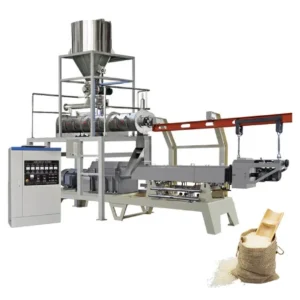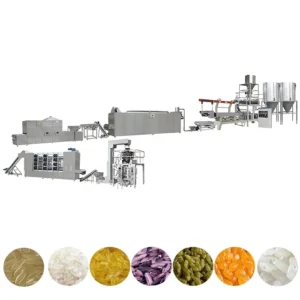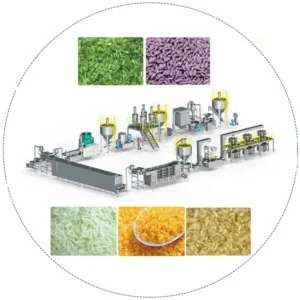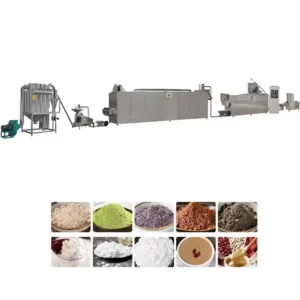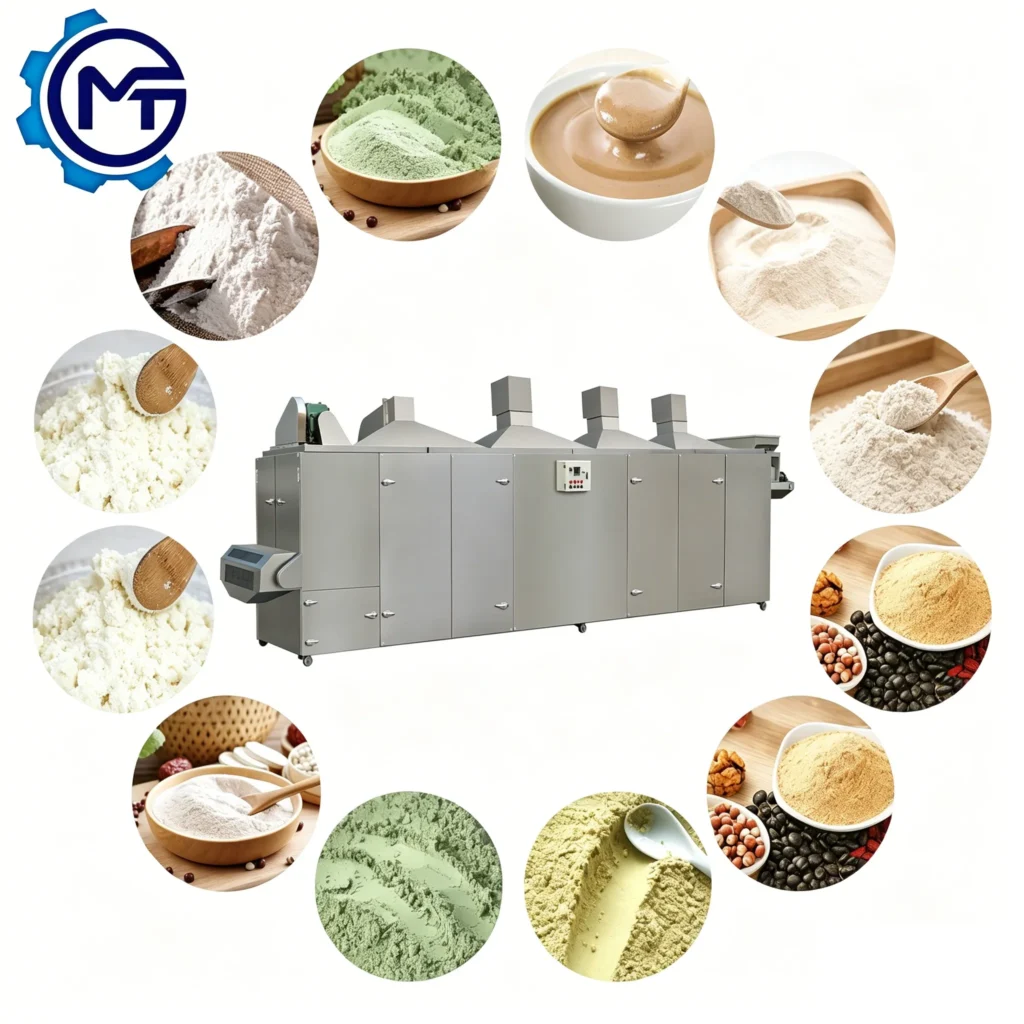
Balanced Throughput Across Stations — Every supporting machine is matched to the extruder’s output so no single unit bottlenecks the nutritional powder processing line.
Technical Specifications
| Parameter | Value |
|---|---|
| Product Type | Nutritional Powder Processing Line |
| Output Capacity | 200–500 kg/h (basis not stated in source — confirm raw material type, moisture content, and formulation) |
| Construction Material | Food-Grade 304 Stainless Steel |
| Control System | Touch Control Panel with Digital System |
| Automation Level | Full Automatic |
| Heat Source Options | Electric / Gas / Steam |
| Line Stations | Mixers, Extruders, Baking Ovens, and downstream stations (full configuration to be confirmed) |
| Warranty | 1 Year |
| After-Sales Service | Overseas Engineer Service Available |
| Voltage & Frequency | Configurable to target market standard (to be confirmed) |
| Screw Type | To be confirmed (single or twin screw) |
| Certification | CE and ISO compliance (documentation available) |
Application Suitability
| Application | Material or Output |
|---|---|
| Baby food porridge and instant cereal | Rice, corn, oat, and mixed grain flours |
| Infant nutritional powder | Pre-gelatinised starch blends with vitamin premix |
| Fortified weaning food | Bean, millet, and sorghum-based formulations |
| Instant health drink powder | Multi-grain blends with protein and fibre additions |
Why Matching Dryer Capacity to Extruder Output Matters on a Nutritional Powder Processing Line
A bottleneck at the dryer is the most common reason a nutritional powder processing line equipment setup fails to reach its rated throughput.
I have watched lines where the extruder pushed product at a steady rate but the oven could not remove moisture fast enough, forcing operators to slow the entire sequence. The result is not just lower output — it is inconsistent moisture in the finished powder, which affects shelf life and reconstitution behaviour. When the baking oven, mixer, and downstream packing station are all specified against the same raw material and target capacity, these mismatches disappear before the equipment leaves the factory floor [NEED_CITE: common bottlenecks in extruded food processing lines].
How Each Station Fits in the Full Equipment Range
The baby food extruder machine full equipment range begins with a batching and mixing station where grain flours, starches, and micro-ingredients are blended to a uniform moisture level before entering the extruder barrel. From there, the extruded material passes through a baking or drying oven where residual moisture is driven off under controlled temperature zones. Each station — mixing, extrusion, drying, cooling, and packing — must handle the same throughput range so that no single machine dictates the pace of the entire line.
Selecting Heat Sources for Your Facility Environment
Factory utility infrastructure varies significantly between regions, and the nutritional powder processing line equipment supports electric, gas, and steam heat sources for the drying stage. Electric heating offers precise zone control and is straightforward to install where three-phase power is stable. Gas-fired dryers suit facilities with existing gas lines and lower electricity tariffs, while steam-based systems integrate well into plants that already operate boilers for other processes. Confirming the heat source early avoids costly utility retrofits after installation [NEED_CITE: industrial dryer heat source selection criteria].
Reading the Specs That Actually Affect Product Quality
The construction material — food-grade 304 stainless steel — matters for hygiene compliance and for withstanding the acidic or alkaline cleaning agents used between production runs. The touch control panel with digital system allows operators to store recipes and recall barrel temperature profiles, which keeps batch-to-batch gelatinisation consistent when switching between rice-based and bean-based formulations. Output capacity listed at 200–500 kg/h must always be validated against the buyer’s specific raw material and moisture content, because a high-fat infant formula blend behaves very differently inside the barrel than plain rice flour. The full automatic configuration spanning mixers and baking ovens means fewer manual transfer points where contamination or moisture pick-up could occur.
The Hidden Cost of Skipping the Line-Level Specification
When individual machines are sourced from separate vendors without a unified capacity calculation, the gaps show up during commissioning — a cooler that cannot keep pace with the dryer, or a packing station that forces product to queue and absorb ambient humidity. These problems are not solved by adjusting a setting; they require physical equipment changes. I have seen projects delayed by weeks because the dryer footprint did not match the available floor space, and the ductwork had to be redesigned on site [NEED_CITE: importance of line-level throughput matching in food extrusion projects].
Why Sourcing the Full Range from One Supplier Changes the Outcome
Every station in this nutritional powder processing line is specified under one responsibility, so throughput calculations account for the actual material behaviour at each stage. Screw and die configurations are matched to the buyer’s raw material rather than copied from a generic build, which directly affects expansion ratio and powder density. The in-house testing workshop allows trial runs on the customer’s own formulation before shipment, catching issues like incorrect gelatinisation or poor flow characteristics before the line is crated. Pre-sales consultation covers line layout and utility planning, reducing the chance of surprises during installation. Overseas engineer service is available for commissioning and operator training at the buyer’s facility.
Documentation & Verification
- Line layout and capacity calculation showing throughput at each station
- Machine specification sheet with confirmed voltage, frequency, and control language
- Screw and die configuration record matched to your raw material
- Factory test record and trial run report on your formulation before dispatch
- CE declaration of conformity and ISO certificate for customs clearance
- Operation and maintenance manual with wear parts list included
Installation, Commissioning & Support
- Foundation and floor space planning based on the full line footprint and station spacing
- Dedicated electrical circuit sized to the confirmed voltage and total connected load
- Equipment shipped in sectional modules for easier positioning in facilities with limited door clearance
- First-run parameter setting covering barrel temperatures, screw speed, and dryer zone profiles
- Operator training on recipe storage via the touch control panel and routine cleaning procedures
- Wear parts list with lead times for replacement screws, dies, and seals provided at handover
What to Prepare Before Requesting a Quote
To specify the right nutritional powder processing line equipment for your product, share your raw material formulation including moisture content, target output in kg per hour, and the finished powder specification you need to meet. Confirm your facility’s voltage, frequency, and available heat source so the dryer and control system can be matched from the start. If you have existing upstream or downstream equipment that the new line must integrate with, provide the make and capacity of those machines.
Frequently Asked Questions
Q: What machines are included in a complete nutritional powder processing line, and where does each station fit?
A: The full equipment range covers batching mixers, the extruder, baking ovens or dryers, coolers, and packing stations. Each unit is positioned in sequence so that material moves continuously from blending through extrusion, moisture removal, temperature reduction, and final packaging without manual transfer points.
Q: How do I match extruder output with dryer, cooler, and packing capacity to avoid bottlenecks?
A: Provide your raw material type and target kg/h rate so the line can be calculated as one system. Throughput at every station is then balanced to that figure, ensuring the dryer residence time, cooler belt length, and packing speed all align with the extruder’s actual output.
Q: What heat source options are available, and how do I choose between electric, gas, and steam?
A: Electric, gas, and steam options are available for the drying station. The choice depends on your facility’s existing utility infrastructure, local energy costs, and the temperature precision your formulation requires. Confirming this early prevents utility upgrades after delivery.
Q: Which raw materials are compatible, and how does formulation affect machine selection?
A: Rice, corn, beans, oats, and multi-grain blends are all processable. High-fat or high-protein formulations affect barrel wear, screw configuration, and die selection, so sharing your exact recipe allows the extruder to be configured for correct gelatinisation and powder density.
Q: What spare wear parts are stocked, and what is the lead time for first replacement?
A: A wear parts list covering screws, dies, and seals is provided at commissioning. First replacement sets are typically available within standard lead times, and keeping an initial spare set on site prevents unplanned downtime when the first wear cycle is reached.