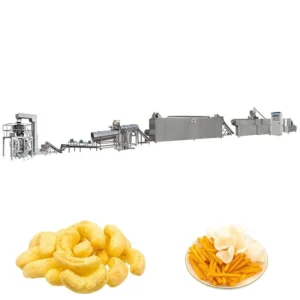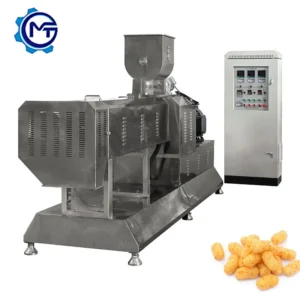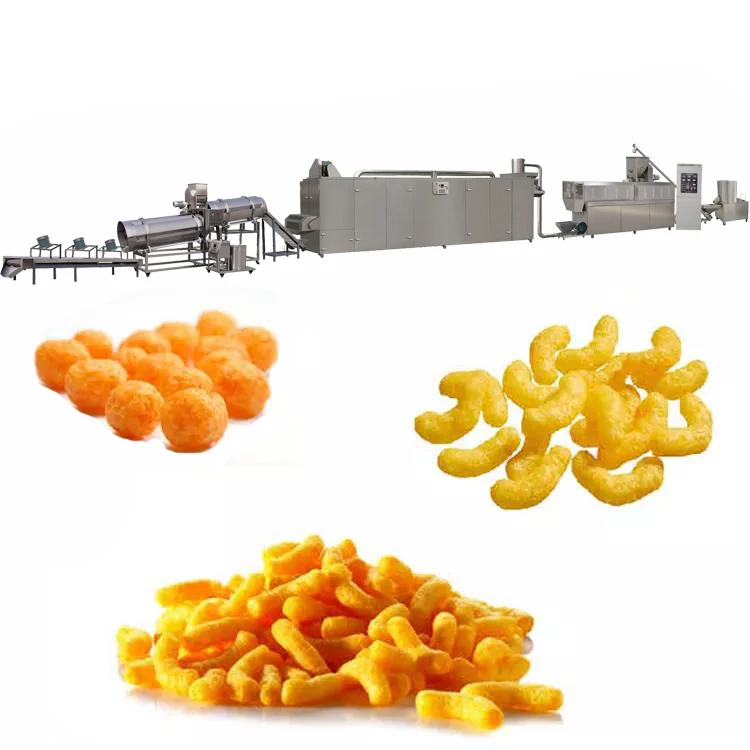
Integrated Equipment Catalogue — every station in the puffed snack food extrusion line full equipment range is specified, matched, and verified under one supplier to eliminate throughput bottlenecks.
Technical Specifications
| Parameter | Value |
|---|---|
| Product Type | Puffed Snack Food Extrusion Line |
| Extruder Type | Twin-screw (double screw) |
| Line Stations | Mixing, extruding, shaping, cutting, drying, flavoring |
| Control System | Automatic (PLC/MCC level to be confirmed per order) |
| Dryer Type | Multi-layer belt dryer (length and layer configurable) |
| Flavoring System | Semi-automatic or automatic options (sugar, oil, powder seasoning) |
| Output Capacity | To be confirmed based on raw material, moisture, and product format |
| Voltage & Frequency | Configurable per target market |
| Screw Configuration | Interchangeable screws and dies for different product shapes |
| Assembly State | Complete line, one-pass operation from mixing to flavoring |
| Warranty | 24 months |
| Customization | Machine custom service and line layout engineering available |
| Certification | CE, ISO |
Application Suitability
| Application | Material or Output |
|---|---|
| Puffed corn snacks | Corn flour, corn grits, maize-based formulations |
| Puffed rice snacks | Rice flour, broken rice, rice-grain blends |
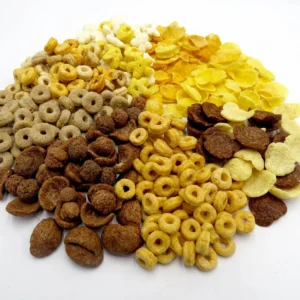
| Extruded snack shapes | Various die-dependent profiles — rings, balls, tubes, stars |
| Coated and seasoned snacks | Sugar-glazed, oil-sprayed, or powder-dusted finished goods |
What Sizing the Extruder Without Sizing the Dryer Really Costs
A puffed snack food extrusion line full equipment range is only as fast as its slowest station, and that station is almost never the extruder itself.
When the extruder pushes product into a dryer that cannot remove moisture quickly enough, material backs up on the belt, residence time stretches, and the line runs below the extruder’s rated throughput. I have watched buyers sign contracts based on extruder output alone, only to discover during commissioning that the dryer was spec’d for a lighter product format. The result is weeks of re-engineering belt speed and temperature zones on-site instead of running production. [NEED_CITE: typical moisture reduction targets for puffed cereal and snack drying stages]
How Each Station in the Line Connects
The twin-screw extruder sits at the center of the puffed snack food extrusion line full equipment range, but its output means nothing if upstream mixing delivers inconsistent moisture or downstream flavoring drums cannot coat at the same rate. The mixing station must achieve uniform hydration across the grain blend before material enters the barrel. Once extruded and cut, the product moves directly onto the multi-layer belt dryer where configurable length and layer count determine how much moisture is removed per pass.
Matching Dryer Capacity to Extruder Throughput
Dryer selection depends on three variables: the moisture content entering the belt, the target moisture at discharge, and the belt speed that keeps product in the heated zone long enough without overcrowding. A multi-layer configuration allows longer effective belt length within a smaller floor footprint, which matters when workshop space is limited. If the dryer is undersized, operators compensate by slowing the extruder — negating the capacity they paid for. [NEED_CITE: multi-layer belt dryer airflow and temperature zone principles]
Screw Configuration and Die Selection for Snack Geometry
Twin-screw extrusion gives processors control over shear, residence time, and melt temperature by rearranging screw elements along the barrel. For puffed corn snacks, a higher-shear configuration promotes starch gelatinization and expansion at the die face. The die plate itself determines cross-section — round, star, tube, or ring — while the cutter downstream sets product length. Interchangeable dies let a single extruder produce multiple snack formats across different production runs without major mechanical changeover.
What Happens When Stations Are Sourced Separately
When the extruder, dryer, and flavoring drum come from different suppliers, nobody owns the throughput match. The extruder vendor quotes a nameplate capacity, the dryer vendor quotes a separate evaporation rate, and the gap between those two numbers surfaces only during installation. This is where a single puffed snack food extrusion line full equipment range from one manufacturer removes the blame-shifting that delays commissioning. [NEED_CITE: risks of multi-vendor line integration in food processing]
Why Buying the Full Catalogue Matters
Every station in the range is documented with a specification sheet that states motor power, screw diameter, dryer belt area, and flavoring drum volume — allowing buyers to cross-check throughput before any metal is cut. The screw and die configuration record is written against the buyer’s actual raw material, not a generic starch blend. Voltage, frequency, and control language are confirmed in the electrical schematic before production begins, so the panel on the factory floor speaks the operator’s language. Line layout and capacity calculation documents show the throughput assumed at each station, making bottlenecks visible on paper rather than during startup.
Documentation & Verification
- Line layout and capacity calculation showing throughput at every station
- Machine specification sheet per unit — extruder, dryer, flavoring drum
- Screw and die configuration record matched to buyer’s raw material
- Electrical schematic with confirmed voltage, frequency, and control language
- Factory test record documenting trial run on buyer’s supplied material
- Operation and maintenance manual with wear parts list
Installation, Commissioning & Support
- Foundation plan sized to the line’s overall footprint and dryer weight
- Dedicated power circuit matching confirmed voltage and frequency per station
- Assembly sequence for multi-layer dryer belt installation and tensioning
- First-run parameter setting for screw speed, barrel temperature zones, and dryer airflow
- Operator training covering die changeover and screw element rearrangement
- Wear parts inventory — screws, dies, dryer belt sections — supplied with initial shipment
What to Share Before Requesting a Quotation
To size a puffed snack food extrusion line full equipment range accurately, start with the raw material — corn flour, rice flour, or a custom grain blend — along with its moisture content and particle size distribution. Confirm the target product shape, finished moisture, and the seasoning type (sugar, oil, or dry powder). Provide workshop dimensions, ceiling height, and the local voltage and frequency standard so that motor and control specifications are locked before the order goes into production.
Frequently Asked Questions
Q: How do I verify that every station can keep up with the extruder?
A: Request the capacity calculation document that lists throughput at mixing, extrusion, drying, and flavoring. Each value should reference a specific raw material and moisture assumption. Compare those figures against your own formulation to confirm no station bottlenecks the line.
Q: How is the dryer matched to the extruder’s output?
A: The multi-layer belt dryer is configured in length and layer count based on the moisture entering the belt and the target discharge moisture. The supplier should provide a specification sheet showing effective drying area and airflow capacity relative to the extruder’s confirmed throughput.
Q: What screw and die options exist for different snack shapes?
A: Interchangeable screw elements adjust shear and gelatinization for different grain formulations. Die plates determine cross-section — rings, balls, tubes, stars — and the downstream cutter sets length. The configuration record documents which elements and dies are recommended for each product format.
Q: What electrical and control options are available?
A: Voltage and frequency are configured per target market. The control system can include PLC or MCC depending on the automation level selected. The electrical schematic confirms all ratings and the control language before production begins, preventing delays during commissioning.
Q: Which wear parts should I stock from the first order?
A: The wear parts list identifies screws, die plates, and dryer belt sections specific to your line configuration. Ordering a first replacement set with the initial shipment avoids production downtime while waiting for international shipping on consumable components.