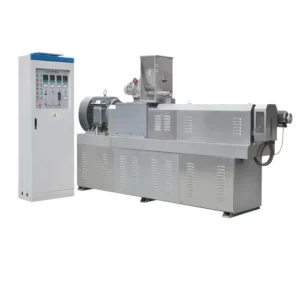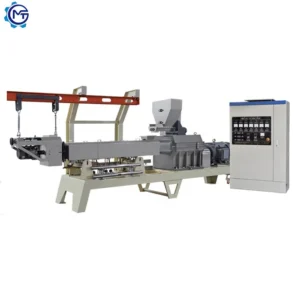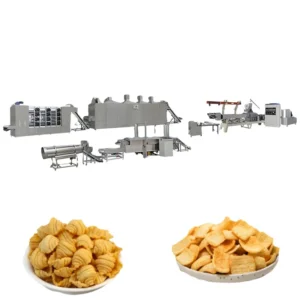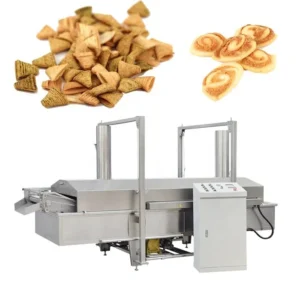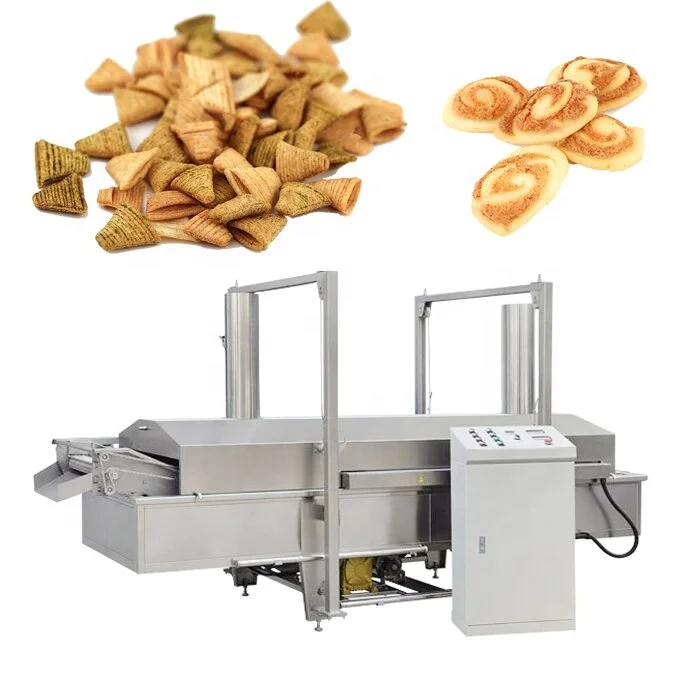
Throughput-Matched Line Design — every station from powder mixing through frying and flavoring is balanced to the same rated output, preventing downstream bottlenecks that generic configurations often create.
Technical Specifications
| Parameter | Value |
|---|---|
| Product Type | Fried Bugles Snack Production Line |
| Model Range | MT65 / MT70 / MT85 / MT75 / MT95 |
| Extruder Type | Double Screw Extruder |
| Installed Power | MT65: 142 kW; MT70: 185 kW; MT85: 240 kW; MT75: 245 kW; MT95: 370 kW |
| Real Power Consumption | MT65: 100 kW; MT70: 130 kW; MT85: 180 kW; MT75: 185 kW; MT95: 280 kW |
| Output Capacity | MT65: 120–150 kg/h; MT70: 200–250 kg/h; MT85: 300–500 kg/h; MT75: 400–500 kg/h; MT95: 800–1000 kg/h (basis not stated in source — confirm raw material and moisture content) |
| Overall Dimensions (L×W×H) | MT65: 22,000×1,200×2,200 mm; MT70: 24,000×1,500×2,400 mm; MT85: 26,000×1,500×2,300 mm; MT75: 26,000×1,500×2,800 mm; MT95: 30,000×1,500×2,800 mm |
| Fryer Temperature Range | 0–260 °C |
| Fryer Capacity | 200–300 kg/h (basis to be confirmed — depends on product type and frying time) |
| Mixer Tank Volume | 150 kg per batch |
| Mixer Rotary Speed | 385 rpm |
| Mixer Mixing Time | 10 min per batch |
| Flavor Line Throughput | 400 kg/h (basis to be confirmed — depends on product type and coating medium) |
| Contact Material | Stainless steel (food-grade contact parts) |
| Warranty | 1 year complete line with lifetime maintenance |
| Standards | CE; ISO |
Application Suitability
| Application Scenario | Typical Raw Material or Output |
|---|---|
| Bugles-style corn chip production | Corn flour, wheat flour blends |
| Tortilla chip and triangle chip lines | Corn masa, wheat flour |
| 3D shaped fried snacks (fish, duck, gourd, Christmas tree) | Rice flour, corn flour, composite cereal blends |
| Rice crust and sala snack manufacturing | Rice flour, starch-based formulations |
| Small fish crisps and golden horn snacks | Wheat flour, corn grits, seasoning premix |
What "Rated kg/h" Actually Means on Your Recipe
Capacity figures only matter when tied to your specific raw material and moisture level.
A fried chips making machine manufacturer may quote a line at a nominal throughput, but that number was likely generated on a standard corn flour recipe at controlled moisture. Switch to a high-protein formulation or a rice-heavy blend, and the extruder barrel pressure changes, the die expansion shifts, and the fryer residence time must be recalculated. I have seen lines lose significant output simply because the buyer’s actual recipe was never tested before the equipment left the factory floor [NEED_CITE: impact of raw material composition on extrusion throughput].
Matching the Extruder to Your Snack Geometry
The double screw extruder in this line is configured with interchangeable dies that determine whether you produce Bugles cones, triangle chips, or 3D shapes like fish and gourd forms. Each die geometry demands a specific screw element arrangement — compression ratio, kneading block placement, and conveying pitch all shift depending on the target shape. Running a Bugles die with a screw profile meant for flat triangles will produce uneven wall thickness and inconsistent oil absorption during frying. A fried chips making machine manufacturer that documents the screw configuration for each product format helps you replicate results across production batches.
Why the Fryer Cannot Be an Afterthought
The continuous fryer operates across a 0–260 °C range and must absorb the full output of the extruder without product backlog. If the fryer belt speed and oil volume are undersized, semi-fried product accumulates on the conveyor, moisture content stays too high, and the flavoring drum receives inconsistent input. Every fried snack production line in this range pairs the fryer capacity with the upstream extruder output to maintain a steady flow from forming through final seasoning [NEED_CITE: continuous frying line throughput balancing principles].
Reading the Power and Dimension Specs
Installed power across the range spans from 142 kW on the MT65 to 370 kW on the MT95, but real consumption sits noticeably lower — between 100 kW and 280 kW — because heating elements and motors cycle rather than run at full draw continuously. The extruder main motor alone on an MT70 configuration pulls 30 kW under load. Overall line length reaches up to 30,000 mm on the largest model, so workshop length, ceiling height, and utility drop locations must be confirmed before foundation work begins. The 150 kg mixer tank cycles every 10 minutes at 385 rpm, which means batching frequency must be coordinated with extruder feed rate to avoid starvation or overflow.
The Hidden Cost of Skipping a Pre-Shipment Trial
When a line ships without a test run on the buyer’s own formulation, the first week of production becomes an expensive experiment. Screw elements get swapped, die openings are re-machined, and fryer temperature profiles are guessed at while raw material is wasted. I worked on a project for a Middle East client where the sample run used standard corn flour, but the client’s recipe had a much higher protein content. The Bugles entered the oil bath and expanded unevenly, cutting effective throughput sharply. That experience reinforced a strict rule: run the buyer’s actual material through the full line — mixer, extruder, fryer, flavor drum — and lock the parameters before the equipment is crated [NEED_CITE: pre-shipment factory acceptance testing for extrusion lines].
Why Sourcing the Full Line from One Supplier Matters
Throughput matching across stations is the core advantage of buying the complete fried chips making machine manufacturer package rather than assembling from separate vendors. When the mixer, extruder, fryer, and flavoring drum come from one source, the capacity calculation accounts for real transfer losses between each stage. The screw and die configuration is specified to your target product shape and raw material before production starts. Electrical schematics are confirmed against your factory voltage and frequency, avoiding commissioning delays. The in-house testing workshop allows a full trial run on your formulation so product texture and density are validated before shipment. And wear parts — screws, dies, fryer belt segments — are catalogued and available from day one rather than back-engineered later.
Documentation & Verification
- Line layout and capacity calculation showing matched throughput from mixer through flavor drum
- Screw and die configuration record mapped to your target snack shape and recipe
- Electrical schematic with voltage, frequency, and control language confirmed for your facility
- Trial run report on your raw material documenting product texture, density, and actual output
- CE declaration of conformity and ISO certificate for customs and regulatory clearance
- Operation and maintenance manual with wear parts list and replacement intervals
Installation, Commissioning & Support
- Overall line length up to 30,000 mm requires confirmed workshop length and utility drop positions before delivery
- Real power draw up to 280 kW demands dedicated circuit sizing and transformer verification at your facility
- Line ships in modular sections; on-site assembly includes conveyor alignment and fryer leveling
- First-run commissioning covers extruder barrel temperature profiling and fryer belt speed calibration
- Operator training addresses screw element changes, die swaps, and fryer oil filtration routines
- Wear parts inventory includes screws, dies, and mixer blades matched to your initial configuration
What to Include in Your Inquiry
To size the correct model and configure the line accurately, share your target product shape and raw material formulation, your expected daily output, and your workshop dimensions including ceiling height. Confirm your local voltage and frequency so the electrical system is built to match. If you have existing upstream or downstream equipment that this line must integrate with, note those connection points as well.
Frequently Asked Questions
Q: How is the stated kg/h output confirmed on my specific raw material and recipe?
A: We run your actual formulation through the extruder and fryer in our testing workshop before shipment. The trial run measures real throughput, product expansion, and texture. Results are documented in a test report, and the screw and die configuration is locked to those parameters so the line performs the same way in your factory.
Q: How are electrical specifications confirmed for my target market before production?
A: During the quotation stage we collect your factory voltage, frequency, and preferred control language. The electrical schematic is then designed to match those requirements. This avoids rewiring or transformer additions after the line arrives and keeps commissioning on schedule.
Q: How is the extruder configured for different snack shapes like Bugles, triangles, or 3D forms?
A: Each shape requires a specific die plate and screw element arrangement. Compression ratio and kneading block positions are adjusted to control dough pressure and expansion at the die face. We document the full configuration so you can switch between formats or reorder wear parts with confidence.
Q: How do you ensure the fryer and flavor line keep pace with the extruder at rated output?
A: The line is designed as a matched system. Fryer belt speed, oil volume, and residence time are calculated against the extruder output. The flavoring drum throughput is sized to receive the full fried product flow. This prevents product backlog or idle time between stations.
Q: Can I send my raw material for a test run before the line ships?
A: Yes. Sending your formulation to our testing workshop is standard procedure. We run the complete sequence — mixing, extrusion, frying, and flavoring — and share the trial report with you. Any adjustments to screw configuration or fryer temperature are made before the equipment is packed for shipment.