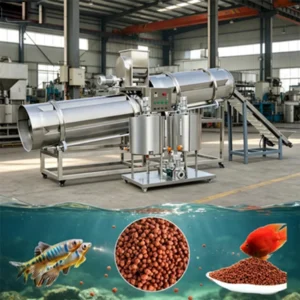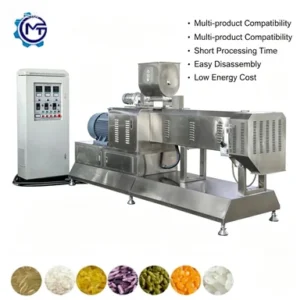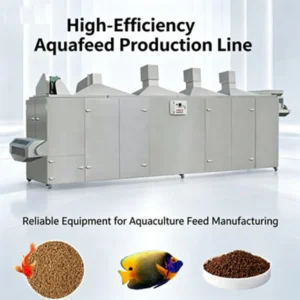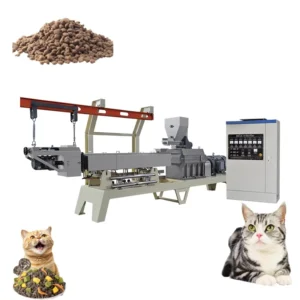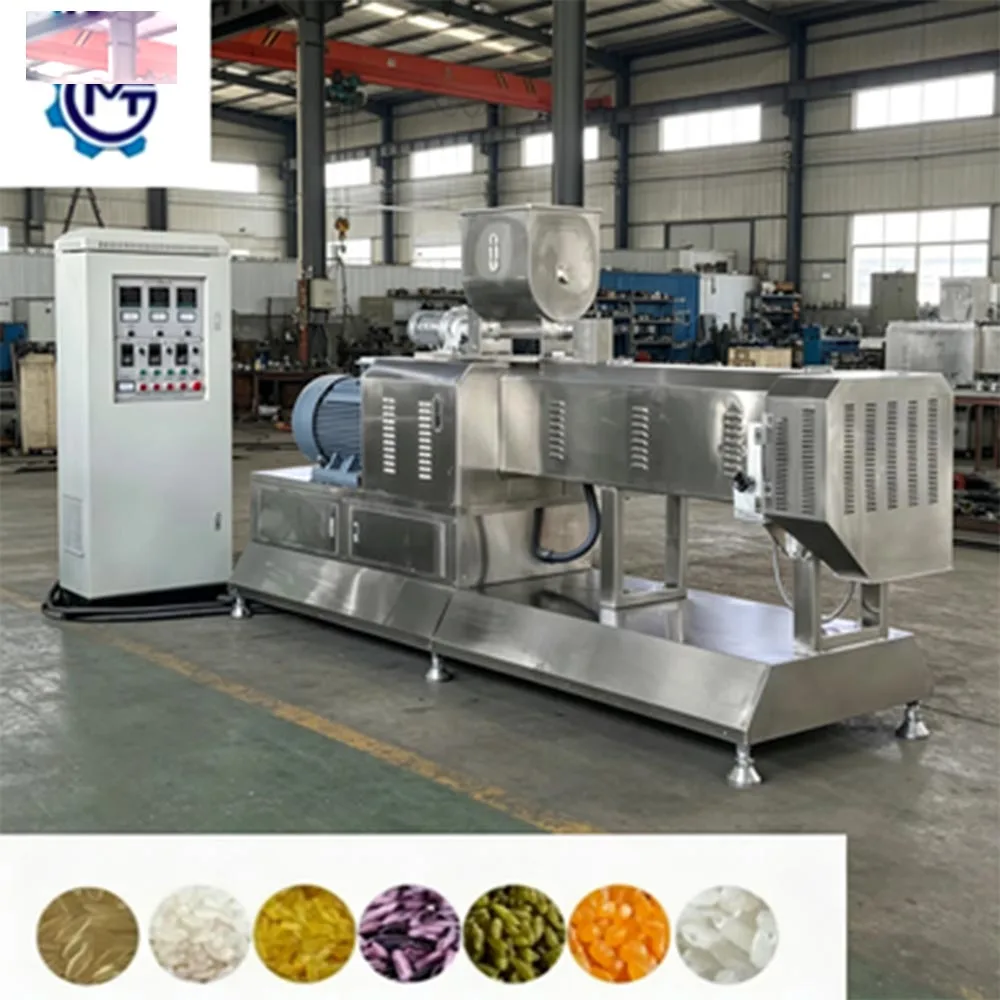
Throughput-Matched Stations — every mixer, extruder, dryer and screen on this aquatic feed line is calculated against the same output target, so no single unit holds back the next.
Technical Specifications
| Parameter | Value |
|---|---|
| Product Type | Twin Screw Fish Feed Extruder Production Line |
| Screw Type | Twin screw |
| Control System | Intelligent PLC automatic control system |
| Contact Material | Food-grade 304 stainless steel |
| Process Capability | High temperature and high pressure full ripening of raw materials |
| Pellet Adjustability | Size, hardness, buoyancy (floating and sinking) |
| Line Stations | Raw material mixer, extruder, dryer, seasoning coating machine, vibrating sieve, conveyor equipment |
| Automation Level | Full continuous automatic production from mixing to finished product discharging |
| Output Capacity | Medium to large scale industrial production (basis not stated in source — confirm raw material formulation, pellet size, and target density) |
| Operating Interface | Humanized operation interface with simple parameter adjustment |
| Maintenance Design | Quick replacement of vulnerable parts, convenient daily cleaning |
| Standards | CE compliant |
Application Suitability
| Application | Material or Output |
|---|---|
| Floating fish feed pellet production | Fish meal, soybean meal, corn powder, compound additives |
| Sinking aquatic feed for bottom-feeding species | High-protein formulations with adjusted starch-to-protein ratios |
| Ornamental fish feed for koi and goldfish | Pigmented compound additives with controlled pellet density |
| Tropical fish feed in small-diameter pellets | Fine-grind soybean meal and corn powder blends |
| Freshwater aquaculture feed at industrial scale | Locally sourced grain and protein meals in bulk formulations |
What "Medium to Large Scale Output" Actually Depends On
Line capacity only holds when the screw configuration and die design match the buyer’s exact raw material formulation and target pellet buoyancy.
I once watched an aquatic feed line stall at half its quoted throughput because the screw profile was set up for a standard corn-heavy mix, while the buyer was running a formulation with a noticeably higher meat-meal share. The extruder could not build enough shear to gelatinise the starch properly, pellet density drifted outside spec, and the downstream dryer could not keep up with the moisture load. The fish feed extruder production line sat idle for days while the screw set was reconfigured and the die geometry was changed. That kind of mismatch does not show up in a brochure capacity figure [NEED_CITE: twin-screw extrusion behaviour across varying protein-to-starch ratios].
Screw Configuration Dictates Pellet Density and Buoyancy
The twin-screw extruder at the heart of this aquatic feed processing equipment for sale is where buoyancy is won or lost. Floating pellets require a screw profile that generates enough shear and residence time to fully expand the starch matrix, trapping microscopic air cells inside each pellet. Sinking pellets need a different compression ratio and die geometry so the starch gelatinises without excessive expansion. Every fish feed extruder production line we ship carries a screw and die configuration record written against the buyer’s specific formulation, not a generic template pulled from another project.
High-Temperature Full Ripening and Surface Finish
Aquatic feed quality hinges on how thoroughly the raw materials are cooked inside the barrel. The high-temperature, high-pressure full ripening process in this twin screw extruder breaks down anti-nutritional factors in soybean meal and gelatinises starch granules uniformly. The result is a pellet with a smooth surface that resists crumbling during transport and holds its shape in water long enough for fish to consume it [NEED_CITE: starch gelatinisation temperature thresholds in twin-screw extrusion]. Inconsistent ripening leaves raw cores inside the pellet, which dissolve too quickly and foul the water in aquaculture ponds.
How Control and Material Choices Affect Daily Operation
The intelligent PLC automatic control system keeps barrel temperature zones, screw speed, and feed rate locked within tight tolerances across every production shift. Operators adjust parameters through a humanized operation interface rather than manually tuning individual heaters and drives. Food-grade 304 stainless steel on all contact surfaces resists the corrosive effect of fish meal salts and moisture, which is critical in humid processing environments where carbon steel would pit within a season. Quick-change vulnerable parts mean that when a screw section or die plate needs replacement, the line is back in production within a maintenance window rather than an extended shutdown.
The Hidden Cost of Unmatched Downstream Equipment
A fish feed extruder production line is only as productive as its weakest station. If the dryer is sized for a lower throughput than the extruder actually delivers, pellets enter the coating drum still carrying excess moisture, and the seasoning layer clumps instead of distributing evenly. I have seen entire batches of floating pellets rejected because the vibrating sieve was too narrow to handle the extruder’s discharge volume, causing a backlog that cooled the pellets below coating temperature. Every station on this aquatic feed processing equipment for sale is throughput-matched during the layout phase, so the mixer, extruder, dryer, coating drum, and sieve all run at the same continuous rate [NEED_CITE: bottleneck analysis in continuous feed processing lines].
Why This Line Stands Up to Real-World Audits
Every throughput calculation starts from the buyer’s raw material sample, not a generic capacity chart. The screw configuration and die design are specified to achieve the exact floating or sinking density the market requires, then validated in an in-house testing workshop before the line leaves the factory. All contact parts are food-grade 304 stainless steel, documented in the material certificates that ship with the machine. The PLC control system is configured to the buyer’s local voltage, frequency, and language preference before production begins, so commissioning is a matter of fine-tuning rather than rewiring.
Documentation & Verification
- Line layout and capacity calculation showing throughput matching across every station
- Screw and die configuration record written against your raw material formulation
- Trial run report on your actual raw material completed in the testing workshop before shipment
- Electrical schematic with confirmed voltage, frequency, and PLC language for your market
- CE declaration of conformity and ISO certificate included in the shipping documentation package
- Wear parts list with reorder codes for screws, dies, and seals
Installation, Commissioning & Support
- Foundation plan provided based on the full line footprint including mixer, extruder, dryer, and conveyor layout
- Dedicated power circuit specification matched to the PLC-controlled extruder motor and heater loads
- Equipment arrives in sectional modules for assembly inside facilities with limited door clearance
- First-run commissioning includes barrel temperature profiling and screw speed calibration on your raw material
- Operator training covers PLC parameter adjustment, daily cleaning routines, and vulnerable-part replacement
- Spare screw sections, die plates, and seals shipped with the line to cover the initial maintenance cycle
Before You Request a Quote
To size a fish feed extruder production line correctly, we need your raw material formulation with approximate protein, starch, and moisture percentages, plus the pellet diameter range and target buoyancy — floating, sinking, or slow-sinking. Share your workshop floor dimensions and ceiling height so the layout can account for dryer length and conveyor routing. Confirm your local voltage and frequency, and whether the PLC interface should run in English or another language.
Frequently Asked Questions
Q: How is line capacity verified before shipment?
A: Capacity is verified through a trial run on your actual raw material in our in-house testing workshop. We record throughput, pellet density, moisture content after drying, and surface quality, then compile a trial run report. The screw and die configuration used during the test is the same one installed on your production line.
Q: How do you match screw configuration to floating or sinking pellet requirements?
A: Floating pellets need a screw profile that maximises starch expansion and traps air cells, while sinking pellets require higher compression and a different die geometry. We adjust screw element arrangement, pitch, and die opening based on your formulation’s protein-to-starch ratio and confirm buoyancy during the pre-shipment trial run.
Q: What electrical and control details are confirmed before production starts?
A: We confirm your site voltage, frequency, and plug standard, then configure the PLC system and motor drives accordingly. The operating language on the humanized interface is set to your preference. An electrical schematic and voltage confirmation sheet are included in the documentation package shipped with the line.
Q: What does the pre-shipment trial run report cover?
A: The report documents the raw material batch used, screw and die configuration, barrel temperature profile, extruder screw speed, pellet dimensions, density and buoyancy test results, dryer outlet moisture, and coating uniformity. It serves as the baseline for your first production runs after installation.
Q: Which spare wear parts come with the line and how are replacements handled?
A: The line ships with a set of spare screw elements, die plates, and barrel liners sized for the initial maintenance cycle. A wear parts list with reorder codes is included in the documentation. Replacement lead times depend on configuration complexity and are confirmed at the time of order.