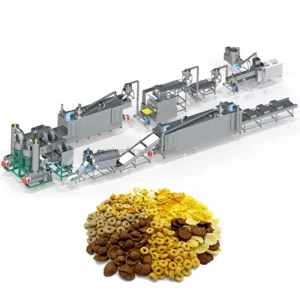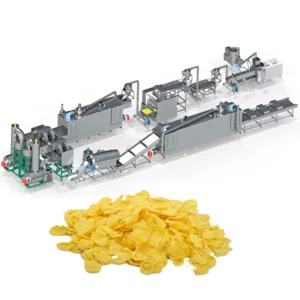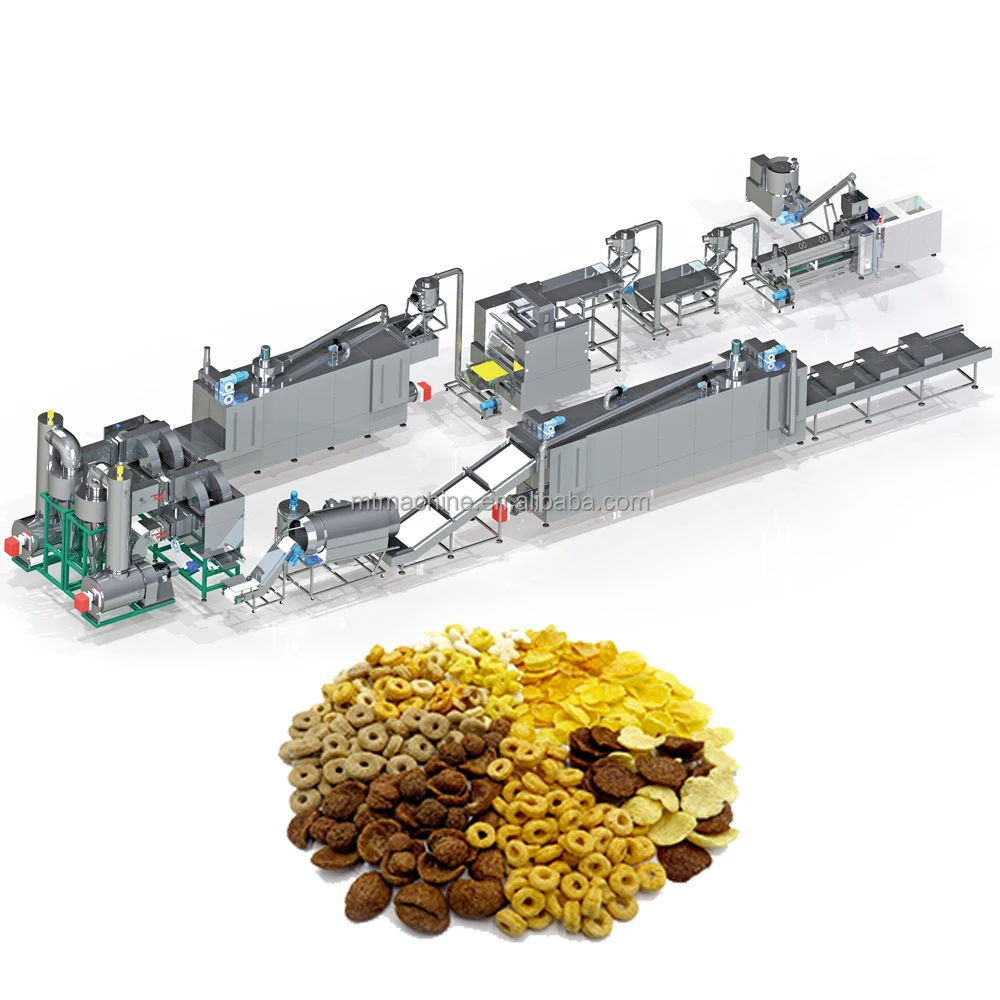
Screw and die design matched to raw material — every MT-75 corn flakes line ships with a screw configuration record and trial run report on your specific grain blend, so expansion and density are verified before the extruder leaves the factory.
Technical Specifications
| Parameter | Value |
|---|---|
| Model | MT-75 |
| Product Type | Corn Flakes Breakfast Cereal Production Line |
| Screw Type | Twin-screw |
| Rated Capacity | 200–300 kg/hr (basis not stated in source — confirm raw material and moisture content) |
| Voltage | 220V / 380V (configurable to site requirement) |
| Control System | PLC with infrared sensor temperature control |
| Flaking Machinery | Double-motor separate roller drive; hydraulic system for double rollers |
| Hot Air Roasting Oven | Dual circulating fans; cyclone dust removal; conciliation burner combustion chamber |
| Coating System | Double tumble sugar melting; elevator; dedicated spraying nozzle |
| Heating Source (Dryer) | Gas or Electric |
| Core Components | Gearbox |
| Assembly State | Complete line: Mixing → Extruding → Flaking → Drying → Hot Air Roasting → Sugar Coating → Cooling → Packing |
| Standards | CE, ISO |
| Warranty | 1 Year (including core components) |
| Machinery Test Report | Provided |
| Video Outgoing-Inspection | Provided |
Application Suitability
| Application | Material or Output |
|---|---|
| Traditional corn flakes | Maize grits, plain or sugar-coated |
| Multi-grain breakfast flakes | Rice, wheat, oat, barley blends |
| Fortified cereal flakes | Grain base with added vitamin and mineral premix |
| Snack flakes | Sweet or savoury coated flaked cereal for retail snack packing |
Why "Rated Capacity" Means Nothing Without the Rest of the Line
A corn flakes production line full equipment range is only as fast as its slowest station.
I have seen buyers receive an extruder rated for a certain output, only to discover the dryer cannot keep up, forcing the entire corn flakes production line full equipment range to idle while moisture drops to target levels. The flaker sits unused, the roaster cools down, and the promised throughput disappears into a queue of half-dried product on the cooling belt. This mismatch rarely shows up in a brochure — it reveals itself on the first day of commissioning, when the buyer is already committed. [NEED_CITE: common causes of throughput bottlenecks in cereal extrusion lines]
How Each Station Connects to the Next
The MT-75 twin-screw extruder cooks and forms the grain dough under controlled shear and temperature. From there, the product moves to the flaking machinery, where the hydraulic double-roller system presses each pellet into a uniform flake. Double motors drive the rollers independently, so speed differential can be adjusted to control flake thickness. The PLC tracks roller gap and motor load in real time, keeping flake geometry consistent across the full batch.
What the Hot Air Roasting Oven Actually Does
Flaking gives the cereal its shape, but roasting gives it the snap. The oven uses a vibrating pan to move flakes through a high-temperature zone while two separate circulating fans push heated air across the product bed. A conciliation burner in the combustion chamber modulates heat output so that temperature holds steady even when product load varies. The cyclone dust removal device pulls fines out of the air stream before they can recirculate and scorch onto the flake surface. This level of air management is what separates a flake that stays crisp in the bowl from one that goes soggy within minutes. [NEED_CITE: role of air circulation uniformity in breakfast cereal roasting]
Reading the Specs That Actually Matter
The twin-screw design of the MT-75 matters because corn flakes require a specific degree of starch gelatinisation that single-screw extruders struggle to hold across varying grain moisture levels. The PLC-controlled flaking station with infrared sensor temperature control ensures the pipe heating is even, so flakes do not stick or tear as they pass through the rollers. Voltage configurability between 220V and 380V is not a trivial detail — buyers targeting markets with 60 Hz power grids need motor winding and VFD settings confirmed before the gearbox is assembled. The option for gas or electric heating on the dryer lets the line adapt to local energy costs, which can differ significantly between regions.
The Hidden Cost of a Mismatched Coating Station
When the sugar coating drum is sized for a lower throughput than the extruder, the line must either slow down or skip coating entirely for part of the batch. I have watched producers run plain flakes through the packing station because the tumble melter could not dissolve sugar fast enough to feed the spraying nozzle. The result is two separate SKUs from a line that was supposed to produce one, with changeover downtime eating into the shift. This is why the coating system on this line includes a dedicated elevator and double tumble melter — to hold melting capacity in step with extruder output. [NEED_CITE: coating station sizing relative to extruder throughput in cereal lines]
Why Source the Full Range From One Supplier
Every station on this corn flakes line is engineered so that conveyor speed, dryer residence time, and roaster pan vibration frequency all reference the same throughput target. The screw configuration and die design are documented against the buyer’s raw material before the extruder enters production. An in-house testing workshop runs trial batches on customer-supplied grain, generating a test report that confirms flake density and expansion before the line ships. Electrical schematics, voltage confirmation, and control language are locked in during the specification stage, not discovered during installation. CE and ISO documentation accompanies every shipment, supporting customs clearance and local regulatory registration.
Documentation & Verification
- Line layout and capacity calculation showing throughput matched across mixer, extruder, flaker, dryer, roaster, coater and packer
- Screw and die configuration record tied to your grain blend and target flake density
- Electrical schematic with confirmed voltage, frequency and PLC language before production starts
- Trial run report from the in-house testing workshop on your raw material before dispatch
- CE declaration of conformity and ISO certificate included with customs documentation
- Operation and maintenance manual with wear parts list for screws, dies and flaking rollers
Installation, Commissioning & Support
- Foundation plan based on the MT-75 line footprint, covering load-bearing requirements for the extruder gearbox and flaking machinery
- Dedicated power circuit sized to the confirmed voltage and total connected load of all stations
- Assembly sequencing from mixing station through packing, with station-by-station alignment checks
- First-run parameter setting on the PLC for barrel temperature profile, roller gap and roaster fan speed
- Operator training covering screw wear monitoring, hydraulic roller adjustment and sugar coating changeover
- Wear parts list identifying screws, dies and flaking rollers with recommended replacement intervals
What to Prepare Before Requesting a Quote
To size a corn flakes production line full equipment range correctly, share the specific grain or grain blend you plan to run, the target flake thickness, and whether sugar coating is required. Include your facility voltage and frequency, the available floor space with ceiling height, and the language preference for the PLC interface. If you have upstream milling or downstream packing equipment already installed, provide those specifications so the line can be configured to integrate.
Frequently Asked Questions
Q: How is the output capacity of each station verified against my raw material?
A: The in-house testing workshop runs a trial on your actual grain blend before the line ships. Extruder output, flaker throughput and dryer residence time are all measured during this run, and the results are documented in a trial run report that accompanies the shipment.
Q: What voltage, frequency and control language options are available for my target market?
A: The line is configurable for 220V or 380V supply, and motor windings and VFD parameters are set accordingly during assembly. PLC language is confirmed at the specification stage so that the operator interface matches your team’s preference before commissioning begins.
Q: How do I ensure the extruder, flaker and dryer are correctly sized to avoid line bottlenecks?
A: Request the line layout and capacity calculation document, which maps throughput at every station against a single production target. This calculation accounts for moisture reduction in the dryer and residence time in the roaster, not just extruder output.
Q: Can the line produce both plain and sugar-coated corn flakes with the same equipment set?
A: Yes. The coating system can be bypassed when plain flakes are required, and the double tumble melter and spraying nozzle are engaged only for coated runs. Changeover involves clearing the sugar line and adjusting the PLC recipe, without mechanical modifications.
Q: What spare wear parts are included and what is the replacement lead time?
A: The shipment includes a wear parts list identifying screws, dies and flaking rollers as the primary consumables. Initial spare sets are quoted with the line, and replacement lead times are confirmed during the specification stage based on your production schedule.