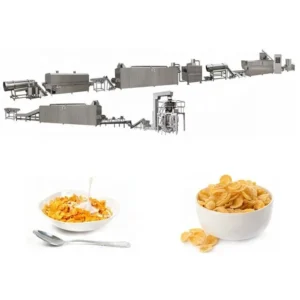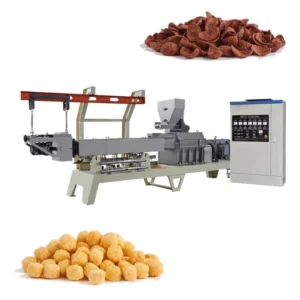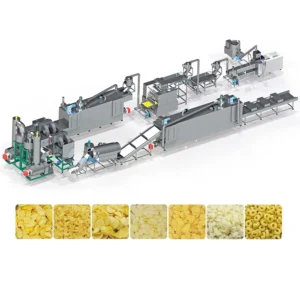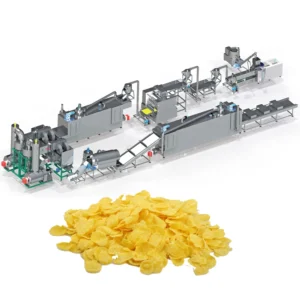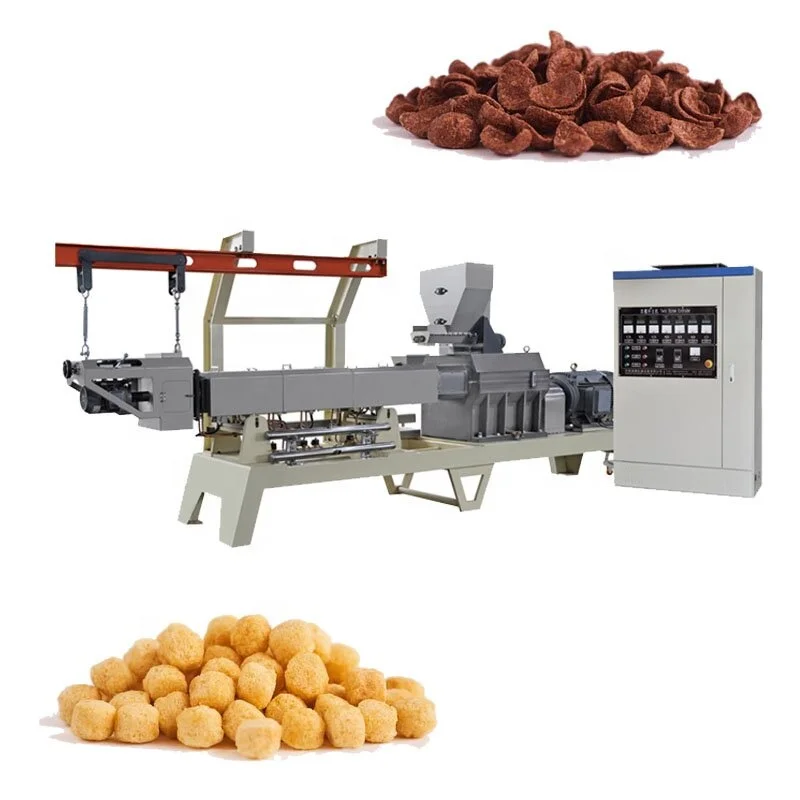
Integrated Line Stations — Every unit from mixing through packing is sized to match throughput, preventing bottlenecks across the full corn flakes process.
Technical Specifications
| Parameter | Value |
|---|---|
| Model | MT70 / MT85 / MT75 |
| Product Type | Corn Flakes Production Line |
| Screw Type | Twin-screw |
| Output Capacity | 150–200 kg/h (basis not stated in source — confirm raw material type, moisture content and product format) |
| Installed Power | 160 kW (MT70) / 190 kW (MT85) / 210 kW (MT75) |
| Power Consumption | 120 kW (MT70) / 140 kW (MT85) / 150 kW (MT75) |
| Overall Dimensions | 41 × 1.5 × 2.2 m (MT70) / 43 × 1.5 × 3.2 m (MT85) / 45 × 1.5 × 3.5 m (MT75) |
| Control System | PLC and MCC |
| Flaking Machine | Hydraulic double rollers, independent motor drives, infrared temperature control |
| Dryer Heating Source | Gas or electric |
| Roasting Oven | Vibrating pan, dual circulating fans, cyclone dust removal |
| Coating System | Double tumble sugar melting, elevator, coating drum, spraying nozzle |
| Extruder Screw Feature | Automatic lubricating and cooling |
| Final Product Shapes | Ball, tube, stick, ring, fruit loop, star, wheel, flower, heart |
| Raw Materials | Corn, rice, wheat, oat, barley powder |
| Certification | CE, ISO |
Application Suitability
| Application | Material or Output |
|---|---|
| Natural corn flakes production | Corn grits and corn flour at controlled moisture |
| Sugar-coated breakfast cereal | Corn, rice, or wheat base with sugar spray coating |
| Multi-grain cereal formats | Blends of oat, barley, and wheat powder |
| Shaped cereal snacks | Fruit loops, stars, rings via adjustable extruder die |
| Fortified breakfast cereal | Grain powder with added nutritional premix |
Why "Rated Capacity" Means Nothing Without the Full Line Context
A breakfast cereal production line equipment setup only delivers its stated output when every station is matched.
I once saw a producer install a high-output extruder and then feed it into an undersized dryer. The extruder ran fine for twenty minutes, then wet product piled up on the dryer belt and the whole line shut down. The rated throughput of the extruder became irrelevant because the downstream equipment could not keep pace. [NEED_CITE: line throughput balancing principles in food extrusion]
When buyers request a breakfast cereal production line equipment quotation, the first question should not be about the extruder alone. It should be about the dryer belt length, the flaking machine roller width, and the roasting oven residence time. If those stations are sized for a lower tonnage than the extruder, the line will never reach its nameplate number regardless of how well the extruder performs.
How Each Station Feeds the Next
A corn flakes line moves through mixing, extruding, flaking, drying, hot air roasting, optional sugar coating, cooling, and packing. The twin-screw extruder cooks and shapes the dough, but the extrudate arrives at the flaking machine hot and plastic. If the hydraulic double-roller flaking unit cannot accept the extruder discharge rate, material backs up and cools before pressing, resulting in uneven flake thickness. Every station in this breakfast cereal production line equipment catalogue is specified so that discharge from one unit aligns with the intake capacity of the next.
Matching Dryer and Roaster to Extruder Output
The dryer must remove moisture from pressed flakes before roasting, and the roasting oven uses a vibrating pan with dual circulating fans to achieve even surface blistering. If the dryer is too short for the volume coming off the flaking machine, flakes enter the roaster with excess moisture and scorch rather than puff. The cyclone dust removal on the roaster keeps fines from recirculating, but it only works correctly when the feed rate matches the oven design. [NEED_CITE: moisture reduction targets in flaked cereal drying]
Reading the Power and Dimension Data
Installed power ranges from 160 kW on the MT70 to 210 kW on the MT75, with actual consumption roughly 75% of installed capacity. The line footprint stretches 41 to 45 metres in length, so buyers need a clear workshop layout before committing to a model. The PLC and MCC control system integrates across stations, meaning a fault on the coating drum registers on the main panel and pauses upstream feed rather than letting product pile up. Twin-screw extrusion relies on precise barrel temperature zones and screw speed to control starch gelatinisation, and the automatic lubricating and cooling function on the screw assembly keeps the extruder running through long shifts without manual greasing interruptions.
What Happens When Stations Are Mismatched
A flaking machine set too slow produces thick flakes that do not toast evenly in the roasting oven. A coating drum running faster than the cooling conveyor can accept dumps warm, sticky flakes into the packing hopper where they clump. I have walked into factories where the extruder was running at half speed because the operator learned that pushing it harder just created a jam two stations down. These are not equipment failures — they are configuration errors that surface after installation when the line is supposed to be earning revenue. [NEED_CITE: common line imbalance symptoms in cereal manufacturing]
What This Equipment Range Covers Under One Source
The twin-screw extruder, hydraulic flaking machine, dryer, vibrating roasting oven, and double-tumble coating system are all available from a single equipment catalogue rather than assembled from separate vendors. Throughput calculations are done across the full line during the layout stage, not station by station in isolation. Screw configuration and die design are matched to the buyer’s actual grain blend and target flake texture. An in-house testing workshop allows trial runs on the buyer’s raw material before any unit ships. Documentation includes line layout drawings, capacity calculations, electrical schematics, and screw configuration records specific to the order.
Documentation & Verification
- Line layout and capacity calculation matched to your grain blend and target flake format
- Screw and die configuration record specifying barrel zones for your raw material moisture
- Electrical schematic with voltage and frequency confirmed for your facility
- Factory test record from trial run on your supplied raw material before dispatch
- Operation and maintenance manual covering all stations from mixer to packing conveyor
- CE declaration of conformity and ISO certificate included with shipment
Installation, Commissioning & Support
- Floor plan review for the 41–45 m line length and 1.5 m width clearance per station
- Dedicated power circuit sizing based on 160–210 kW installed load depending on model selected
- PLC and MCC panel configured to local voltage, frequency, and operator language before shipping
- On-site commissioning covering extruder barrel temperature profile and flaking roller gap setting
- Operator training on screw lubrication intervals and hydraulic flaking pressure adjustment
- Wear parts list with first-replacement screws, dies, and roller sleeves identified before startup
What to Share Before Requesting a Quote
Send the specific grain types and any blend ratios you plan to run, along with the moisture content of your raw material as received. Confirm your workshop length, ceiling height, and available voltage and frequency so the line layout and electrical schematics match your site. Let us know whether you need the sugar coating station or only natural flake output, and specify the target flake size and final packaging format.
Frequently Asked Questions
Q: How is output capacity verified across each station to avoid line bottlenecks?
A: Each station — extruder, flaking machine, dryer, roasting oven, coating drum — is calculated against the extruder discharge rate for your specific raw material and moisture level. The line layout document shows throughput at every transfer point so no single unit restricts flow. Trial runs in the testing workshop confirm actual rates before shipment.
Q: What supporting equipment matches each extruder model?
A: The MT70, MT85, and MT75 extruders each pair with a dryer, flaking machine, and roasting oven sized to their respective output ranges. Hydraulic roller width, dryer belt length, and roaster pan area are scaled accordingly. The quotation specifies which supporting units correspond to the extruder model selected.
Q: Which raw material types and moisture levels are compatible with the twin-screw extruder?
A: Corn, rice, wheat, oat, and barley powder are all processed on this twin-screw platform. The screw configuration and barrel temperature profile are adjusted to the specific grain and its incoming moisture content. A trial run on your actual raw material confirms the correct setup before the line ships.
Q: How are voltage, frequency, and control language confirmed before commissioning?
A: The electrical schematic and PLC configuration are finalised during the pre-sales stage based on your site supply details. The MCC panel, motor ratings, and control interface language are set before factory testing so that commissioning on arrival addresses process parameters rather than electrical mismatches.
Q: What spare wear parts are available for first replacement?
A: The wear parts list included with documentation identifies screws, dies, flaking roller sleeves, and spraying nozzles as primary consumables. Quantities for a first replacement cycle are specified so buyers can order spares alongside the initial line or before the first scheduled maintenance window.