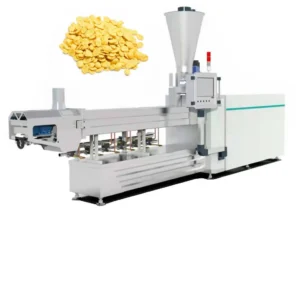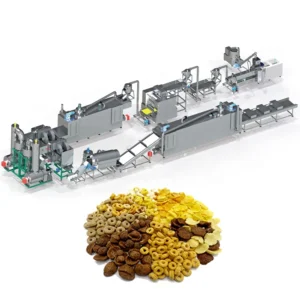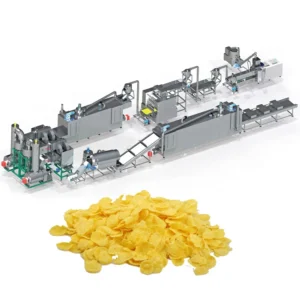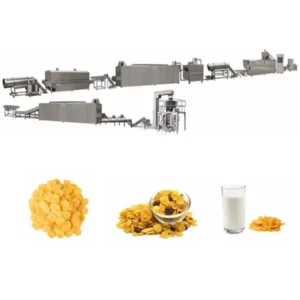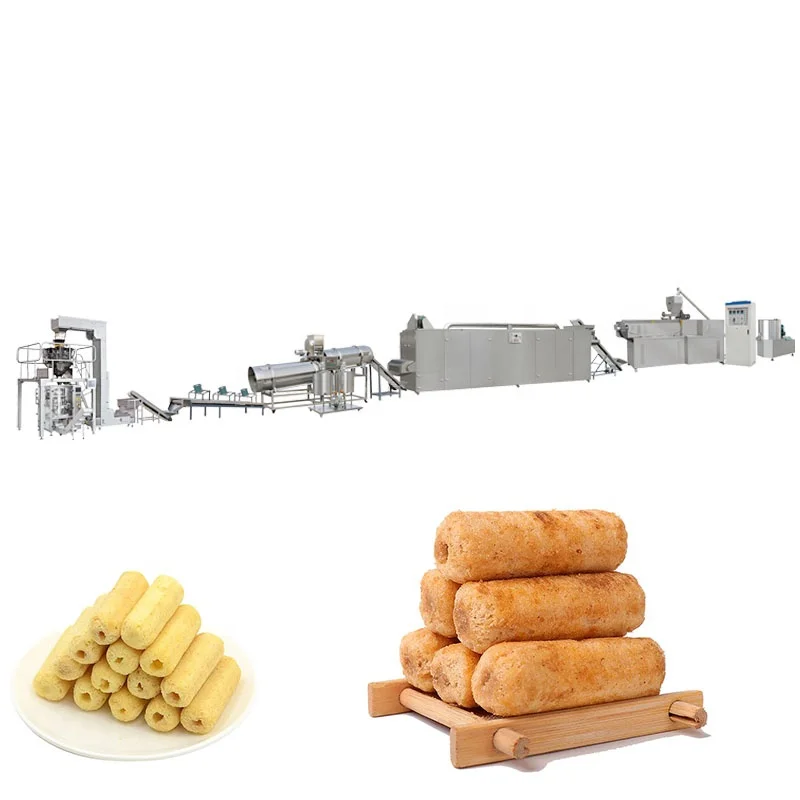
Throughput-Matched Stations — Every unit in this breakfast cereal extruder machine for sale line is sized to the extruder model you choose, so dryer, flaker and roaster capacities align rather than bottleneck.
Technical Specifications
| Parameter | Value |
|---|---|
| Model | MT70 / MT85 / MT75 |
| Product Type | Corn Flakes Processing Line / Breakfast Cereal Extruder Line |
| Extruder Type | Twin Screw Extruder |
| MT70 Installed Power | 160 kW |
| MT70 Power Consumption | 120 kW |
| MT70 Capacity | 150–200 kg/hr (basis to be confirmed) |
| MT70 Overall Dimensions | 41 × 1.5 × 2.2 m |
| MT85 Installed Power | 190 kW |
| MT85 Power Consumption | 140 kW |
| MT85 Capacity | 300–400 kg/hr (basis to be confirmed) |
| MT85 Overall Dimensions | 43 × 1.5 × 3.2 m |
| MT75 Installed Power | 210 kW |
| MT75 Power Consumption | 150 kW |
| MT75 Capacity | 300–500 kg/hr (basis to be confirmed) |
| MT75 Overall Dimensions | 45 × 1.5 × 3.5 m |
| Control System | PLC control (flaking machinery); automatic lubricating and cooling system (extruder) |
| Flaking Machinery Drive | Double motors for separate roller driving; hydraulic system for double rollers |
| Flaking Temperature Control | Infrared sensor for even temperature pipe control |
| Dryer Heating Source | Gas or Electric |
| Roasting Oven | Hot air roasting with vibrating pan, conciliation burner, dual circulating fans, cyclone dust removal |
| Coating System | Double tumble sugar melter, elevator, coating drum, spraying nozzle |
| Raw Materials | Corn, rice, wheat, oat, barley powder |
| Final Product Shapes | Ball, tube, stick, ring, fruit loop, star, wheel, flower, heart |
| Voltage & Frequency | Customized to customer’s local voltage |
| Standards | CE, ISO |
Application Suitability
| Application | Material or Output |
|---|---|
| Natural corn flakes | Corn grits, corn flour |
| Sugar-coated corn flakes | Corn base with sugar glaze |
| Shaped breakfast cereals | Rice, wheat, oat, barley powder blends |
| Snack-format cereals | Fruit loops, rings, stars, balls via die change |
Why a Corn Flakes Machine Full Equipment Range Must Be Sized as One System
A flaker or roaster undersized for the extruder output turns a rated line into a partial-capacity line.
When buyers source a breakfast cereal extruder machine for sale from one vendor and the dryer from another, the gap between stations rarely shows up on paper. The extruder pushes material faster than the flaker can flatten it, or the roaster cannot hold temperature across a heavier load. I have walked through facilities where the extruder ran at half speed just to keep the downstream stations from jamming. The whole line节拍 drops, and the buyer assumes the extruder was overrated. [NEED_CITE: throughput matching between extrusion and downstream thermal stations]
How Each Station Connects to the Extruder
The corn flakes machine full equipment range starts with the twin-screw extruder, where raw cereal powder is mixed, cooked and forced through a die. From there, the extrudate moves to the flaking machinery, where hydraulic double rollers flatten each pellet under PLC-controlled pressure. The flaker runs on separate motors per roller, which prevents uneven sheet thickness when the material density shifts between corn, rice and oat blends.
Downstream, the dryer removes surface moisture before the product enters the hot air roasting oven. This oven uses a conciliation burner with two circulating fans and a cyclone dust removal device to hold a consistent roasting temperature across the vibrating pan. If the dryer is too small for the extruder output, flakes enter the roaster wet and scorch on the outside while staying soft inside — a defect that only appears after packing.
Natural vs. Sugar-Coated Line Configurations
A natural corn flakes line follows a shorter path: mixing, extruding, flaking, drying, hot air roasting, cooling and packing. The sugar-coated variant inserts a coating system after roasting — a double tumble sugar melter feeds syrup through a spraying nozzle into the coating drum, followed by a second drying stage before cooling.
The coating drum must handle the full extruder throughput without creating a surge pile. When I first configured a sugar-coated line, the coating drum was sized for a lower output and the sugar crystallized unevenly on the flakes that sat too long in the tumbler. We resized the drum and adjusted the elevator feed rate, and the glaze consistency matched the market spec the buyer needed. [NEED_CITE: sugar coating drum residence time and glaze uniformity]
Reading the Power and Dimension Data
The MT70 draws 160 kW installed and 120 kW in operation, with a footprint of 41 × 1.5 × 2.2 m. The MT85 steps up to 190 kW installed across 43 × 1.5 × 3.2 m, and the MT75 reaches 210 kW installed over 45 × 1.5 × 3.5 m. These dimensions reflect the full line length, not just the extruder — a critical detail for factory planners mapping utility drops and floor space.
The flaking machinery relies on infrared sensors for temperature pipe control, which keeps the roller surface even across long production runs. The roasting oven’s dual circulating fans and cyclone dust removal address both heat distribution and particulate management, two factors that affect food safety audits in breakfast cereal plants. Screw material uses wear-resistant treatment, which matters when running abrasive corn grits for extended shifts without scheduled screw changes.
The Cost of Mismatched Stations Downstream
An extruder that produces material faster than the dryer can handle forces the operator to slow the entire line. The roaster then runs below its designed load, temperature fluctuates, and the final moisture content drifts outside specification. Flakes that should be crisp arrive at packing with a chewy center, and the buyer blames the extruder when the real issue is a dryer two sizes too small. [NEED_CITE: moisture drift in cereal roasting when upstream throughput exceeds dryer capacity]
When the flaker rollers are not matched to the extruder die output, pellets stack on the belt and feed into the rollers at inconsistent intervals. This causes uneven sheet thickness — some flakes too thin to survive packing, others too thick to toast properly in the consumer’s bowl. These defects do not appear during a short factory acceptance test but emerge after the first full shift of continuous production.
Why Source the Full Range From One Manufacturer
Screw configuration and die design are specified to the buyer’s raw material and target product shape, not copied from a generic build. When you send us your corn or oat flour, we run it through the twin-screw extruder in our testing workshop and document the results before the line is finalized.
Every station — mixer, extruder, flaker, dryer, roaster, coater, cooler, packer — is selected so throughput matches across the chain. The line layout and capacity calculation document shows exactly how each station relates to the extruder model you chose. PLC and MCC control are configured to your local voltage and preferred language before production begins. The flaking machinery, roasting oven and coating system are all part of the same equipment range, so warranty and spare parts come through one channel.
Documentation & Verification
- Line layout and capacity calculation showing throughput matching for your chosen extruder model
- Screw and die configuration record matched to your corn, rice or oat raw material
- Electrical schematic with voltage and frequency confirmed before production starts
- Trial run report from testing workshop using your actual cereal powder
- Operation and maintenance manual covering extruder, flaker, roaster and coater
- Wear parts list with recommended first-order spares for screws, dies and flaker rollers
Installation, Commissioning & Support
- Floor plan review against MT70/MT85/MT75 dimensions (up to 45 m line length) before foundation work
- Dedicated power circuit sized to extruder installed power (up to 210 kW for MT75)
- PLC control language and HMI labels set to operator preference before dispatch
- First-run parameter logging for barrel temperature, roller pressure and roaster airflow
- Operator training covering die changes for all nine product shapes
- Spare screw and die sets identified and quoted alongside initial order
What to Include With Your Inquiry
To configure a breakfast cereal extruder machine for sale that fits your facility, share your target cereal type (natural or sugar-coated), raw material specification including particle size, daily output target and available floor space. Include your local voltage and frequency, preferred control language, and whether you can send a raw material sample for a pre-shipment trial run.
Frequently Asked Questions
Q: How is each station sized to match the selected extruder model?
A: Each dryer, flaker, roaster and coater is selected based on the throughput of the MT70, MT85 or MT75 you choose. We provide a line layout and capacity calculation document that shows the rated flow between every station, so no single unit becomes a bottleneck during continuous production.
Q: What is the difference between the natural and sugar-coated corn flakes line?
A: The natural line runs through mixing, extruding, flaking, drying, roasting, cooling and packing. The sugar-coated version adds a double tumble sugar melter, coating drum with spraying nozzle, and a second drying stage after coating. This extends the line footprint and adds utility requirements for the sugar melting station.
Q: Which voltage and control configurations are confirmed before production?
A: Voltage, frequency and control language are confirmed during the specification stage. The PLC system on the flaking machinery and the extruder control panel are configured to your local electrical standards and operator language before assembly begins, preventing commissioning delays on site.
Q: Can the same extruder produce multiple breakfast cereal shapes?
A: Yes. The twin-screw extruder supports ball, tube, stick, ring, fruit loop, star, wheel, flower and heart shapes through die changes. The screw configuration may also be adjusted for different raw materials like rice or oat powder to maintain proper expansion and texture across shapes.
Q: What spare wear parts should be ordered with the line?
A: We recommend including a first-order set of replacement screws, dies and flaker roller surfaces. The wear parts list provided with your documentation identifies each component by part number, so reordering does not require on-site measurement or reverse engineering after the line is installed.