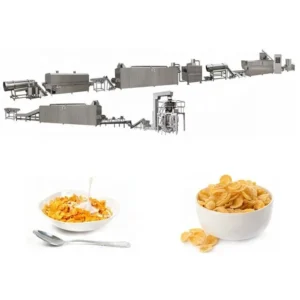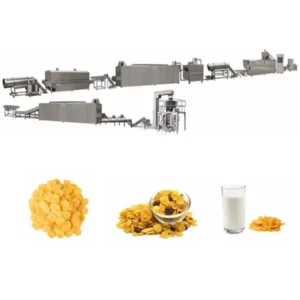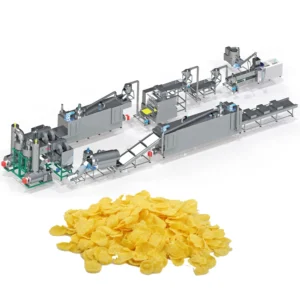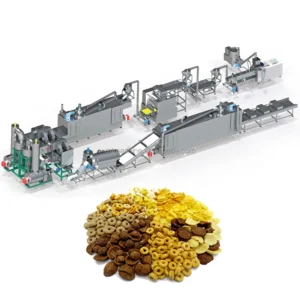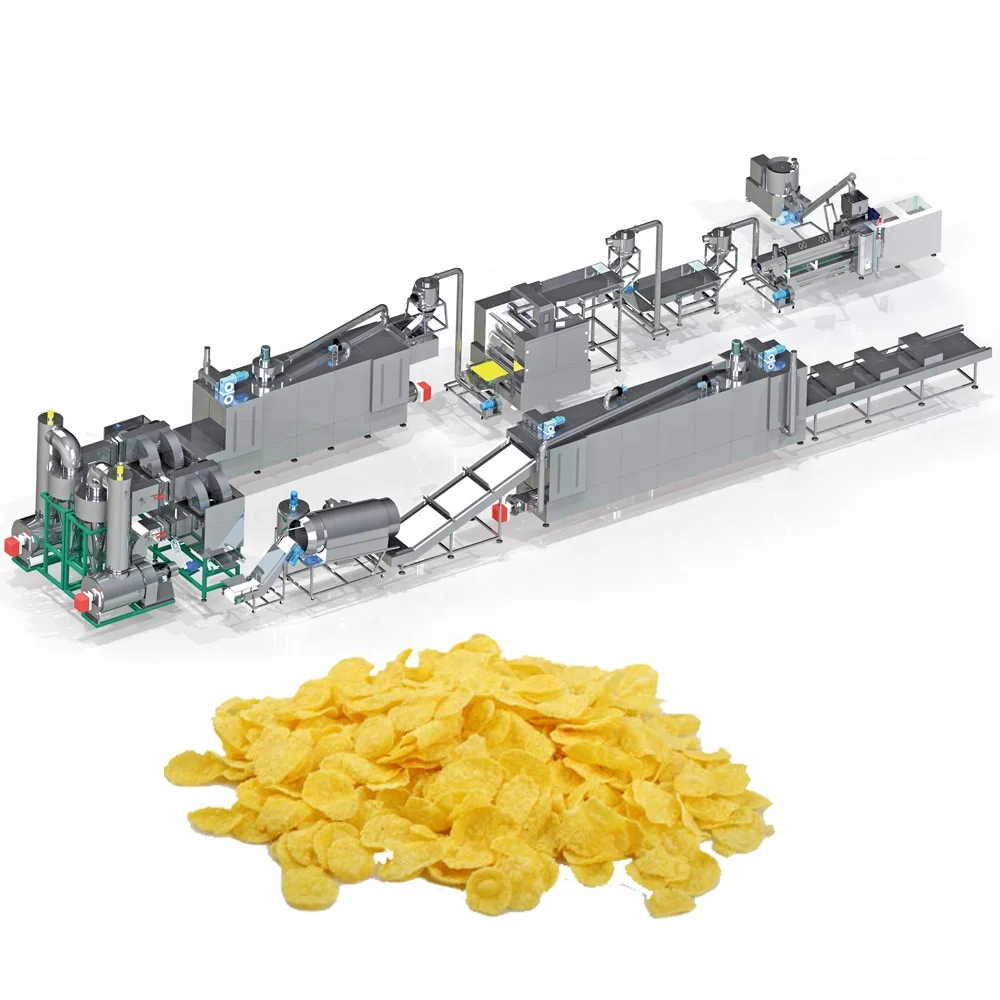
Thermally-Matched Stations — Every unit from mixer to roaster in this corn flakes line is sized against the same throughput target, eliminating the bottleneck that occurs when extruders and dryers are sourced from different vendors.
Technical Specifications
| Parameter | Value |
|---|---|
| Product Type | Twin Screw Food Extruder for Corn Flakes Production Line |
| Model | MT75 |
| Screw Type | Twin Screw |
| Installed Power | 210 kW |
| Power Consumption | 150 kW |
| Output Capacity | 300–500 kg/h (basis not stated in source — confirm raw material and moisture content) |
| Voltage Options | 380V / 220V |
| Control System | Available with PLC or MCC control |
| Contact Material | Food-grade stainless steel |
| Flaking Unit | Hydraulic double-roller system with separate dual motors and infrared temperature monitoring |
| Dryer Heating Source | Gas or electric |
| Roasting Oven | Hot air circulation with dual fans, conciliation burner, cyclone dust removal |
| Coating System | Double tumble sugar melter, elevator, coating drum, spray nozzle array |
| Overall Line Dimensions | 45 × 1.5 × 3.5 m |
| Line Weight | Approximately 5000 kg (verify against final configuration) |
| Assembly State | Complete line |
| Warranty | 1 year, including core components |
| Certification | CE, ISO |
Application Suitability
| Application | Material or Output |
|---|---|
| Natural corn flakes for retail breakfast cereal packaging | Corn grits, corn flour |
| Sugar-coated corn flakes with glazed finish | Corn base plus sugar syrup coating |
| Ring, ball, and fruit loop cereal shapes | Corn, rice, wheat, oat, or barley flour blends with die changes |
| Fortified breakfast cereals for institutional nutrition programmes | Grain flour premixed with vitamin and mineral additives |
| Pilot-scale cereal product development | Small-batch runs on buyer-supplied raw material in testing workshop |
What Buyers Overlook When Comparing Corn Flakes Line Capacities
The rated output of the extruder means nothing if the flaking rolls, dryer, and roasting oven cannot keep pace.
I remember standing in a Southeast Asian cereal plant watching their extruder run at full speed while the downstream dryer choked on wet flakes, forcing the operator to cut feed every twenty minutes. The buyer had specified the extruder by catalogue capacity without confirming whether the dryer’s evaporation rate matched the actual moisture load. That mismatch cost them months of lost production before we reconfigured the line. [NEED_CITE: dryer evaporation rate versus extruder moisture output in cereal processing] When evaluating a corn flakes making machine full equipment range, the honest question is not how fast the extruder can push material, but whether every station from mixing through packing can sustain the same throughput on your specific raw material.
Matching Every Station Across the Corn Flakes Line
A natural corn flake line moves material through mixing, extruding, flaking, drying, hot air roasting, cooling, and packing. Each station introduces its own residence time and capacity limit. If the flaking rollers cannot accept the extruder’s discharge rate, cooked dough backs up and cools below the temperature needed for clean sheeting. The corn flakes making machine full equipment range described here sizes the hydraulic double-roller flaking unit, the gas or electric dryer, and the hot air roasting oven to the extruder’s actual output, so material flows without accumulation or starvation between stages.
How Raw Material Changes the Real Throughput
Corn flour, rice flour, oat powder, and barley blends all behave differently inside the twin-screw barrel. A coarse corn grit absorbs water more slowly than fine rice flour, which shifts the gelatinisation point and changes how much material the extruder can process per hour. This is why the output figures in the specification table carry a caveat — the real capacity depends on what you feed into the hopper. [NEED_CITE: effect of particle size on twin-screw extrusion throughput in breakfast cereal production] Before we quote a line, we ask for a sample of your raw material and run it through our in-house testing workshop to confirm screw configuration, moisture addition rate, and barrel temperature profile.
Reading the Specifications for Production Reality
The MT75 carries 210 kW of installed power with a typical running consumption around 150 kW. That gap reflects the peak torque needed during startup and when dense dough passes through the die plate. The twin-screw configuration allows operators to adjust screw element sequencing — alternating kneading blocks and conveying elements — to control shear intensity, which directly governs starch gelatinisation and flake texture after roasting. The hydraulic flaking unit uses separate motors on each roller, so the gap can be adjusted under load without stopping the line. Infrared sensors on the temperature pipes monitor roller surface heat, keeping the dough sheet pliable enough to flatten without tearing or sticking. The roasting oven’s two circulating fans and conciliation burner create a cross-flow hot air pattern that blisters the flake surface evenly, giving the final product its characteristic crunch rather than a hard, glassy bite.
The Hidden Cost of Assembling a Line from Separate Vendors
When a buyer sources an extruder from one supplier, a dryer from another, and a coating drum from a third, nobody takes responsibility for the gaps between them. A coating drum that cannot handle the roaster’s discharge rate forces the roaster to idle, burning fuel on empty pans. [NEED_CITE: throughput mismatch consequences in multi-vendor food processing lines] Voltage incompatibility compounds the problem — a 380V extruder paired with a 220V roaster control panel will require a transformer that adds cost, heat, and a failure point. These issues surface only after the machines are bolted to the floor and the buyer has already paid for shipping and installation.
Why Sourcing the Full Range from One Supplier Matters Here
Every station in this corn flakes line — batching, extruding, flaking, drying, roasting, sugar coating, cooling, packing — is specified under one project scope, so capacity calculations are cross-checked before fabrication begins. The screw configuration and die design are selected for the buyer’s actual raw material, not copied from a generic template. An in-house testing workshop allows trial runs on customer-supplied corn flour or grain blends before the extruder leaves the factory. Electrical schematics, voltage, frequency, and control language are confirmed before production starts, preventing commissioning delays on site. PLC and MCC control options are available to match the buyer’s existing factory automation standard. [NEED_CITE: PLC versus MCC control standards in food processing plants]
Documentation & Verification
- Line layout drawing showing throughput matched at every station from mixer to packer
- Screw and die configuration record specific to your corn flour particle size and moisture target
- Electrical schematic with voltage and frequency confirmed for your facility before production
- Trial run report on your raw material from our in-house testing workshop before shipment
- CE declaration of conformity and ISO certificate for customs and regulatory clearance
- Factory test record with video outgoing-inspection of the MT75 and supporting equipment
Installation, Commissioning & Support
- Foundation plan accounts for the 45-metre line footprint and the hydraulic flaking unit’s dynamic load
- Dedicated power circuit sized for the 210 kW installed load with voltage verified on arrival
- Extruder barrel and screw elements shipped assembled; flaking rollers and roaster oven crated separately
- First-run parameter setting includes barrel temperature profile, roller gap, and roaster air flow calibration
- Operator training covers screw element changes, die swaps for alternate cereal shapes, and PLC navigation
- Wear parts list with reorder codes for screws, dies, flaking roller surfaces, and roaster fan belts
- Scheduled maintenance intervals for hydraulic fluid, infrared sensor calibration, and cyclone filter cleaning
What We Need to Configure Your Line Accurately
Send us the type and particle size of the grain flour you plan to run, along with the moisture content you typically receive from your supplier. Let us know your target hourly output and whether you need natural flakes, sugar-coated flakes, or both on the same line. Confirm your facility’s voltage, frequency, and preferred control language so the electrical package is built correctly before the machines ship.
Frequently Asked Questions
Q: How is line throughput matched across extruder, dryer, flaking, and coating stations?
A: Each station is sized during the layout phase using the same throughput calculation based on your raw material and target product. The flaking unit, dryer belt length, and roasting oven volume are all scaled to the extruder’s confirmed output from the trial run, so no single station creates a bottleneck.
Q: What voltage, frequency, and control language options are confirmed before shipment?
A: We confirm your facility’s voltage and frequency — such as 380V at 50 Hz or 220V at 60 Hz — before production starts. Control language for the PLC interface is set to your operator’s preference. Electrical schematics are provided for your electrician to review before the machines arrive.
Q: Can the extruder die be adjusted to produce multiple breakfast cereal shapes on one line?
A: Yes. The twin-screw extruder accepts interchangeable dies that produce shapes including balls, tubes, rings, stars, wheels, and fruit loops. Changing the die requires a scheduled line stop and re-threading of downstream equipment, which is covered during operator training.
Q: What is included in the machinery test report and video outgoing-inspection?
A: The test report documents extruder running current, barrel temperature profile, flake thickness from the hydraulic roller gap, and roaster air temperature. The video inspection shows the full line running on test material, including the coating drum and packing station, so you can verify operation before shipment.
Q: How are spare wear parts such as screws, dies, and flaking rollers supplied and replaced?
A: A wear parts list with part numbers is included with the line documentation. Screws, die plates, and flaking roller surfaces are stocked or manufactured to lead times stated at purchase. Replacement procedures are covered in the operation manual and during on-site commissioning training.