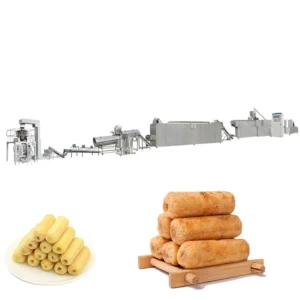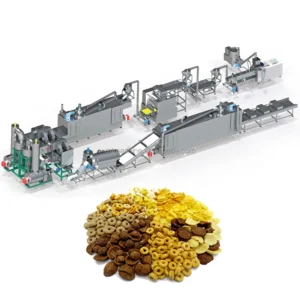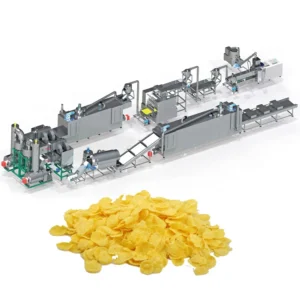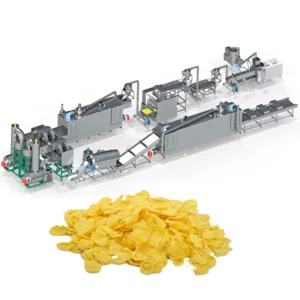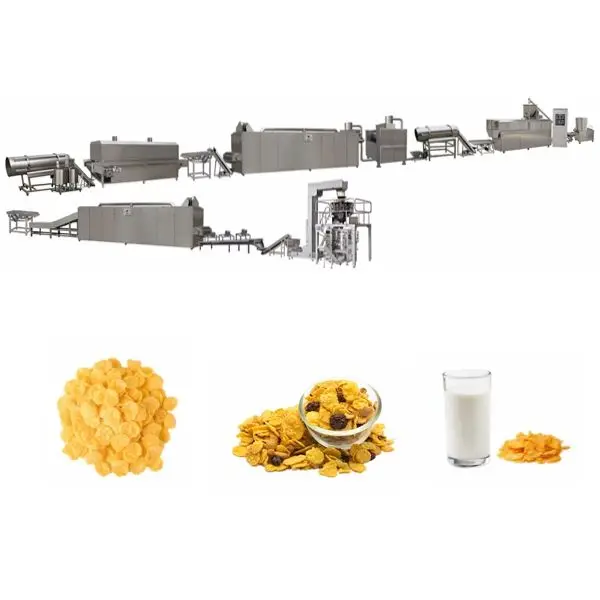
Integrated Throughput Matching — Every station on this corn flakes line is sized to the extruder output, preventing dryer or coater bottlenecks that fragment lines often encounter.
Technical Specifications
| Parameter | Value |
|---|---|
| Product Type | Corn Flakes Production Line |
| Model Options | MT70 / MT85 / MT75 |
| Extruder Type | Twin Screw |
| Installed Power (MT70) | 160 kW |
| Installed Power (MT85) | 190 kW |
| Installed Power (MT75) | 210 kW |
| Power Consumption (MT70) | 120 kW |
| Power Consumption (MT85) | 140 kW |
| Power Consumption (MT75) | 150 kW |
| Capacity (MT70) | 150–200 kg/h (basis not stated in source — confirm raw material type / moisture content) |
| Capacity (MT85) | 300–400 kg/h (basis not stated in source — confirm raw material type / moisture content) |
| Capacity (MT75) | 300–500 kg/h (basis not stated in source — confirm raw material type / moisture content) |
| Overall Dimensions (MT70) | 41 × 1.5 × 2.2 m |
| Overall Dimensions (MT85) | 43 × 1.5 × 3.2 m |
| Overall Dimensions (MT75) | 45 × 1.5 × 3.5 m |
| Flaking Machinery Drive | Double motors with hydraulic system for separate roller driving |
| Flaking Temperature Control | Infrared sensor |
| Dryer Heating Source | Gas / Electric |
| Roasting Oven | Hot air with vibrating pan, dual circulating fans, cyclone dust removal |
| Coating System | Double tumble sugar melting, elevator, coating drum, spraying nozzle |
| Control System | PLC control; MCC available |
| Screw Material | Wear-resistant special treatment |
| Voltage & Frequency | Customized to customer local voltage |
| Line Stations | Mixing → Extruding → Flaking → Drying → Hot Air Roasting → Coating → Drying → Cooling → Packing |
| Raw Materials | Corn, rice, wheat, oat, barley powder |
| Standards | CE, ISO |
Application Suitability
| Application | Material or Output |
|---|---|
| Natural corn flakes production | Corn grits and corn flour blends |
| Sugar-coated breakfast cereals | Corn, rice, or wheat base with sugar coating |
| Shaped cereal snacks | Ball, tube, stick, ring, fruit loop, star, wheel, flower, heart formats via extruder die changes |
| Multi-grain cereal processing | Oat, barley, and mixed grain powder formulations |
Why Nominal Capacity Alone Misleads Buyers on a Corn Flakes Line
A corn flakes production line for sale quoted at a single output number without raw material context often fails to deliver that throughput on the buyer’s actual grain.
I spent years on the assembly floor in Shandong before moving into technical sales, and the lesson I keep learning is that grain particle size and moisture content change everything. One customer signed for a line rated at a certain capacity, but their corn flour was coarser than our test batch. The actual throughput dropped noticeably, and every downstream station fell out of sync — the flaker ran starved, the dryer cycled half-empty, and the roaster temperature profile drifted. The line was not defective; it was configured against assumptions that did not match the buyer’s supply chain [NEED_CITE: raw material variability in grain extrusion processing].
This is the reason our first step is always asking for a raw material sample before locking in screw configuration and die selection.
Every Station Sized to the Same Throughput Target
A corn flakes production line for sale assembled from separate vendors often reveals its weakest link at the dryer or the coater. The extruder pushes product forward at a steady rate, but if the dryer belt area cannot remove moisture fast enough, material backs up and the entire line slows. On the MT70, MT85, and MT75 models, each downstream station — flaker, dryer, roaster, coating drum — is specified to handle the extruder output so that no single machine dictates the real capacity.
Flaking and Roasting Precision for Consistent Texture
The flaking machinery uses double motors for independent roller driving with a hydraulic system controlling roller gap pressure. An infrared sensor monitors roller surface temperature continuously, which matters because corn flakes that stick to cold rollers tear rather than flatten cleanly. The hot air roasting oven follows with a vibrating pan that keeps flakes moving, dual circulating fans for even heat distribution, and a cyclone dust removal device to keep fine particles out of the product stream [NEED_CITE: flaking temperature and moisture targets for breakfast cereal texture].
What the Power and Dimension Figures Tell You
The MT70 draws 120 kW during operation across a 41-meter line footprint, while the MT85 pulls 140 kW over 43 meters and the MT75 sits at 150 kW across 45 meters. These installed-to-consumption power ratios reflect the actual energy profile during steady-state extrusion rather than peak motor draw. For facility planners, the dimension figures include every station from the mixer to the packing conveyor, which determines the minimum workshop length required. The twin-screw extruder at the heart of each model uses wear-resistant screws with a configuration matched to the buyer’s target grain, meaning the L/D ratio and screw element spacing are set to achieve the correct degree of starch gelatinisation for corn, rice, or multi-grain blends. Voltage and frequency are configured to the buyer’s local grid before production begins, avoiding commissioning delays caused by motor or PLC incompatibility.
The Hidden Cost of Skipping Raw Material Trials
Lines shipped without a trial run on the buyer’s actual grain often require weeks of on-site adjustment after installation. Screw elements configured for a generic corn meal behave differently against a buyer’s specific supplier grind, and die geometry that works at the factory may produce flakes that are too dense or too fragile in real production [NEED_CITE: extrusion die geometry and product density correlation]. The flaker roller gap that produces ideal thickness on one formulation may crush another. These mismatches do not show up on a specification sheet — they surface only when material is running through the machines.
Why Source This Line Here
The corn flakes production line for sale here covers every station from batching to packing under one supplier, which means throughput is matched across the entire sequence rather than assembled from mismatched vendors. Screw configuration and die design are specified to the buyer’s raw material and target flake geometry. An in-house testing workshop allows trial runs on customer grain samples before shipment, so the extrusion profile is validated in advance. Twin-screw expertise spans corn, rice, wheat, oat, and barley applications, meaning the process parameters are set from experience with each grain’s gelatinisation behaviour. Pre-sales consultation covers line layout engineering, and support extends through on-site installation, commissioning, and ongoing maintenance.
Documentation & Verification
- Line layout drawing matched to your factory footprint and ceiling height
- Screw and die configuration record for your specific corn or grain blend
- Electrical schematic with voltage and frequency confirmed for your local grid
- Trial run report on your raw material sample before shipment
- CE declaration of conformity and ISO certificate for import compliance
- Operation and maintenance manual with wear parts replacement intervals
Installation, Commissioning & Support
- MT70 requires a minimum 41-meter straight-line floor space with level concrete foundation
- Dedicated power circuit sized to 160 kW installed capacity for the MT70 model
- Line ships in modular sections for sequential assembly from mixer through packing station
- First-run parameter setting includes flaker roller gap and roaster temperature calibration
- Operator training covers PLC interface navigation and emergency stop procedures
- Wear parts list identifies screws, dies, and flaker rollers with reorder lead times
What to Prepare Before Inquiry
To configure a corn flakes production line for sale that matches your actual production conditions, we need to understand your starting point. Share the grain type and particle size specification from your supplier, your target daily output in finished product weight, and the available workshop dimensions including ceiling height. Your local voltage and frequency standard determines motor and control panel specifications, so confirm those values early. If you are replacing or expanding an existing line, let us know which upstream or downstream equipment will remain in place.
Frequently Asked Questions
Q: How is the capacity of each model verified before the line is built?
A: Capacity figures listed for the MT70, MT85, and MT75 are reference ranges. We verify actual throughput by running your specific raw material sample in our testing workshop, measuring output under the screw and die configuration selected for your grain type and target flake geometry.
Q: What voltage and control options are confirmed before production starts?
A: Motor voltage, frequency, and PLC interface language are confirmed to match your local electrical grid and operator requirements before the line enters production. An electrical schematic is provided for your approval so that no commissioning delays occur on site.
Q: How are downstream stations matched to extruder output?
A: The flaker roller width, dryer belt area, roaster pan capacity, and coating drum volume are each specified to handle the extruder throughput of your chosen model, preventing any single station from becoming the limiting factor.
Q: What product shapes are possible beyond standard corn flakes?
A: By changing the extruder die, the line can produce ball, tube, stick, ring, fruit loop, star, wheel, flower, and heart shapes. Die changes are part of the configuration process and documented in the screw and die record.
Q: Which wear parts should be stocked for the first year of operation?
A: Extruder screws, die inserts, and flaker rollers are the primary wear items. A wear parts list with specifications is included in the documentation package, and replacements are available through direct order from the factory.