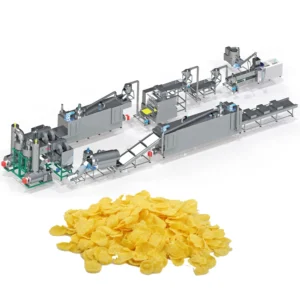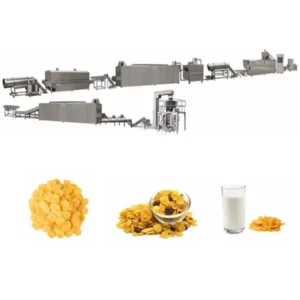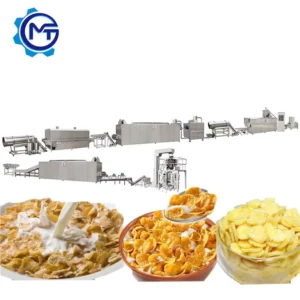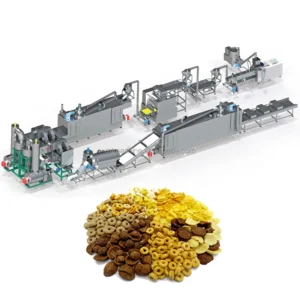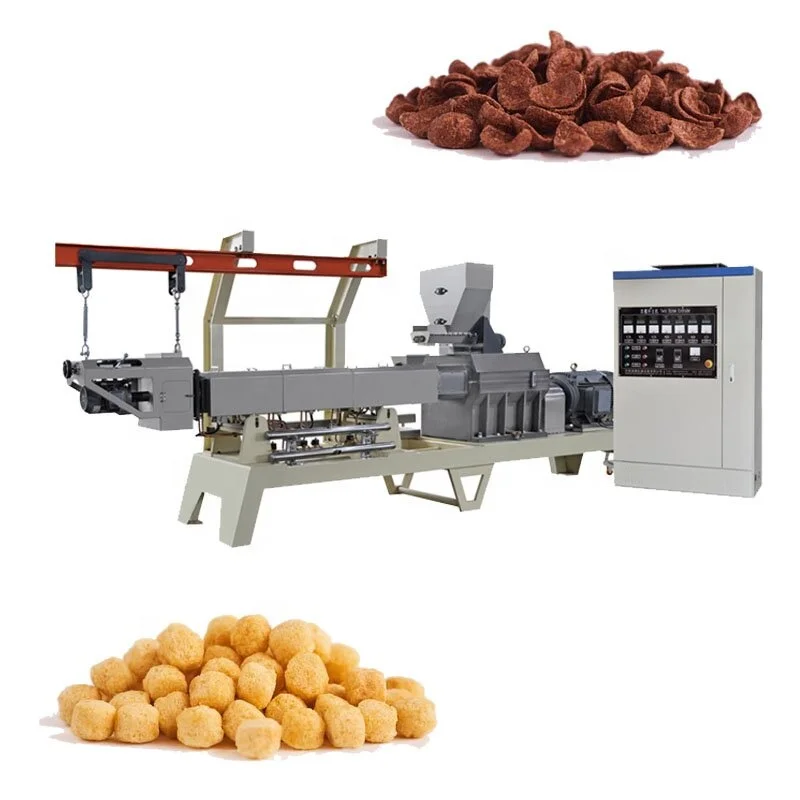
Integrated line sizing — Every station from mixer to packing scale is matched to the MT70 extruder output so the corn flakes production line full equipment range stays balanced without mid-line bottlenecks.
Technical Specifications
| Parameter | Value |
|---|---|
| Product Type | Corn Flakes Production Line |
| Model | MT70 (also available in MT75, MT85 configurations) |
| Screw Type | Twin Screw |
| Installed Power | 160 kW |
| Power Consumption | 120 kW |
| Output Capacity | 150–200 kg/h (basis not stated in source — confirm raw material, moisture content and product format) |
| Overall Dimensions | 41 × 1.5 × 2.2 m |
| Control System | PLC control on flaking machinery; MCC and PLC available for line |
| Basic Raw Materials | Powder of corn, rice, wheat, oat, barley |
| Production Procedure | Mixing → Extruding → Flaking → Drying → Hot Air Roasting → Sugar Coating → Cooling → Packing |
| Dryer Heating Source | Gas or Electric |
| Flaking Machinery | Hydraulic double-roller system, double motors, infrared temperature sensor |
| Roasting Oven | Vibrating pan, conciliation burner, dual circulating fans, cyclone dust removal |
| Coating System | Double tumble sugar melter, elevator, coating drum, spraying nozzle |
| Extruder Features | Automatic lubricating, cooling function, wear-resistant screw technology |
| Certification | CE, ISO |
Application Suitability
| Application | Material or Output |
|---|---|
| Natural corn flakes for breakfast cereal market | Corn powder at controlled moisture |
| Sugar-coated corn flakes SKU expansion | Corn, rice or mixed grain base with sugar spray coating |
| Extruded cereal shapes (rings, balls, stars, fruit loops) | Corn, wheat, oat or barley powder with die changes |
| Fortified breakfast cereals for nutrition programmes | Grain blends with vitamin and mineral premix |
| Alternative grain flake production | Rice, oat or barley powder with adjusted screw configuration |
What the Extruder Output Figure Does Not Tell You About Downstream Matching
A 150–200 kg/h extruder means nothing if the dryer or coater cannot keep pace. The corn flakes production line full equipment range must be surveyed as a connected system, not as isolated machine specs. I once watched a Middle East installation sit idle for two weeks because the roaster was sized for a smaller extruder — the flakes piled up wet, stuck to the vibrating pan, and caramelised unevenly. The buyer had compared extruder prices across three suppliers but never asked what happened to throughput after the die [NEED_CITE: importance of throughput balancing across sequential food processing stations].
When a buyer receives a quote listing only the extruder model and output, the downstream stations are often generic placeholders. The flaking rollers, dryer length, roasting oven capacity and coating drum volume all need to match the actual mass flow exiting the extruder at the buyer’s real moisture and recipe. Without that calculation, the corn flakes production line full equipment range becomes a collection of mismatched machines rather than a coordinated system.
How Each Station Connects to the Next
The production sequence runs through eight distinct stages, and every transition point carries a risk of material accumulation or throughput loss. The mixing system feeds the twin-screw extruder at a controlled rate, where corn powder undergoes gelatinisation under heat and shear. The extruded mass exits through the die and is cut before entering the flaking machinery. Here the hydraulic double-roller system presses the cooked material into flakes of consistent thickness, with the infrared sensor monitoring roller temperature to prevent sticking or uneven compression. Each station in the corn flakes production line full equipment range must accept the output of the previous one without buffer overflow or starvation.
Where Throughput Mismatches Typically Hide
The dryer and roasting oven are where most line imbalances surface. A dryer that is too short leaves flakes above the target moisture, forcing the roaster to work harder and scorch the surface before the core dries through. The roasting oven on this line uses a conciliation burner with dual circulating fans and cyclone dust removal, which gives operators control over temperature zones — but only if the pan loading rate matches the extruder output. Similarly, the coating system with its double tumble sugar melter must melt and deliver sugar at a rate that keeps pace with cooled flakes arriving from the conveyor [NEED_CITE: thermal balance requirements in sequential drying and roasting operations]. When any one of these stations is undersized, the entire line slows to the pace of its weakest link.
Reading the Specs That Actually Matter for Flake Quality
The twin-screw configuration matters for corn flakes because it handles the high-moisture, high-starch dough that single-screw extruders struggle to convey consistently. The screw’s wear-resistant construction extends service intervals when processing abrasive corn grits over long production runs. Installed power of 160 kW with 120 kW consumption indicates the thermal and mechanical energy available for starch gelatinisation inside the barrel — insufficient energy input produces undercooked extrudate that flakes poorly and shatters during roasting. The hydraulic flaking system with separate roller motors allows independent speed adjustment, which controls flake density and thickness. The PLC control on the flaking machinery lets operators store roller gap and temperature profiles for repeatable batch-to-batch results, which is critical when switching between natural and sugar-coated product runs.
The Cost of Skipping the Downstream Audit
Buyers who focus their evaluation on the extruder alone often discover problems only after the line is bolted to the factory floor. Flakes that are too thick because the roller gap was never matched to the actual extrudate moisture will not roast evenly, producing a mix of burnt and undercooked product in the same batch. A coating drum that cannot tumble fast enough leaves sugar pooling on one side of the flakes while the other side stays bare. These are not extruder failures — they are line integration failures, and they cost weeks of lost production and raw material waste to diagnose and correct [NEED_CITE: common causes of commissioning delays in food extrusion lines]. The buyer ends up paying for engineering time that should have been spent in the supplier’s testing workshop before shipment.
What This Equipment Range Covers Beyond the Brochure
Every station in the corn flakes production line full equipment range comes from a single supplier, meaning throughput calculations are done across the full sequence rather than left to the buyer to reconcile between separate vendors. Screw configuration and die design are specified against the buyer’s actual raw material — not copied from a generic build. The in-house testing workshop runs trial production on the buyer’s corn, rice or mixed grain formula before the line ships, so flake thickness, roast colour and coating adhesion are verified before installation begins. Electrical schematics confirm voltage and frequency for the destination factory, and control language is set before the PLC is programmed. Spare wear parts including screws, dies and flaking rollers are listed and available from the point of first replacement.
Documentation & Verification
- Line layout drawing showing throughput matching between extruder, flaker, dryer, roaster and coater
- Screw and die configuration record matched to your specific grain formula
- Trial run report produced on your raw material in the testing workshop
- Electrical schematic with voltage, frequency and control language confirmed for your site
- Factory test record documenting output and flake quality before dispatch
- CE declaration of conformity and ISO certificate included with shipment
Installation, Commissioning & Support
- Foundation plan accounts for the 41 m line length and 2.2 m maximum height across all stations
- Dedicated power circuit sized for 160 kW installed load with voltage confirmed pre-production
- Flaking machinery hydraulic system commissioned on-site with roller gap set to your target flake thickness
- PLC and MCC control panels configured in your preferred operator language before power-on
- Twin-screw and die wear parts list provided with first replacement set included at delivery
- Roaster burner and gas train inspected against local safety codes during commissioning week
What to Prepare Before Requesting a Quote
To size the corn flakes production line full equipment range correctly, share your primary grain material and any secondary grains in the blend, along with typical moisture content at the mixer. Specify whether you need natural flakes, sugar-coated variants, or both, and whether extruded shapes are part of the product plan. Provide your factory’s voltage, frequency and phase, along with available floor length and ceiling height. If you have existing upstream milling or downstream packing equipment, note the interface points so the line layout connects without modification.
Frequently Asked Questions
Q: How is the 150–200 kg/h capacity verified, and on which raw material?
A: That output range is published without a stated raw material or moisture basis. Before quotation, we run your actual grain formula in the testing workshop and document the real throughput on your recipe. The trial report becomes the capacity reference for your specific line configuration, not a generic catalogue figure.
Q: How do I confirm voltage, frequency and control language before shipment?
A: Electrical specifications are confirmed during the quotation stage using a dedicated checklist. The electrical schematic, motor nameplate ratings and PLC interface language are all locked before production begins, so the line arrives ready for your local power supply without on-site rewiring or reprogramming delays.
Q: Which supporting stations are matched to the extruder model I choose?
A: Every downstream station — flaker, dryer, roaster, coater and cooler — is sized to the extruder’s verified mass flow on your recipe. The line layout shows each station’s throughput rating alongside the extruder output so no single process step becomes a bottleneck during continuous production.
Q: Can the same line produce both natural and sugar-coated corn flakes?
A: Yes. The coating system with double tumble sugar melter and spraying nozzle is included as a station that can be engaged or bypassed. Switching between natural and coated product involves clearing the coating drum and adjusting the roaster temperature profile, both stored in the PLC for repeatable changeovers.
Q: What spare wear parts are included, and how are replacements sourced?
A: A wear parts list covering screws, dies and flaking rollers is provided with the line documentation. The first replacement set ships with the machine. Subsequent orders are fulfilled from the factory with configuration records on file, so replacement screws match the exact geometry used in your original trial run.