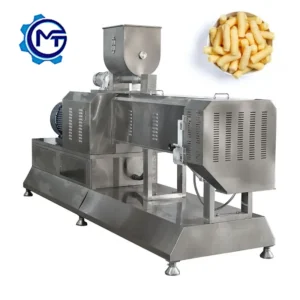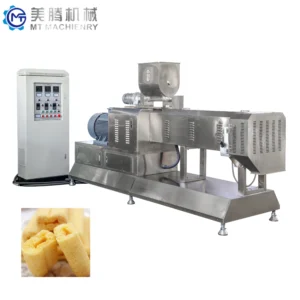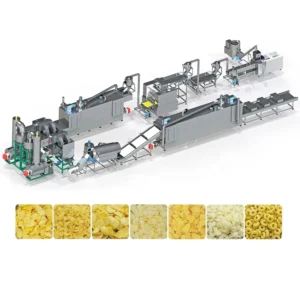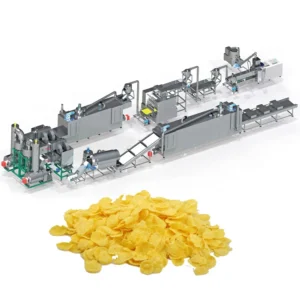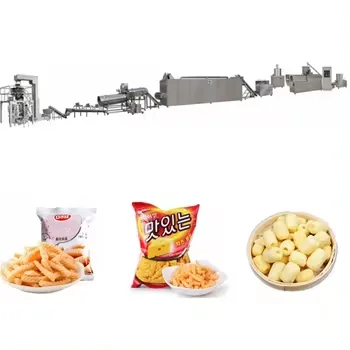
Matched station throughput — every unit from the batching mixer to the packing scale in this corn puff snack extrusion machine full equipment range is sized against the extruder’s real output, not a catalog peak.
Technical Specifications
| Parameter | Value |
|---|---|
| Product Type | Corn Puff Snack Extrusion Processing Line |
| Model Options | MT65 / MT70 / MT85 / MT100 |
| Screw Type | Twin Screw |
| Installed Power (MT65) | 130 kW |
| Installed Power (MT70) | 180 kW |
| Installed Power (MT85) | 220 kW |
| Installed Power (MT100) | 240 kW |
| Real Consumption (MT65) | 95 kW |
| Real Consumption (MT70) | 120 kW |
| Real Consumption (MT85) | 130 kW |
| Real Consumption (MT100) | 160 kW |
| Output Capacity (MT65) | 120–150 kg/h (basis not stated in source — confirm raw material type, moisture content and die configuration) |
| Output Capacity (MT70) | 200–300 kg/h (basis not stated in source — confirm raw material type, moisture content and die configuration) |
| Output Capacity (MT85) | 300–500 kg/h (basis not stated in source — confirm raw material type, moisture content and die configuration) |
| Output Capacity (MT100) | 600–800 kg/h (basis not stated in source — confirm raw material type, moisture content and die configuration) |
| Control System | Frequency speed controlling system, automated |
| Lubrication | Automatic lubricating and cooling system |
| Dryer Heating Source | Electric, steam, or gas (configurable to site conditions) |
| Flavoring System | Double drum flavoring line with sugar melting and spraying nozzle |
| Packing Machine | Automatic weighing, sealing, marking, coding; vibration feeding with electronic pad weighing |
| Line Stations | Material preparation → Batching → Extruding → Drying → Coating/Flavoring → Cooling → Packing → Stacking |
| Die Configuration | Interchangeable dies for cheese ball, tube, stick, ring, fruit loop, star, wheel, flower, heart shapes |
| Core Filling Option | Available with added core filling machine and cutting machine |
| Raw Materials | Corn, rice, wheat, oat, barley flour and similar grain-based materials |
| Voltage & Frequency | Configurable to target market (basis to be confirmed) |
| Assembly State | Turnkey line, OEM/ODM layout design available |
| Warranty | 1 year |
| Delivery Time | Approx. 20 working days for line; approx. 35 working days with packing and stacking machine included |
Application Suitability
| Application | Material or Output |
|---|---|
| Puffed corn snack production | Corn flour, corn grits at controlled moisture |
| Cheese ball and ring snacks | Corn and rice flour blends with cheese powder coating |
| Core-filled extruded snacks | Grain-based outer shell with cream or chocolate filling |
| Multi-grain extruded snacks | Wheat, oat, barley flour combinations |
| Breakfast cereal formats | Rice and corn blends for fruit loops and star shapes |
Why the Dryer Sizing Matters More Than the Extruder Nameplate
A corn puff snack extrusion machine full equipment range that mismatches dryer capacity to extruder throughput will bottleneck your entire shift.
When I was running after-sales calls across Latin America, I walked into a plant where the extruder was pushing product faster than the dryer could handle. Moisture content at the dryer exit was too high, the coating drum couldn’t accept the output, and half-finished puffs were piling up on every flat surface in the workshop. The extruder itself was fine. The dryer was simply undersized for the real-world throughput the screw configuration was delivering on that specific flour blend. That kind of mismatch doesn’t show up in a brochure comparison. [NEED_CITE: throughput matching across extrusion line stations]
Screw Configuration and Die Selection Across the Line
The twin-screw platform in this corn puff snack extrusion machine full equipment range uses interchangeable dies to produce cheese balls, tubes, sticks, rings, stars, wheels, flowers, and heart shapes from one extruder base. Switching die geometry changes the pressure profile inside the barrel, which means screw configuration must be adjusted alongside the die to maintain consistent expansion and density. The automatic lubricating and cooling system keeps barrel temperatures stable during extended runs, reducing the variation you see between the first hour and the sixth hour of a shift.
How the Flavoring and Coating Stage Keeps Pace
The double drum flavoring line includes an integrated sugar melting unit and spraying nozzle, which applies coating evenly across irregular shapes like fruit loops and star forms. Drum speed and spray rate are linked to the upstream extruder output through the frequency speed controlling system. If the extruder model is changed or the die is swapped to a shape with higher surface area, the drum residence time and nozzle flow rate need corresponding adjustment. This is where buying the complete line from one source matters — the drum volume and conveyor widths are already calculated against the selected extruder’s throughput envelope. [NEED_CITE: flavoring drum sizing relative to extruder output in snack lines]
Reading the Power and Capacity Figures
The installed power ratings run from 130 kW on the MT65 to 240 kW on the MT100, while real consumption figures sit lower — 95 kW to 160 kW respectively. The gap between installed and consumed power reflects the headroom needed for startup surges and load variations when raw material moisture fluctuates. The output capacities listed for each model carry a basis-to-be-confirmed note because actual throughput on corn puff snacks depends on flour type, moisture content at the feed hopper, and the die geometry selected. A tube die with a thick wall will extrude less mass per hour than a thin-wall ring die on the same screw speed. The frequency speed controlling system allows operators to fine-tune screw RPM within the safe operating window once the line is running on the actual raw material.
What Happens When Stations Are Sourced Separately
I have seen snack producers buy an extruder from one vendor, a dryer from another, and a coating drum from a third. Each piece of equipment performs well in isolation, but the conveyor heights don’t align, the dryer belt width is narrower than the extruder die output spread, and the flavoring drum cannot accept the surge volume during a die changeover. The downtime from these interface problems accumulates across every shift. [NEED_CITE: integration risks in multi-vendor food processing lines] When the corn puff snack extrusion machine full equipment range is supplied as a matched set, the transition points between extruder, dryer, cooler, and packing station are designed with the same throughput target in mind.
Why Sourcing the Complete Range Matters
Every station in the line — from the batching mixer through the extruder, dryer, flavoring drums, cooler, and automatic packing machine — is configured under one layout calculation, so throughput is matched rather than guessed. The screw and die configuration is specified against the buyer’s declared raw material and target snack shape before production begins. An in-house testing workshop runs trial production on customer-supplied flour blends before the line ships, generating a trial run report that documents actual output and product texture. Voltage, frequency, and control language are confirmed against the buyer’s factory utilities before electrical panels are wired. The dryer heating source — electric, steam, or gas — is selected based on the site’s available infrastructure rather than a default option.
Documentation & Verification
- Line layout and capacity calculation showing matched throughput at every station
- Screw and die configuration record tied to your declared flour blend and target shape
- Electrical schematic with voltage, frequency, and control language confirmed before build
- Trial run report on your raw material documenting real output and product density
- Factory test record with photos before crating and dispatch
- Operation and maintenance manual covering each station in the line
Installation, Commissioning & Support
- Utility planning for the selected dryer heating source — electric, steam, or gas — matched to site supply
- Electrical connection to the automated frequency speed controlling system with confirmed voltage and phase
- Assembly of the full station sequence from batching through packing, including conveyor alignment
- First-run commissioning with screw speed and barrel temperature tuning on your actual raw material
- Operator training on die changeover procedures and automatic lubricating system maintenance intervals
- Wear parts list covering screws, dies, and dryer belt sections with recommended replacement schedule
What to Share When Requesting a Line Proposal
To configure the right corn puff snack extrusion machine full equipment range, the useful starting information includes your target snack shapes and the flour or grain blend you plan to run. Share your available voltage and frequency, the heating source you can supply for the dryer, and the daily output target so the correct extruder model and supporting station sizes can be selected. If you have existing upstream or downstream equipment that the new line must connect to, include those interface dimensions.
Frequently Asked Questions
Q: How is the output capacity for each extruder model verified before shipment?
A: Each model’s kg/h rating depends on raw material type, moisture content, and die configuration, which must be confirmed against your actual flour blend. A trial run on your supplied raw material is conducted in the testing workshop before dispatch, and the resulting report documents real throughput, product texture, and density measurements for your specific product target.
Q: Which supporting stations are included, and how is their throughput matched?
A: The line includes batching, extruding, drying, double drum flavoring with sugar melting, cooling, automatic weighing and packing, and stacking stations. Each station’s capacity is calculated against the selected extruder model’s real output on your raw material, so no single station becomes a bottleneck during continuous production.
Q: What die shapes are available, and how is the selection made?
A: Interchangeable dies cover cheese ball, tube, stick, ring, fruit loop, star, wheel, flower, and heart shapes. Die selection is matched to your target snack geometry and desired density. The screw configuration is adjusted alongside each die to maintain consistent expansion and product texture across the full production run.
Q: What electrical and control specifications are confirmed before production begins?
A: Voltage, frequency, and control panel language are confirmed against your factory’s utility supply and operator requirements before the electrical panels are wired. The electrical schematic is provided for review, and the dryer heating source is configured to electric, steam, or gas based on your available site infrastructure.
Q: Is a trial run performed on customer-supplied raw material before dispatch?
A: Yes. A trial run using your actual flour blend and target die configuration is conducted in the in-house testing workshop. The trial run report covers real output rate, product expansion, texture, and moisture content at each station, giving you documented confirmation of line performance before the equipment leaves the factory.