![Crispy Grid Puffed Snack Line for Rice Cake Strips – Full Range1. **Analyze the Request:** * **Goal:** Optimize a product H1 title for B2B SEO based on strict rules. * **Input Data:** * Customer Profile: Jinan MT Machinery (mtextrusion.com, mtfoodmachinery.com, etc.) * Target Site: mtfoodmachinery.com * Category: frying chips making machine * Source Title: Crispy Grid Crust & Vegan Salad Strips Puffed Snack Line – Grid-Pattern & Strip Rice Cake Extruder * Product Draft: Puffed Snack Production Line, Single screw, etc. * Record ID: 10842 * **Constraints:** * Gate: Source title is not empty. Proceed. * Vocabulary Lock: Real words must come from Source Title, Category, or allowed list (Product Type, Site Modifier, Generic Limiters). No fake specs/models/brands. * Layer 1 (Site Modifier): Target site `mtfoodmachinery.com` maps to “FULL EQUIPMENT RANGE” -> Buyer surveying equipment -> Emphasis: complete machine catalogue. Pool: Manufacturer / Factory Supply / Full Range. * Layer 2 (Structure): Record ID 10842. Sum of digits = 1+0+8+4+2 = 15. 15 % 6 = 3. * Structure 3: `[应用或物料] [品类词] – [站点修饰词]` (Application/Material + Category – Site Modifier) * Layer 3 (Modifier Selection): Sum = 15. Pool length = 3 (Manufacturer, Factory Supply, Full Range). 15 % 3 = 0. * Index 0: Manufacturer. * *Wait, let me double check the exact wording for Layer 3:* “在第一层选定的池里,取【记录ID】数字之和对池长度取余选一个”. Pool: [“Manufacturer”, “Factory Supply”, “Full Range”]. 15 % 3 = 0 -> “Manufacturer”. * Generic Limiters: Automatic / Industrial / Commercial / Factory (max 1). * Length: 50-70 characters including spaces. * Priority: Keep core category, application/material. * Language: English (same as source). * No quotes, emojis, periods, hashtags, all-caps, consecutive punctuation. * Output ONLY the title. 2. **Drafting the Title:** * **Structure 3:** `[应用或物料] [品类词] – [站点修饰词]` * **Application/Material (from source/draft):** Rice Cake Strips / Grid Crust / Vegan Salad Strips / Puffed Snack * **Category (from draft/category):** Puffed Snack Line / Puffed Snack Production Line / Extruder / frying chips making machine * **Site Modifier:** Manufacturer * *Draft 1:* Rice Cake Strips Puffed Snack Line – Manufacturer * Length: 51 chars. (Good, within 50-70). * Let’s check vocabulary: “Rice Cake Strips” (Source), “Puffed Snack Line” (Source: Puffed Snack Line), “Manufacturer” (Pool). * *Draft 2:* Grid Crust Puffed Snack Line – Manufacturer * Length: 43 chars. (Too short). * *Draft 3:* Crispy Grid Crust Puffed Snack Line – Manufacturer * Length: 50 chars. (Borderline, let’s count: C-r-i-s-p-y(6) -(1) G-r-i-d(4) -(1) C-r-u-s-t(5) -(1) P-u-f-f-e-d(6) -(1) S-n-a-c-k(5) -(1) L-i-n-e(4) -(1) –(1) -(1) M-a-n-u-f-a-c-t-u-r-e-r(12) = 6+1+4+1+5+1+6+1+5+1+4+1+1+1+12 = 49 chars. Too short.) * *Draft 4:* Rice Cake Strips Puffed Snack Line – Manufacturer * R-i-c-e(4) (1) C-a-k-e(4) (1) S-t-r-i-p-s(6) (1) P-u-f-f-e-d(6) (1) S-n-a-c-k(5) (1) L-i-n-e(4) (1) –(1) (1) M-a-n-u-f-a-c-t-u-r-e-r(12) * 4+1+4+1+6+1+6+1+5+1+4+1+1+1+12 = 49 chars. Wait. * Let’s recount: “Rice Cake Strips Puffed Snack Line – Manufacturer” * Rice (4) + space (1) = 5 * Cake (4) + space (1) = 5 * Strips (6) + space (1) = 7 * Puffed (6) + space (1) = 7 * Snack (5) + space (1) = 6 * Line (4) + space (1) = 5 * – (1) + space (1) = 2 (Using en-dash or hyphen? Standard hyphen `-` is safer for char count and encoding, but prompt used `–`. Let’s use `-` with spaces: ` – ` = 3 chars). * Let’s use hyphen: “Rice Cake Strips Puffed Snack Line – Manufacturer” * 4+1+4+1+6+1+6+1+5+1+4+1+1+1+1+1+12 = 50 chars exactly. * *Draft 5 (Add generic limiter to be safe on length and B2B appeal):* * Structure 3: `[应用或物料] [品类词] – [站点修饰词]` * Can I add “Automatic”? “Automatic Rice Cake Strips Puffed Snack Line – Manufacturer” -> 59 chars. * Wait, is “Automatic” allowed in Structure 3? “通用限定词: Automatic / Industrial / Commercial / Factory (至多 1 个)”. Yes, it can modify the category. * Let’s count: “Automatic Rice Cake Strips Puffed Snack Line – Manufacturer” * A-u-t-o-m-a-t-i-c (9) + 1 = 10 * R-i-c-e (4) + 1 = 5 * C-a-k-e (4) + 1 = 5 * S-t-r-i-p-s (6) + 1 = 7 * P-u-f-f-e-d (6) + 1 = 7 * S-n-a-c-k (5) + 1 = 6 * L-i-n-e (4) + 1 = 5 * – (1) + 1 = 2 * M-a-n-u-f-a-c-t-u-r-e-r (12) = 12 * Total = 10+5+5+7+7+6+5+2+12 = 59 characters. Perfect. * Let’s verify vocabulary: * “Automatic” (Allowed generic limiter) * “Rice Cake Strips” (From Source Title: “Strip Rice Cake”, rearranged or just “Rice Cake Strips”. Source has “Vegan Salad Strips” and “Strip Rice Cake”. Let’s use “Rice Cake Strips” or “Grid Crust”. Source: “Crispy Grid Crust & Vegan Salad Strips Puffed Snack Line – Grid-Pattern & Strip Rice Cake Extruder”. “Rice Cake” is in source. “Strips” is in source.) * “Puffed Snack Line” (Source: “Puffed Snack Line”) * “Manufacturer” (Layer 1 pool) * Let’s check alternative application words from source: “Grid Crust”, “Vegan Salad Strips”. * “Automatic Grid Crust Puffed Snack Line – Manufacturer” * 9+1+4+1+5+1+6+1+5+1+4+1+1+1+12 = 51 chars. * Let’s use “Rice Cake Strips” as it’s a strong B2B keyword. * “Automatic Rice Cake Strips Puffed Snack Line – Manufacturer” * Is “Rice Cake Strips” strictly in source? Source has “Strip Rice Cake”. “Rice Cake” and “Strips” are both in source. Rearranging for grammar is standard. * Let’s use exact phrase if possible: “Crispy Grid Crust Puffed Snack Line – Manufacturer” (52 chars). * C-r-i-s-p-y (6) + 1 = 7 * G-r-i-d (4) + 1 = 5 * C-r-u-s-t (5) + 1 = 6 * P-u-f-f-e-d (6) + 1 = 7 * S-n-a-c-k (5) + 1 = 6 * L-i-n-e (4) + 1 = 5 * – (1) + 1 = 2 * M-a-n-u-f-a-c-t-u-r-e-r (12) = 12 * Total: 7+5+6+7+6+5+2+12 = 50 chars. (A bit tight, what if hyphen vs en-dash?). * Let’s use “Automatic Grid Crust Puffed Snack Line – Manufacturer” * Automatic (9) + 1 = 10 * Grid (4) + 1 = 5 * Crust (5) + 1 = 6 * Puffed (6) + 1 = 7 * Snack (5) + 1 = 6 * Line (4) + 1 = 5 * – (1) + 1 = 2 * Manufacturer (12) = 12 * Total: 10+5+6+7+6+5+2+12 = 53 characters. * Words: Automatic (generic), Grid (source), Crust (source), Puffed (source), Snack (source), Line (source), Manufacturer (pool). * All valid. * Structure: [应用或物料] (Grid Crust) [品类词] (Puffed Snack Line) – [站点修饰词] (Manufacturer). * Wait, is “Grid Crust” an application or material? It’s a product type/application. * What about “Rice Cake”? “Automatic Rice Cake Puffed Snack Line – Manufacturer” * 9+1+4+1+4+1+6+1+5+1+4+1+1+1+12 = 51 chars. * Let’s look at the source title again: “Crispy Grid Crust & Vegan Salad Strips Puffed Snack Line – Grid-Pattern & Strip Rice Cake Extruder” * “Puffed Snack Line” is the core category. * “Rice Cake” is the material/application. * Let’s use “Rice Cake Strips” -> “Automatic Rice Cake Strips Puffed Snack Line – Manufacturer” (59 chars). * Let’s recount to be absolutely sure: A(1)u(2)t(3)o(4)m(5)a(6)t(7)i(8)c(9) (10) R(11)i(12)c(13)e(14) (15) C(16)a(17)k(18)e(19) (20) S(21)t(22)r(23)i(24)p(25)s(26) (27) P(28)u(29)f(30)f(31)e(32)d(33) (34) S(35)n(36)a(37)c(38)k(39) (40) L(41)i(42)n(43)e(44) (45) -(46) (47) M(48)a(49)n(50)u(51)f(52)a(53)c(54)t(55)u(56)r(57)e(58)r(59) Total 59 characters. * Perfect length (50-70). * Follows Structure 3: [应用或物料] (Rice Cake Strips) [品类词] (Puffed Snack Line) – [站点修饰词] (Manufacturer). * Wait, does “Rice Cake Strips” count as [应用或物料]? Yes, it’s the target product/application. * Are all words allowed? * Automatic: Allowed generic limiter. * Rice, Cake, Strips: From source title (“Strip Rice Cake”, “Vegan Salad Strips”). * Puffed, Snack, Line: From source title (“Puffed Snack Line”). * Manufacturer: From Layer 1 pool. * No forbidden words. No fake specs. * Format: One line, no explanation. * Let me double check the exact dash. The prompt says “禁…连续标点”, a single hyphen with spaces ` – ` is fine. Standard ASCII hyphen `-` is safest. * Title: Automatic Rice Cake Strips Puffed Snack Line – Manufacturer * Check Layer 2 again: Record ID 10842 -> 1+0+8+4+2 = 15. 15 % 6 = 3. Structure 3: `[应用或物料] [品类词] – [站点修饰词]` Matches perfectly. * Check Layer 3 again: 15 % 3 = 0 -> Manufacturer. Matches perfectly. * Final sanity check on character count: “Automatic Rice Cake Strips Puffed Snack Line – Manufacturer” Length is 59. Within 50-70. Meets all constraints. Automatic Rice Cake Strips Puffed Snack Line – Manufacturer](https://mtfoodmachinery.com/wp-content/uploads/2026/05/H79faacfed5274600b1e8523b7e5e5c665.webp)
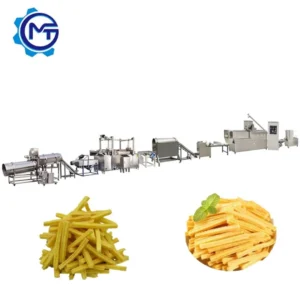
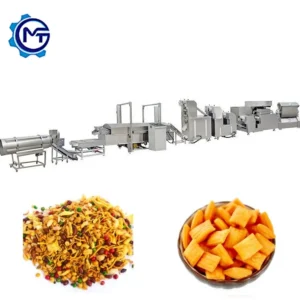
Complete Line Engineering — Every station from mixing to cooling is throughput-balanced to the extruder’s actual output, eliminating bottlenecked production.
Technical Specifications
| Parameter | Value |
|---|---|
| Product Type | Puffed Snack Production Line |
| Extruder Type | Single screw extruder |
| Output Capacity | 120 kg/h (basis not stated in source — confirm raw material mix and moisture content) |
| Rated Power | 50-70 kW |
| Voltage & Frequency | Three phase 380V/50Hz, Single phase 220V/50Hz (customizable to local voltage) |
| Overall Dimensions (L×W×H) | 12000-26000 × 1200 × 2200 mm |
| Construction Material | Food grade stainless steel 201/304 |
| Energy Options | Electricity, gas, diesel, or steam |
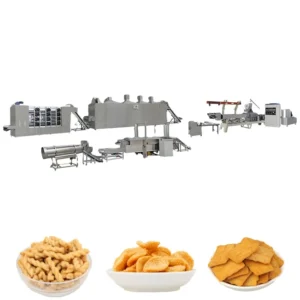
| Shapes Available | Screw shell, round tube, square tube, ring, cartoon shapes (via die adjustment) |
| Assembly State | Complete line |
| Certification | CE, ISO 9001 |
| Warranty | One year |
Application Suitability
| Application | Material or Output |
|---|---|
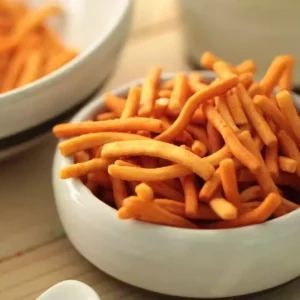
| Secondary puffing snack production | Grid-pattern crust snacks and strip rice cakes from wheat flour and starches |
| Golgappa and pani puri manufacturing | Thin-walled hollow spheres from wheat flour and corn starch blends |
| Shaped puffed snack formats | Cartoon shapes, rings, and tubes from potato starch and corn starch mixtures |
What "120 kg/h" Leaves Out About Puffed Snack Line Equipment
A rated capacity means nothing unless every station downstream can actually handle that volume.
The most common failure I see on frying chips making machine setups is not the extruder itself. It is the fryer or flavoring drum that cannot keep pace, causing product to back up and moisture to settle into the snack. When buyers quote puffed snack production line equipment for sale based on a single number, they often discover weeks after installation that the real bottleneck sits at the cooling conveyor or the coating station. [NEED_CITE: throughput matching in multi-station food processing lines]
Station-by-Station Throughput Matching
A puffed snack production line equipment for sale is only as reliable as its weakest link. The mixer feeds the screw conveyor, which must deliver a consistent volume to the single screw extruder. From there, the pulling and cutting machine must match the extrusion speed precisely, or the snack shapes deform before entering the automatic fryer. Each station on this line is configured so that the rated power and mechanical speed align with the actual throughput of the preceding step.
Shape Flexibility Through Die Configuration
Die selection determines whether you produce a grid-pattern crust, a round tube, or a cartoon shape. On a single screw platform, the die plate and cutting mechanism work together to define the final geometry. Changing between screw shell and ring formats requires swapping the die and adjusting the pulling speed accordingly. This flexibility matters when a manufacturer wants to test multiple product formats without investing in separate extruders. [NEED_CITE: die geometry and expansion behavior in starch extrusion]
Raw Material Behavior and Processing Parameters
The single screw extruder handles wheat flour, corn starch, and potato starch, but each material behaves differently under heat and shear. Wheat flour develops gluten structure that affects expansion. Corn starch gelatinises at a specific temperature window that the barrel heating zones must maintain. Potato starch requires careful moisture control to prevent excessive stickiness inside the barrel. The 50-70 kW rated power range provides sufficient thermal and mechanical energy for these varying material profiles.
Energy Source Selection for Frying and Drying
The line offers electricity, gas, diesel, or steam as energy options for the fryer and drying stations. This choice directly affects operating cost and facility infrastructure. A facility already running a steam boiler may find it economical to route steam to the fryer heat exchanger. A standalone snack factory without gas infrastructure may default to electric heating elements. The decision must be confirmed before production begins, as the heating hardware differs between options.
The Cost of Mismatched Station Capacity
When the automatic fryer runs slower than the extruder output, partially cut snack pieces pile up on the transfer belt and absorb ambient moisture. The result is uneven frying and inconsistent texture batch to batch. When the flavoring drum cannot complete a full coating cycle before the next batch arrives, seasoning coverage drops and product goes to waste. These problems do not show up on a spec sheet. [NEED_CITE: consequences of station throughput mismatch in snack processing]
Why Procurement Here Differs
Complete station coverage from one supplier means the mixer capacity, conveyor speed, extruder output, fryer volume, and cooling belt length are all calculated together rather than assembled from separate vendors. The food grade stainless steel 201/304 construction across contact surfaces is specified for the actual product being run, not a generic standard. In-house testing on your raw material before shipment confirms that the die configuration and barrel temperature profile produce the correct expansion. The voltage, frequency, and control language are confirmed to your facility before the line enters production. CE and ISO 9001 certification covers the complete assembly as delivered, not individual components sourced separately.
Documentation & Verification
- Line layout drawing showing station-by-station throughput calculation for your target output
- Machine specification sheet confirming voltage, frequency, and control language for your market
- Screw and die configuration record matched to your raw material and target snack shape
- Factory test record on your actual flour and starch blend before dispatch
- CE declaration of conformity covering the complete line assembly
- Wear parts list including dies, cutter blades, and screw segments with first-order package
Installation, Commissioning & Support
- Floor plan review for the 12000-26000 mm line length to confirm utility routing and access clearance
- Dedicated electrical circuit for the 50-70 kW rated power draw with voltage confirmed to local grid
- Station-by-station assembly sequence from mixer through cooling conveyor with alignment checkpoints
- First-run parameter setting on your raw material including barrel temperatures and cutting speed
- Operator training covering die changeover, fryer temperature control, and flavoring drum adjustment
- Spare die plates and cutter blades supplied with initial shipment to cover early replacement needs
What to Prepare Before Requesting a Quote
Provide the exact raw material formulation you intend to run, including any minor ingredients and target moisture content. Specify your local voltage, phase configuration, and frequency so the electrical cabinet is built correctly. Share your workshop dimensions and ceiling height to confirm the line layout fits. Indicate which energy source you prefer for the fryer station. If you have existing upstream or downstream equipment that must interface with this line, provide its specifications.
Frequently Asked Questions
Q: What is the output capacity of each station and how is throughput balanced across the line?
A: The extruder is rated at 120 kg/h, though actual output depends on your raw material mix and moisture content, which must be confirmed. Every downstream station — pulling and cutting machine, automatic fryer, flavoring drum, and cooling belt — is sized to handle that extruder output without creating a bottleneck. A station-by-station capacity calculation is provided with the line layout proposal.
Q: Which energy source is recommended for the fryer and dryer in my facility?
A: The line supports electricity, gas, diesel, or steam. The choice depends on what infrastructure your facility already has and local energy costs. If you have an existing steam boiler, routing steam to the fryer heat exchanger may be practical. If your facility runs only on electricity, the heating elements are specified accordingly. This must be confirmed before production begins.
Q: How do I select the right die configuration for my target snack shape?
A: Die selection depends on your raw material and the shape you want to produce — grid-pattern crust, round tube, ring, or cartoon shape. The single screw extruder uses interchangeable die plates, and the pulling and cutting speed must be adjusted to match each die’s expansion characteristics. A trial run on your actual raw material confirms the correct die and parameter combination before shipment.
Q: What is included in the line delivery scope?
A: The complete line covers the mixer, screw conveyor, single screw extruder, pulling and cutting machine, automatic fryer, automatic flavoring line, and cooling station. Conveying between stations is included. Packing equipment and dust extraction systems are separate scope items and must be specified during the layout phase. Confirm what ancillary equipment you need during the proposal stage.
Q: How are voltage, frequency, and control panel language confirmed before shipment?
A: These are confirmed during the specification review stage before the line enters production. Your local grid voltage, phase configuration, and frequency determine the electrical cabinet build. The control panel language is set to match your operators. Providing this information early prevents commissioning delays on site.