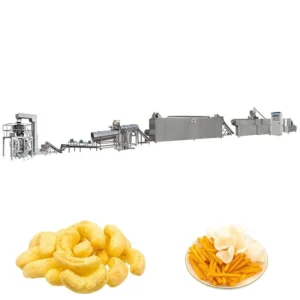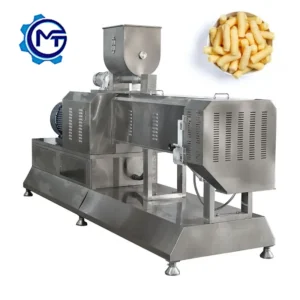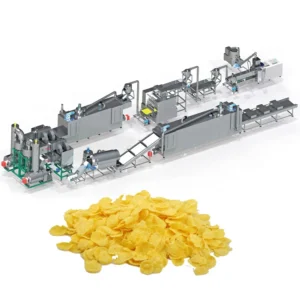
Balanced station throughput — every unit from the mixer to the packaging station is mapped to the same hourly target, so no single machine bottlenecks the line.
Technical Specifications
| Parameter | Value |
|---|---|
| Model | MT65 / MT70 / MT85 |
| Product Type | Corn Flakes and Rice Crispies Extrusion Production Line |
| Screw Type | Twin-screw |
| Installed Power | 86.35 kW (MT65), 90.75 kW (MT70), 121.06 kW (MT85) |
| Power Consumption | 55 kW (MT65), 57 kW (MT70), 85 kW (MT85) |
| Output Capacity | 100–150 kg/h (MT65), 150–200 kg/h (MT70), 200–350 kg/h (MT85) (basis not stated in source — confirm raw material and moisture) |
| Overall Dimensions | 21000×1200×2200 mm (MT65), 23000×1500×2200 mm (MT70), 28000×3500×4300 mm (MT85) |
| Control System | PLC-based control cabinet with adjustable temperature 0–200°C |
| Oven Type | Electric, stainless steel double-layer mesh belt, available in 3-layer, 5-layer, or 7-layer configurations |
| Oven Temperature Range | 0–200°C |
| Cutting Size Range | 2 cm – 20 cm, adjustable |
| Seasoning Options | Octagonal drum, cylinder, single-roller, or double-roller; supports oil spraying, sugar spraying, and coating |
| Line Stations | Mixer → Feeder → Extruder → Core Injection Machine → Cutting Machine → Elevator → Multilayer Oven → Elevator → Fuel/Oil Injection Machine → Roller (Seasoning Drum) → Packaging Machine |
| Raw Materials | Corn flour, rice flour, wheat flour, grain flour |
| Voltage & Frequency | Configurable to target market (basis to be confirmed) |
| Standards | CE |
Application Suitability
| Application | Material or Output |
|---|---|
| Traditional corn flakes production | Corn flour and maize grits, processed through flaking and toasting |
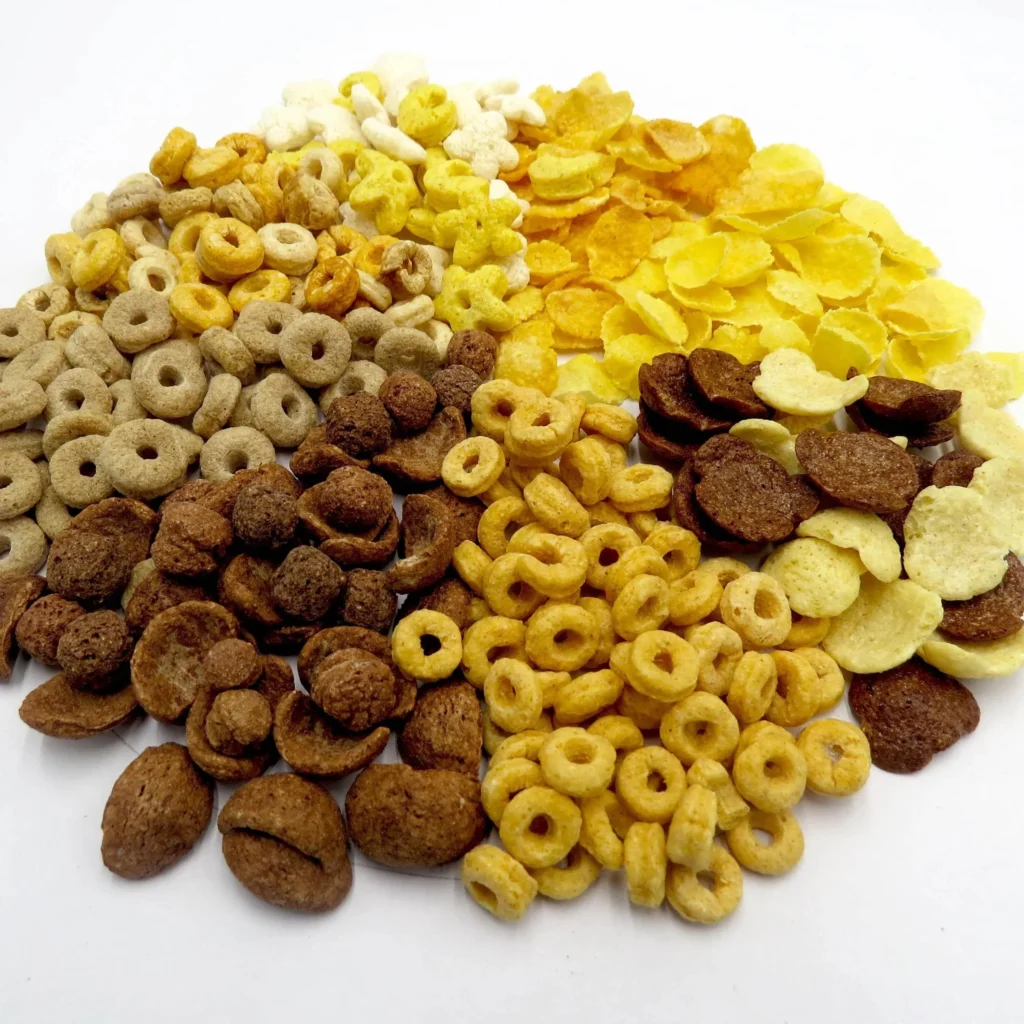
| Rice crispies and puffed cereal snacks | Rice flour or blended grain flour for light, expanded textures |
| Chocolate corn flakes and coated cereals | Base flakes passed through sugar or chocolate coating stations |
| Core-filled and sandwich snacks | Peanut butter, chocolate sauce, or fruit paste injected between extruded shells |
| Nutritious and fortified breakfast cereals | Grain flour blended with vitamin and mineral premixes |
| Wheat flaking and multigrain snacks | Wheat flour or combined grain formulations |
Why Matching Oven Capacity to Extruder Output Matters on a Corn Flakes Extrusion Production Line
An undersized dryer turns a high-capacity extruder into an expensive bottleneck.
When buyers evaluate a corn flakes extrusion production line full equipment range, the conversation often starts with extruder output and ends there. But extruded cereal leaves the die at high moisture and must be dried to a precise level before flaking or packaging. If the multilayer oven cannot remove moisture fast enough, product backs up on the conveyor, residence time becomes inconsistent, and the entire line slows to match the dryer’s pace. [NEED_CITE: moisture removal requirements in cereal extrusion processing] I have seen lines where the extruder was rated for a certain throughput on paper, yet the oven’s belt speed and thermal profile could not keep up with the actual material flow on the buyer’s specific grain blend. The result was a line that ran at a fraction of its nameplate capacity during the first production season.
Every Station Catalogued for Throughput Matching
This corn flakes extrusion production line full equipment range lists each station individually — mixer, feeder, twin-screw extruder, core injection unit, cutter, elevator, multilayer oven, oil injection drum, seasoning roller, and packaging machine. The purpose is straightforward: when a buyer or a machinery distributor reviews the catalogue, they can compare the rated capacity of every station and confirm that no single unit constrains the others. Throughput balancing is the difference between a line that delivers its stated output and one that requires constant manual intervention to prevent material pile-ups between stages.
Oven Layer Configuration and Floor Space Planning
The electric multilayer oven is available in 3-layer, 5-layer, or 7-layer configurations, each affecting both drying capacity and the physical footprint of the line. A 3-layer oven suits lower-throughput lines or facilities with limited floor length, while a 7-layer unit provides extended residence time for higher volumes or denser cereal products that require gradual moisture reduction. The stainless steel double-layer mesh belt carries product through adjustable temperature zones from ambient up to 200°C, giving operators control over the drying curve. [NEED_CITE: thermal profile impact on cereal flake texture and shelf stability] Choosing the right layer count depends on the target output, the moisture content entering the oven, and the available ceiling height in the production hall.
Reading the Specification Sheet Beyond Installed Power
Three extruder models — MT65, MT70, and MT85 — cover output ranges from small-batch production to continuous industrial volumes. Installed power rises from 86.35 kW on the MT65 to 121.06 kW on the MT85, but power consumption under load sits lower at 55 kW, 57 kW, and 85 kW respectively. This gap between installed and consumed power reflects motor sizing for peak startup torque rather than steady-state draw. The PLC-based control cabinet lets operators set barrel temperature profiles across the 0–200°C range, which directly affects starch gelatinisation in corn and rice flour. The twin-screw configuration provides the shear and mixing intensity needed to handle varying grain particle sizes, a factor that single-screw designs often struggle with when raw material consistency varies between batches.
The Cost of Overlooking Downstream Stations
Skipping the oil injection or seasoning drum specification might seem minor during the quotation phase, yet it surfaces as a real constraint once production begins. An undersized seasoning drum cannot coat flakes evenly at full line speed, leading to rejected batches with inconsistent flavour distribution. Similarly, a core injection machine that cycles slower than the extruder output forces the cutting station to idle, wasting extruded material that has already passed through the barrel. [NEED_CITE: downstream station bottlenecks in snack food extrusion lines] These mismatches are avoidable when every station in the corn flakes extrusion production line full equipment range is specified together rather than sourced from separate vendors who do not coordinate throughput ratings.
Why Source the Full Range From One Supplier
Screw configuration and die design are specified to the buyer’s actual raw material and target product, not copied from a generic build. An in-house testing workshop allows trial runs on the customer’s corn flour or rice flour before shipment, so extrusion parameters are established in advance rather than discovered during on-site commissioning. Every supporting station — from the batching mixer through the packaging machine — is matched for throughput under a single line layout document, eliminating the coordination gap between independent equipment vendors. Pre-sales consultation includes line layout and capacity calculation, and the documentation package covers machine specifications, electrical schematics, and CE declarations for each station.
Documentation & Verification
- Line layout and capacity calculation showing throughput match across all stations from mixer to packaging machine
- Machine specification sheet for each selected model with screw configuration and die design record
- Electrical schematic confirming voltage, frequency, and PLC control language for the target market
- Trial run report produced on the buyer’s actual corn or rice flour before dispatch
- CE declaration of conformity covering each station in the line
Installation, Commissioning & Support
- Foundation plan accounts for the MT85’s 28-meter line length and 4.3-meter height clearance requirement
- Dedicated power circuit sized for the selected extruder’s installed power up to 121.06 kW
- PLC control cabinet configured with the buyer’s local voltage, frequency, and preferred operating language before shipment
- First-run commissioning includes barrel temperature profiling and oven zone calibration on the buyer’s grain formulation
- Operator training covers screw speed, feeder rate, and cutting size adjustment across the 2 cm to 20 cm range
- Wear parts list itemises replacement screws, dies, and mesh belts with recommended stocking quantities
Preparing Your Inquiry
To receive an accurate line configuration, share the specific grain flour or blend you plan to process, along with the target hourly output on that material. Provide your facility’s available floor length and ceiling height so the oven layer configuration and overall dimensions can be matched to your space. Include your local voltage and frequency standard, the preferred PLC interface language, and whether you require core injection for filled snack formats.
Frequently Asked Questions
Q: How do I match extruder output to dryer and seasoning drum capacity to avoid bottlenecks?
A: Each station in the line carries its own throughput rating. We calculate the moisture load entering the oven based on your raw material and extrusion parameters, then select a 3-, 5-, or 7-layer configuration that removes that moisture within the required residence time. The seasoning drum diameter and rotation speed are sized to coat the full output volume evenly at line speed.
Q: What voltage, frequency, and control language options are available for each station?
A: The PLC-based control cabinet and all motor drives are configured before shipment to match your facility’s electrical supply, whether that is 380V/50Hz, 440V/60Hz, or another standard. The HMI language is set to your operators’ preference. Confirming these details during the specification phase prevents commissioning delays.
Q: Which oven layer configuration suits my target output and floor space?
A: A 3-layer oven handles lower throughput or fits shorter production halls, while a 7-layer unit provides the extended belt length needed for higher volumes or products requiring gradual drying. We factor in your extruder model’s output and the moisture content of the extrudate to recommend the configuration that balances capacity with your available footprint.
Q: Can individual stations be ordered separately or only as a complete line?
A: Individual stations such as the multilayer oven, seasoning drum, or core injection machine can be specified independently for integration into existing lines. When ordered separately, we confirm mechanical and electrical interface points to ensure compatibility with your upstream and downstream equipment.
Q: What spare wear parts are stocked and how are they supplied?
A: A wear parts list accompanies every line, identifying screws, dies, and oven mesh belts that experience routine wear. Replacement sets can be included with the initial shipment or ordered separately. The list specifies part numbers and recommended replacement intervals based on the raw material being processed.