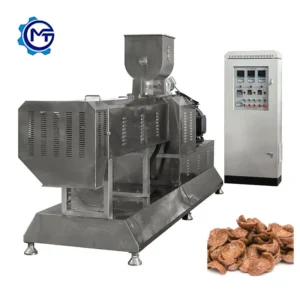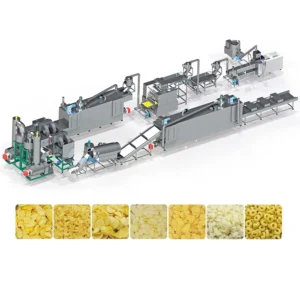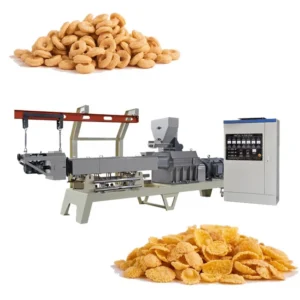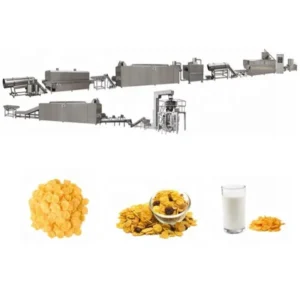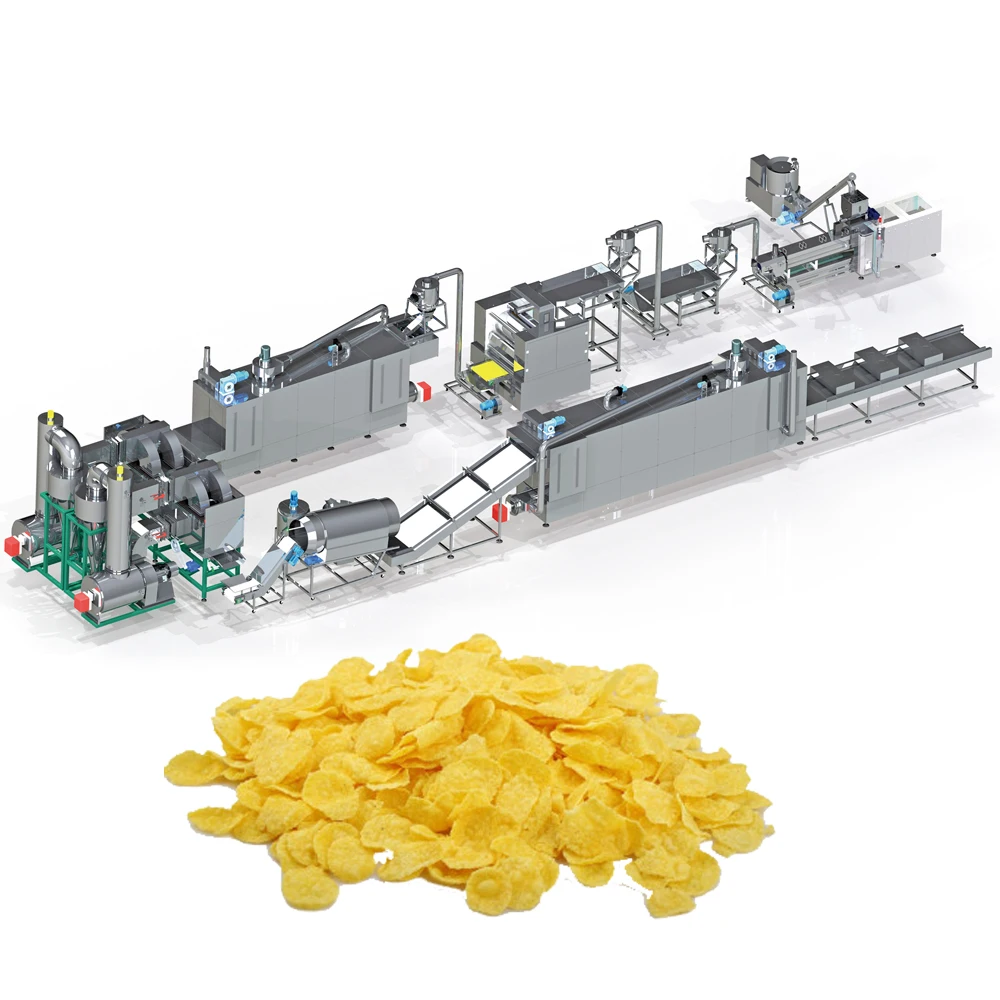
Throughput-matched line design — Every station from the mixer to the sugar spraying system is sized so that the extruder, press, oven, and coating drum run at the same verified rate, preventing the bottlenecks that occur when a line is assembled from separate vendors.
Technical Specifications
| Parameter | Value |
|---|---|
| Model | MT-65 |
| Product Type | Corn Flakes Production Line |
| Extruder Type | Twin Screw (co-rotating, sectional modules) |
| Installed Power | 84 kW |
| Real Power | 59 kW |
| Output Capacity | 120-150 kg/h (basis not stated in source — confirm raw material and moisture content) |
| Overall Dimensions | 12000×1200×2200 mm |
| Control System | Separate Controller Box |
| Screw Feature | Self-cleaning function |
| Gear Box | Oil forced automatic lubrication system |
| Cutting System | Non-stop cutting system |
| Mixer Tank Size | φ600×500 mm |
| Mixer Dimension | 1000×800×1200 mm |
| Mixer Power | 4 kW |
| Mixer Output | 10-30 kg/load |
| Screw Conveyor Power | 0.75 kW |
| Screw Conveyor Dimension | 2700×500×2400 mm |
| Corn Flakes Press Machine Power | 16.12 kW |
| Corn Flakes Press Machine Size | 1550×1300×2000 mm |
| Press Roller Size | 510×310×1050 mm |
| Press Machine Feature | Big roller with cooling system, adjustable roller distance for flakes thickness |
| High-temperature Oven Size | 4.5×1.4×1.8 m |
| High-temperature Oven Power | 3.75 kW |
| Oven Heating | Gas, both-side baking system |
| Sugar Spraying System Total Power | 28.75 kW |
| Sugar Spraying System Dimension | 4000×1900×1880 mm |
| Sugar Spraying Roller Size | Ø600×2700 mm |
| Key Features | Self-cleaning screws, oil-forced gear box lubrication, non-stop cutting, adjustable roller gap |
Application Suitability
| Application | Material or Output |
|---|---|
| Traditional Corn Flakes | Corn grits, corn flour |
| Fortified Breakfast Cereals | Wheat flour, rice flour blended with vitamin premix |
| Multi-Grain Flakes | Oats, soya bean, peanut, walnut formulations |
| Sweetened Cereal Snacks | Sugar-coated or syrup-glazed puffed shapes |
| Core-Filled Snacks | Filled pillow shapes with cream or fruit paste center |
Why "Nominal Capacity" Often Fails on Real Raw Material
Actual throughput depends entirely on your specific recipe moisture, starch profile, and target flake density.
A corn flakes machine full equipment range quoted at a specific hourly figure often collapses when the buyer switches corn suppliers or adjusts the oat ratio in the mix. Higher moisture or higher fat content changes how the dough behaves inside the barrel, altering expansion and slowing the downstream press. I have seen lines stall because the extruder could not push the formulation through the die at the quoted rate, leaving the oven running half-empty [NEED_CITE: material moisture impact on extrusion throughput].
How the Twin-Screw Profile Shapes the Flake
The co-rotating sectional screw modules handle forward transport, mixing, de-gassing, cooking, and forming in a single barrel. This modular arrangement allows the screw profile to be adjusted so that corn grits gelatinise fully before reaching the die, which is critical for achieving the crisp texture expected in a corn flakes machine full equipment range. The self-cleaning function means the screws wipe each other during rotation, reducing dough buildup and keeping batch consistency tight across long production runs.
Matching the Press and Oven to Extruder Output
The press machine uses a large-diameter roller with an integrated cooling system and an adjustable gap to control flake thickness precisely. If the roller gap is too wide, the flakes remain too thick and do not crisp properly in the oven; too narrow, and they shatter during handling. The gas-fired high-temperature oven uses a both-side baking system across its 4.5-meter length to drive moisture out evenly, which is essential for shelf stability [NEED_CITE: baking uniformity requirements for shelf-stable cereals].
Reading the Power and Dimension Data
The installed power of 84 kW versus the real power of 59 kW indicates the peak draw during startup versus steady-state running — a distinction that matters when sizing the workshop transformer. The gear box relies on an oil-forced automatic lubrication system rather than splash lubrication, which protects the gears during continuous shifts. The 12-meter overall line length requires a clear workshop bay with adequate headroom, as the screw conveyor alone stands 2.4 meters tall and feeds material overhead into the extruder hopper.
The Cost of Mismatched Station Throughput
When the extruder pushes material faster than the press can flatten it, dough accumulates on the conveyor and must be scrapped. When the oven cannot dry flakes as fast as they arrive, the product exits with residual moisture, leading to sogginess and shortened shelf life. These mismatches are common when stations are sourced separately, and they surface only after installation, when reconfiguring the line is expensive and disruptive [NEED_CITE: consequences of throughput mismatch in food processing lines].
Why Buyers Specify This Equipment Range Here
The entire corn flakes machine full equipment range comes from a single source, meaning the mixer load size, conveyor speed, extruder output, press capacity, oven length, and coating drum diameter are calculated together rather than assembled from independent catalogues. Screw configuration and die design are specified to the buyer’s actual corn or oat formulation. An in-house testing workshop runs the buyer’s raw material before shipment, so throughput and product texture are verified before the line leaves the factory. Pre-sales consultation covers line layout, and support extends through installation, commissioning, and ongoing maintenance.
Documentation & Verification
- Line layout drawing showing station positions, conveyor routes, and utility connection points for the 12-meter line
- Machine specification sheet listing the 84 kW installed and 59 kW real power for transformer sizing
- Screw and die configuration record matched to your specific corn grits or multi-grain formulation
- Trial run report documenting throughput and flake texture on your raw material before shipment
- Electrical schematic confirming voltage, frequency, and controller language for your facility
Installation, Commissioning & Support
- Foundation plan accommodating the 12000×1200×2200 mm line footprint with level tolerance for the press roller alignment
- Dedicated electrical circuit sized for the 84 kW installed power with separate controller box placement
- Assembly sequence for the screw conveyor, extruder, press, oven, and sugar spraying system
- First-run parameter setting for barrel temperature zones, roller gap, and oven gas flow rate
- Operator training covering screw self-cleaning procedures and gear box oil lubrication checks
- Wear parts list identifying screws, dies, and press rollers with lead times for replacement orders
What We Need to Configure Your Line
To size the stations correctly, share your primary raw material (corn grits, oats, or a multi-grain blend), the target moisture content after mixing, and the desired hourly output in kilograms. Confirm the available voltage and frequency at your facility, and the control language your operators require. If you have existing upstream milling or downstream packing equipment, provide the interface dimensions so the conveyor and sugar spraying system can be matched.
Frequently Asked Questions
Q: How is the output capacity verified against my specific raw material and recipe?
A: Before shipment, your raw material is run in the in-house testing workshop. The trial documents actual throughput, flake thickness, and texture, so the capacity figure you receive reflects your specific corn or oat formulation rather than a generic catalogue value.
Q: What supporting stations are included, and how is throughput matched between them?
A: The line includes the mixer, screw conveyor, twin-screw extruder, flake press, gas oven, and sugar spraying system. Each station is sized so that material flows continuously without accumulation or starvation at any transfer point.
Q: What voltage, frequency, and control language options are confirmed before shipment?
A: The electrical schematic is prepared after confirming your facility’s power supply. The separate controller box is configured with the appropriate voltage rating and the operator interface language your team requires for daily production.
Q: Is a trial run on my raw material performed before the line ships?
A: Yes. The testing workshop runs your actual formulation through the extruder and press. The resulting trial report records throughput, flake dimensions, and any screw or die adjustments made, so your line arrives production-ready.