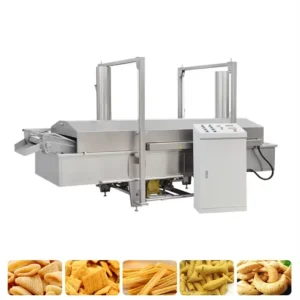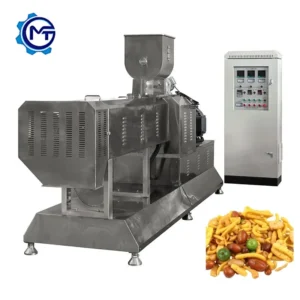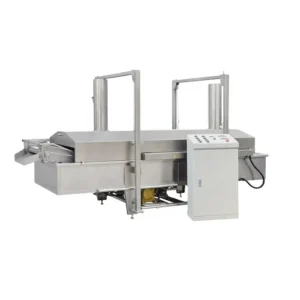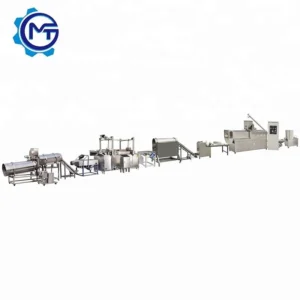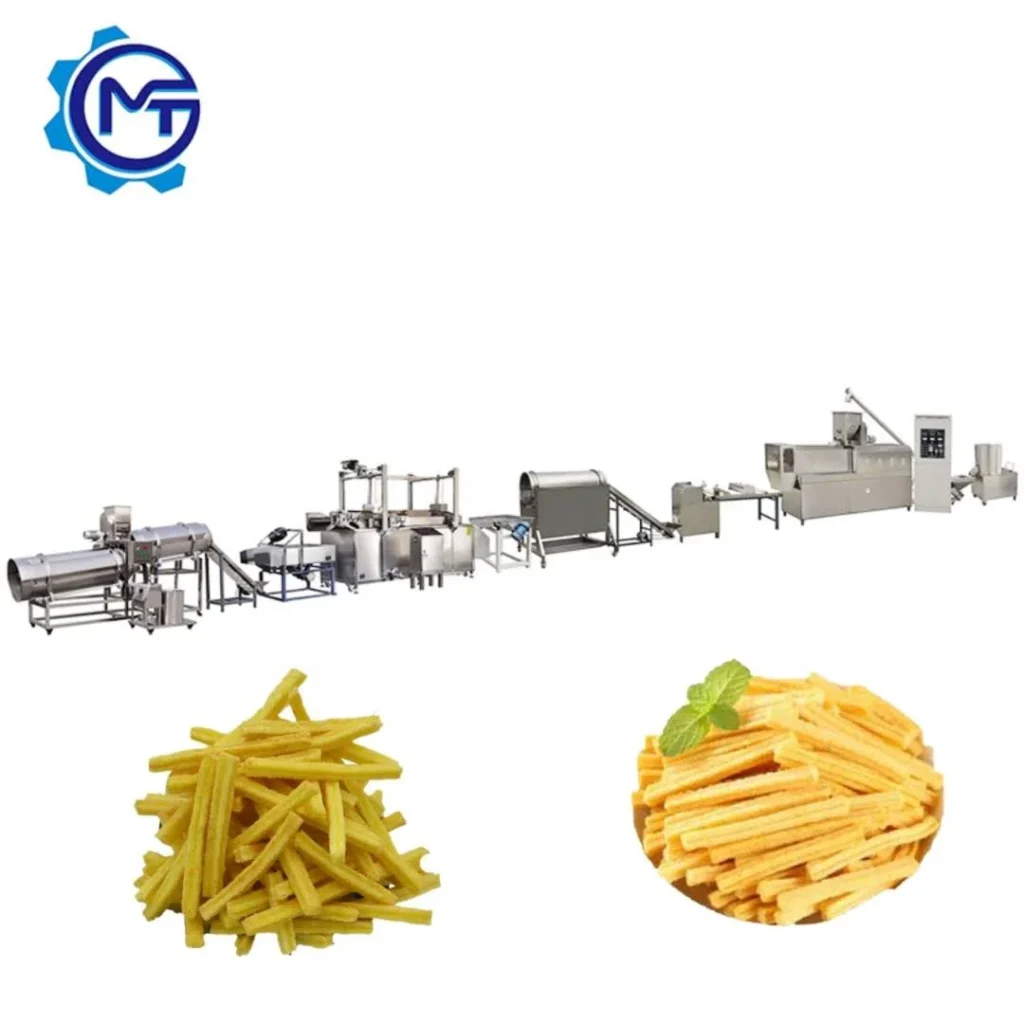
Throughput-Matched Stations — every unit from mixer to flavoring drum is specified as one system, so fryer belt speed and drum rotation stay in step with extruder output.
Technical Specifications
| Parameter | Value |
|---|---|
| Product Type | Fried Snack Food Extrusion and Frying Production Line |
| Line Configuration | Mixer → Press machine → Cutting machine → Fryer → Flavoring machine |
| Fryer Rated Power | 60 kW |
| Flavoring Drum Power | 0.37 kW |
| Voltage & Frequency | Three phases 380V/50Hz, Single phase 220V/50Hz (configurable to destination standard) |
| Control System | Available with PLC or MCC control |
| Certification | CE |
| Assembly State | Complete line with all supporting stations |
| Output Capacity | (basis not stated in source — confirm raw material and target format) |
Application Suitability
| Application | Material or Output |
|---|---|
| Rice crust chips and savory crackers | Wheat flour blends with rice grits |
| Bugles and pillow-shaped snacks | Corn flour and wheat flour composites |
| Expanded fried pellets | Starch-based dough with corn or potato input |
| Coated and seasoned snack formats | Post-fry flavoring with powdered or oil-based seasoning |
What "Line Capacity" Leaves Out About Fried Snack Output
A quoted throughput figure means nothing until the fryer and flavoring drum can actually keep pace with the extruder.
I worked with a snack producer who sized his line around an extruder rated for a certain hourly output on plain wheat flour. When he introduced a corn-heavy recipe, the dough expanded less, the cutting station ran slower to maintain shape integrity, and the fryer ended up half-empty on every pass. The whole line bottlenecked at the press station because the screw configuration and downstream belt speeds were never re-matched to the new material. That producer spent weeks recalibrating before the fryer and extruder finally ran in sync. [NEED_CITE: common throughput mismatch issues in snack extrusion lines]
Matching Every Station From Dough Mixing Through Seasoning
A fried snack food processing line for sale only delivers consistent output when each station is specified against the same raw material and target format. The mixer must produce a dough moisture level that the press machine can handle without sticking or tearing. The cutting machine then needs a blade speed matched to the dough’s elasticity, which shifts depending on whether you are running wheat flour or a corn-heavy blend.
Why Fryer Sizing Decides Your Actual Daily Output
The 60 kW fryer in this line is not just a heating element — its belt length, oil volume, and layer configuration determine how many pieces pass through per minute. If the fryer is undersized relative to the extruder, product queues up on the cutting table and cools before entering the oil, which causes uneven expansion and color variation. We configure fryer dimensions and oil circulation to the specific snack geometry, whether you are producing thin rice crust chips or thicker pillow snacks that require a longer dwell time in hot oil. [NEED_CITE: fryer sizing principles for extruded snack lines]
Reading the Specs That Actually Matter
The voltage and frequency specification — three-phase 380V/50Hz as standard — needs early confirmation against your factory supply. We have seen production delayed by weeks because a buyer’s local grid runs at 60Hz while the motors were wound for 50Hz, causing the press machine and fryer conveyor to run at mismatched speeds. The PLC or MCC control option affects how your operators interact with temperature zones and belt speeds; PLC enables recipe storage for quick changeovers between wheat flour and corn-based runs, while MCC provides direct motor control at a simpler interface level. Food-grade contact materials throughout the line mean that every surface touching the dough or fried product meets hygiene standards required for export markets, and CE certification covers the full assembly rather than individual stations.
The Cost of Skipping the Trial Run
Buyers who skip pre-shipment testing on their actual raw material often discover problems only after installation. A wheat flour recipe that puffs perfectly in our Shandong workshop may behave differently with corn grits sourced from your local supplier, where particle size and starch content vary. Without a trial run, you risk receiving a screw configuration that produces under-expanded dough, forcing the fryer to work harder and the flavoring drum to apply excess seasoning to compensate for poor texture. [NEED_CITE: importance of raw material trial runs in food extrusion]
Why Producers Source This Line From MT
Complete station integration under one supplier means the mixer output, press capacity, fryer belt speed, and flavoring drum rotation are calculated together, not assembled from separate vendors who each optimize for their own machine. The in-house testing workshop allows us to run your actual flour blend and confirm expansion behavior before the line ships. Screw and die configuration is documented for your specific recipe, so when you reorder wear parts months later, the replacements match the original setup exactly. Electrical schematics and voltage confirmation are completed during the order stage, preventing commissioning delays caused by frequency mismatches or control language barriers.
Documentation & Verification
- Line layout drawing with throughput calculation across mixer, press, fryer, and flavoring stations
- Screw and die configuration record matched to your wheat flour or corn-based recipe
- Electrical schematic confirming voltage, frequency, and control language for your market
- Trial run report on your raw material documenting expansion, texture, and fryer dwell results
- CE declaration of conformity covering the complete assembled line
- Wear parts list with first replacement schedule for screws, dies, and fryer belt components
Installation, Commissioning & Support
- Foundation plan accounting for fryer weight and oil load with level tolerance for cutting accuracy
- Dedicated power circuit sizing for the 60 kW fryer and extruder motor to prevent voltage drop
- Station-by-station alignment from mixer discharge through press, cutter, fryer, and flavoring drum
- First-run parameter logging for dough moisture, oil temperature, belt speed, and drum rotation
- Operator training covering PLC recipe storage for changeovers between snack formats
- Spare screw and die inventory recommendation based on your production hours and recipe abrasiveness
What to Prepare Before Requesting a Quote
To configure a fried snack food processing line for sale that matches your production target, we need your primary raw material specification including flour type and particle size, the snack formats you plan to produce such as bugles or rice crust chips, and your target hourly output on that specific recipe. Confirm your factory voltage and frequency, the control language your operators require, and whether you can ship a sample of your raw material to our testing workshop for a pre-shipment trial run.
Frequently Asked Questions
Q: How is line capacity verified against my specific raw material and snack format?
A: We run your actual flour blend through the press machine in our testing workshop, measuring expansion rate, cut weight, and fryer dwell time. The trial run report documents throughput on your recipe, not a generic wheat flour baseline, so the capacity figure you receive reflects your real production conditions.
Q: Can voltage, frequency, and control language be configured for my destination market?
A: Yes. The standard three-phase 380V/50Hz configuration is adjusted during the order stage to match your local grid, including 60Hz markets. Control panel labels, PLC interface language, and electrical schematics are all prepared in your required language before the line ships.
Q: What trial runs are performed before shipment, and can I send my raw material?
A: You can ship your flour or corn blend to our Shandong workshop. We run it through the full station sequence — mixing, pressing, cutting, frying, and flavoring — and provide a documented report covering product density, color, texture, and achievable throughput on your material.
Q: How are fryer capacity and flavoring drum throughput matched to extruder output?
A: The 60 kW fryer belt length and oil circulation rate are sized to the extruder’s cut-piece output, ensuring every piece enters the oil within the correct temperature window. The 0.37 kW flavoring drum rotation speed is then set so that seasoned product exits at the same rate the fryer delivers it.