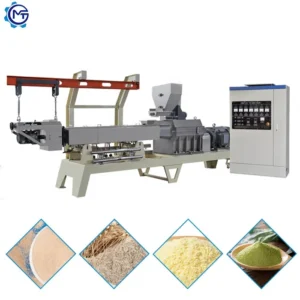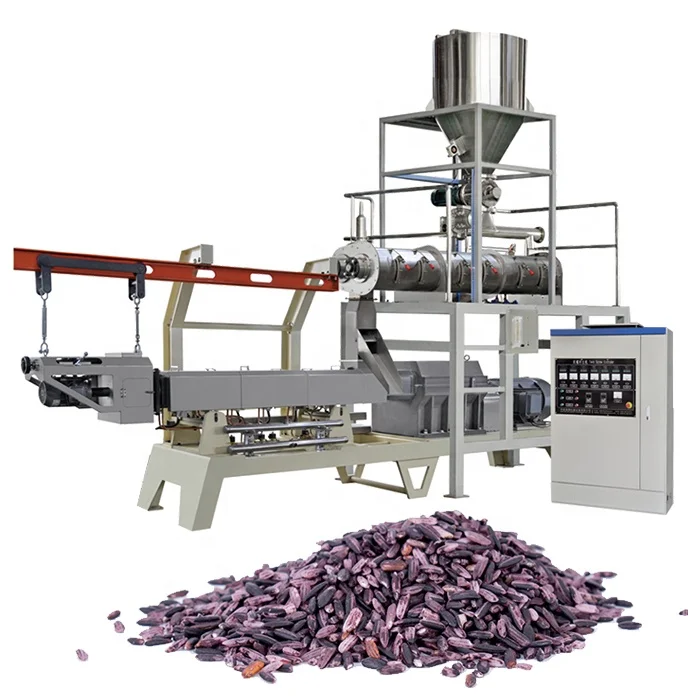
Screw Configuration Matched to Your Grain Base — Every MT65 through MT95 extruder in this Fortified Rice Kernel Extrusion Line ships with screw and die geometry specified to the buyer’s actual broken rice, starch, or millet formulation, not a generic build.
Technical Specifications
| Parameter | Value |
|---|---|
| Model | MT65 / MT70 / MT75 / MT85 / MT95 |
| Product Type | Fortified Rice Kernel Extrusion Line |
| Screw Type | Twin-screw |
| Installed Power | MT65 — 85 kW; MT70 — 120 kW; MT75 — 180 kW; MT85 — 235 kW; MT95 — 260 kW |
| Power Consumption | MT65 — 60 kW; MT70 — 85 kW; MT75 — 135 kW; MT85 — 165 kW; MT95 — 195 kW |
| Output Capacity | MT65 — 80–100 kg/h; MT70 — 100–120 kg/h; MT75 — 300–500 kg/h; MT85 — 200–300 kg/h; MT95 — 800–1000 kg/h (basis to be confirmed with raw material formulation and moisture content) |
| Overall Dimensions (L×W×H) | MT65 — 28 × 1.2 × 2.2 m; MT70 — 30 × 1.5 × 2.2 m; MT75 — 32 × 3.5 × 4.3 m; MT85 — 34 × 3.5 × 4.3 m; MT95 — 36 × 3.5 × 4.3 m |
| Feeding System | Single or double screw feeding, selectable per raw material |
| Screw Material | Wear-resistant alloy, special processing technology |
| Lubrication | Automatic lubricating and cooling system |
| Control System | Frequency speed controlling with high automation |
| Drying Oven Heating Source | Electric or gas |
| Drying Oven Feature | Circulation drying with frequency motor-controlled mesh belt speed |
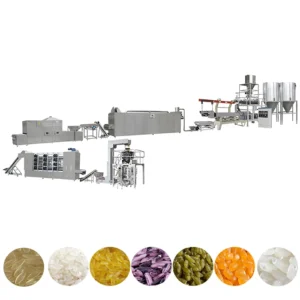
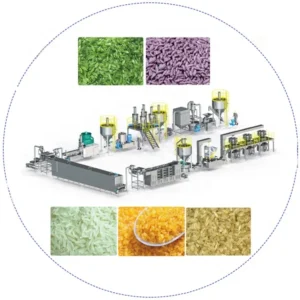
| Line Stations | Mixing → Extruding → Vibrating → Low temperature drying → Cooling → High temperature roasting → Cooling → Packing |
| Assembly State | Complete production line |
Application Suitability
| Application | Material or Output |
|---|---|
| Fortified rice kernel production | Broken rice, rice bran, corn, millet, wheat, oats, buckwheat, bean, starch base with vitamin and mineral premix |
| Nutritional rice reconstitution | Broken rice and rice bran blended with micro-nutrients for food programme distribution |
| Artificial grain pellet production | Starch-dominant formulations shaped into rice-like kernels for nutritional supplementation |
What "800 kg/h Output" Leaves Out on a Fortified Rice Line
Capacity figures are meaningless unless tied to the exact raw material blend and moisture level you will actually run.
I once watched a nutrition programme supplier receive an extrusion line rated at an impressive hourly output, only to discover that their local cassava starch gelatinised at a completely different temperature than the corn starch used during factory testing. The actual throughput dropped dramatically. This Fortified Rice Kernel Extrusion Line catalogue exists so buyers can see every station’s capability before committing. [NEED_CITE: starch gelatinisation temperature differences across grain sources]
Station-by-Station Equipment Breakdown
The Fortified Rice Kernel Extrusion Line begins with a mixing and batching station where broken rice, starch, and vitamin premix are blended before entering the feeding system. The selectable single or double screw feeder adapts to whether the material flows freely or tends to bridge in the hopper. Downstream, the extruder discharges into a vibrating conveyor that separates kernels before they enter the low temperature drying stage.
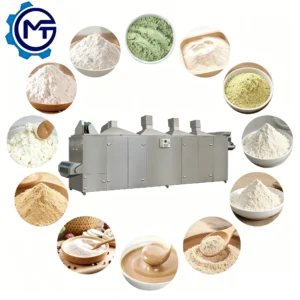
The drying oven uses circulation drying with a frequency motor-controlled mesh belt, allowing residence time to be adjusted to match the extruder’s output rate. After cooling, kernels pass through a high temperature roasting station for surface hardening, then a second cooling phase before packing. Every station in this machine catalogue is sized so throughput is matched across the entire chain rather than bottlenecked at one point. [NEED_CITE: throughput matching principles in extrusion line design]
How Screw and Die Selection Affects Kernel Density
The twin-screw extruder series spans five models from the MT65 to the MT95, each with a different barrel diameter and screw configuration. For a formulation high in broken rice and low in starch, a shorter residence time and specific die geometry keep the kernel firm enough to survive packing without crushing. For a starch-heavy nutritional premix targeting soft-cooking reconstitution, a different screw profile and die aperture control expansion and moisture retention.
The automatic lubricating and cooling system on each extruder supports continuous operation throughout a full production shift, reducing thermal drift in the barrel that would otherwise alter kernel texture batch-to-batch. Wear-resistant alloy screw elements hold their profile longer through abrasive grain mixes, extending the interval between replacement cycles. Buyers comparing this Fortified Rice Kernel Extrusion Line against other options should request the screw and die configuration record specific to their formulation.
Power Draw and Drying Oven Sizing Explained
Installed power ranges from 85 kW on the MT65 to 260 kW on the MT95, while actual power consumption sits lower — between 60 kW and 195 kW — reflecting the difference between peak motor rating and typical running load. This gap matters when sizing your facility’s transformer and dedicated circuit. The drying oven heating source is available in electric or gas, a decision that shifts utility planning significantly. Gas-fired ovens require ventilation and fuel line infrastructure; electric ovens demand substantial amperage on the distribution panel. Either way, the oven’s circulation drying process must be matched to the extruder’s moisture output. Frequency motor control on the mesh belt means operators can slow or speed drying to suit seasonal humidity changes without mechanical adjustments. The overall line dimensions stretch up to 36 metres for the MT95, requiring a facility with adequate floor length and ceiling clearance for the drying and roasting sections.
The Hidden Cost of Skipping Station Matching
An extruder running at full capacity is worthless if the downstream dryer cannot remove moisture fast enough. Kernels leave the extruder at a moisture level that makes them pliable and prone to deformation. If the drying oven belt speed is not calibrated to the extruder output, kernels stick together or develop uneven moisture pockets that crack during roasting. I have seen buyers discover this problem only after installation, when the cost of adding or replacing a dryer far exceeds the price difference of specifying correctly from the start. [NEED_CITE: consequences of mismatched extruder and dryer throughput]
Why Source This Equipment Range Here
Screw configuration and die design are specified to the buyer’s actual raw material rather than copied from a generic template build. The in-house testing workshop allows trial runs on your specific broken rice, starch, or millet formulation before the line ships. Electrical schematics and voltage confirmation are completed before production begins, not discovered during commissioning. The complete line from mixing through packing comes under one supplier, eliminating the integration gaps that appear when stations are sourced from separate vendors. CE-certified construction meets export documentation requirements across markets. Documentation includes a trial run report on the customer’s own raw material, giving buyers a verified baseline before the equipment leaves the factory.
Documentation & Verification
- Line layout and capacity calculation showing throughput across every station from mixer to packer
- Screw and die configuration record matched to your grain base and target kernel density
- Electrical schematic with voltage and frequency confirmation for your local grid before production
- Factory test record and trial run report on your actual raw material before dispatch
- CE declaration of conformity for export market compliance
- Operation and maintenance manual with wear parts list and replacement intervals
Installation, Commissioning & Support
- Floor plan allocation based on line dimensions up to 36 × 3.5 × 4.3 m for the MT95 configuration
- Dedicated electrical circuit sized to 60–195 kW running consumption depending on selected model
- Utility connection points for electric or gas heated drying oven confirmed before shipment
- On-site commissioning includes parameter setting for your raw material moisture and formulation
- Operator training covers screw speed, die pressure, and mesh belt adjustment for consistent kernel output
- Wear parts list includes screw elements and die plates with first replacement schedule
What to Include in Your Inquiry
Send us the specific grain formulation you plan to run — broken rice ratios, starch type, and any vitamin or mineral premix details — along with your target daily output and facility floor dimensions. Confirm your local voltage, frequency, and preferred control language so electrical and automation systems are built correctly. If you want a trial run on your actual raw material in the testing workshop before shipment, include a sample shipment plan with your inquiry.
Frequently Asked Questions
Q: How do I match extruder capacity to dryer and packing station throughput on a fortified rice line?
A: Request the line layout and capacity calculation document from the supplier. This shows how each station’s throughput aligns from the mixer through the twin-screw extruder, drying oven, roasting section, and packer. Mismatched stations create bottlenecks that reduce the line’s effective output below the extruder’s rated figure.
Q: What voltage, frequency, and control language options are available for each model?
A: Electrical specifications are confirmed during the proposal stage based on your facility’s local grid. The control system supports frequency speed controlling with high automation, and the interface language is set before production begins to avoid delays during commissioning.
Q: Which feeding system suits my raw material blend?
A: Single screw feeding works for free-flowing granular blends, while double screw feeding handles formulations that tend to bridge or clump in the hopper. The choice depends on your specific broken rice, starch, and premix characteristics.
Q: What spare wear parts are included and when is the first replacement due?
A: The delivery package includes a wear parts list covering screw elements and die plates. Replacement intervals depend on the abrasiveness of your grain formulation and daily operating hours, documented in the maintenance manual provided with the line.
Q: Can I arrange a trial run on my own raw material before shipment?
A: Yes. The testing workshop can process your actual broken rice and starch formulation on the selected extruder model. The resulting trial run report documents output rate, kernel density, and moisture levels as a verified baseline before the equipment ships.