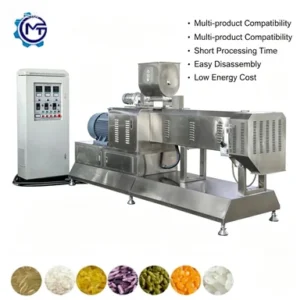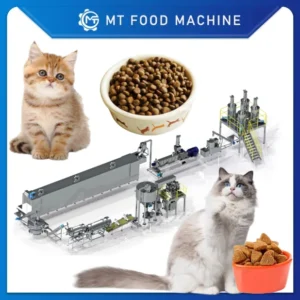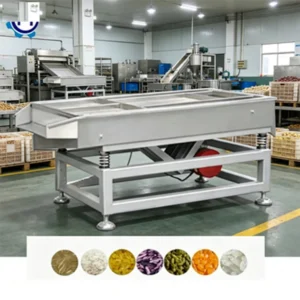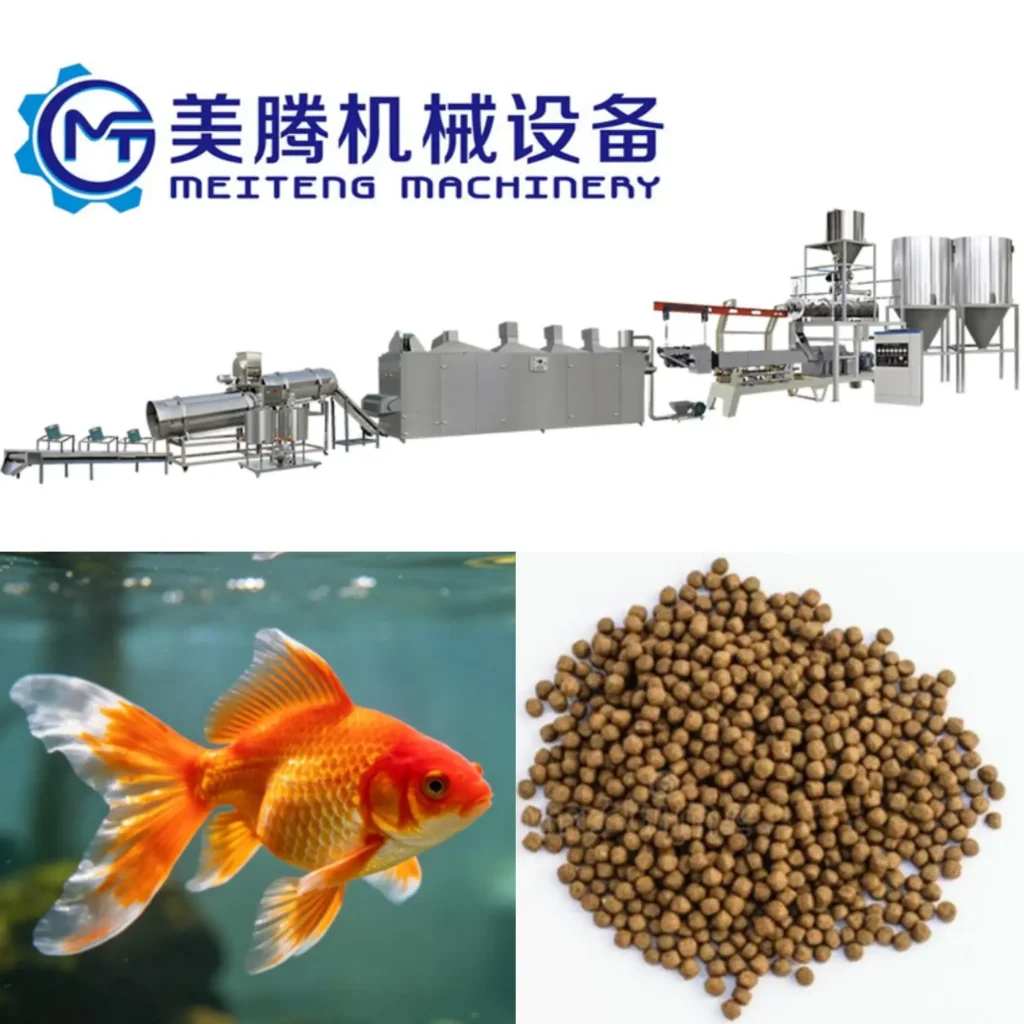
Matched Throughput Across Every Station — This fish feed production line sizes mixing, extrusion, drying, coating, and packing to the same verified output, preventing the bottlenecks that occur when stations are assembled from separate vendors.
Technical Specifications
| Parameter | Value |
|---|---|
| Product Type | Fish Feed Production Line |
| Extruder Type | Twin-screw |
| Output Capacity | 300–600 kg/h (basis not stated in source — confirm raw material formulation, moisture content, pellet size and density) |
| Contact Material | 304 stainless steel (food-grade contact surfaces throughout) |
| Target Species | Trout, salmon, catfish |
| Control System | Available with PLC or MCC control |
| Certifications | CE, ISO |
Application Suitability
| Application | Material or Output |
|---|---|
| Floating aquaculture pellets for trout and salmon | High-protein formulations requiring controlled expansion and low bulk density |
| Sinking feed pellets for catfish | Dense formulations requiring minimal expansion and higher moisture stability |
| Multi-species feed production runs | Flexible die and screw configurations switched between batches |
| Aquaculture operations producing in-house feed | Cost-controlled formulations using locally sourced fish meal, starch, and vitamin premix |
What "300–600 kg/h" Actually Depends On
Capacity is not a fixed number — it moves with your raw material.
I spent years on assembly floors before moving into technical sales across the Yangtze Delta manufacturing belt, and one lesson stuck hard. A client once ordered a twin-screw extruder line rated at a certain throughput on paper. Their actual formulation had a high meat meal ratio, which changed the material viscosity inside the barrel entirely. The screw configuration was not adjusted for that specific blend, and the line ran at roughly half its expected output. The buyer was left scrambling to meet contract obligations. With any fish feed production line manufacturer you evaluate, the capacity figure must be tied to your exact formulation, pellet diameter, and target density — otherwise it is just a number on a brochure [NEED_CITE: twin-screw extrusion output dependency on raw material composition].
Every Station Sized to the Same Throughput Target
A common failure in assembled lines is mismatched station capacity — the extruder pushes material faster than the dryer can handle, or the coater cannot keep pace with the cooling conveyor. This fish feed production line is configured so that the mixing system, twin-screw extruder, dryer, flavouring drum, coater, cooler, and packing station all share a verified throughput target. The result is continuous material flow without accumulation points or idle stations waiting for upstream output.
Screw and Die Configuration Matched to Your Formulation
The twin-screw extruder at the heart of this line is not shipped with a generic screw profile. The screw elements and die geometry are selected based on the buyer’s raw material characteristics — protein content, starch ratio, fat level, and target moisture. Floating pellets for salmon require a different expansion profile than dense sinking pellets for catfish. Getting this wrong means pellets that either sink when they should float or disintegrate before reaching the fish. The configuration is documented before production begins, so you know exactly what was built and why [NEED_CITE: screw configuration impact on pellet buoyancy and density].
Reading the Specs That Actually Matter
The twin-screw design gives this line its formulation flexibility. Unlike single-screw extruders that rely on friction-driven conveyance, twin-screw systems positively pump material through the barrel, handling high-fat and high-moisture formulations without surging. The 304 stainless steel contact surfaces are specified for corrosion resistance against the salts and acids present in fish meal and marine-based ingredients. The available PLC or MCC control options determine how operators interact with barrel temperature zones and screw speed — PLC provides recipe storage and automated sequencing, while MCC offers simpler relay-based control suitable for operations with less automation infrastructure. Choosing between them depends on your operator skill level and how frequently you switch between species formulations.
The Hidden Cost of Ignoring Voltage and Frequency
Exporting a fish feed production line without confirming the destination voltage, frequency, and control language creates problems that surface only after the machine arrives. Motors wound for 380V/50Hz will overheat or underperform on 440V/60Hz supplies. Control panels labeled in a language the local operators cannot read lead to incorrect parameter entry and inconsistent batches. These are not warranty issues — they are specification oversights that delay commissioning by weeks and require on-site rewiring at the buyer’s expense [NEED_CITE: industrial motor voltage and frequency compatibility requirements].
Why Source This Line Here
The entire line from batching to packing comes from a single supplier, which means throughput calculations are coordinated across every station rather than negotiated between multiple vendors. The in-house testing workshop runs your actual raw material before the line ships, so formulation issues are caught in the factory rather than on your production floor. Screw and die configurations are recorded and documented for your specific product, giving you a baseline for future adjustments. Electrical schematics and voltage are confirmed for your market before production starts. Ongoing support covers operator training, wear parts supply, and maintenance guidance after commissioning.
Documentation & Verification
- Line layout and capacity calculation showing throughput match across mixing, extrusion, drying, coating, and packing stations
- Screw and die configuration record tied to your raw material formulation and target pellet density
- Trial run report conducted on your supplied raw material in the in-house testing workshop before shipment
- Electrical schematic with voltage, frequency, and control language confirmed for the destination market
- CE declaration of conformity and ISO certificate for import compliance
- Operation and maintenance manual with wear parts list and replacement intervals
Installation, Commissioning & Support
- Foundation plan provided based on the full line footprint, including dryer and cooler spacing requirements
- Dedicated power circuit specifications confirmed for the twin-screw extruder motor and dryer heating elements before shipment
- Line arrives in modular sections for staged assembly, allowing installation in facilities with limited overhead clearance
- First-run parameter setting covers barrel temperature zones, screw speed, and die pressure for your specific formulation
- Operator training addresses recipe changes between floating and sinking pellet formats and control system navigation
- Wear parts list identifies screws, dies, and cutter blades with recommended replacement intervals based on production hours
Before You Request a Quote
To configure this fish feed production line accurately, provide your raw material formulation including protein source, starch type, and fat percentage. Specify the target pellet diameter, whether you need floating or sinking output, and the daily production volume your facility requires. Confirm the local voltage and frequency supply, along with your preferred control language for the operator interface.
Frequently Asked Questions
Q: How is the 300–600 kg/h output capacity verified for my formulation?
A: The capacity range is confirmed through a trial run using your actual raw material in the in-house testing workshop before shipment. Variables such as protein content, moisture level, pellet diameter, and target density all affect throughput. The trial run report documents the verified output so you know what to expect on your production floor.
Q: What voltage, frequency, and control language options are confirmed before shipment?
A: Electrical specifications are confirmed during the quotation stage. The motor winding, heating elements, and control panel are built to match your facility’s supply. Control language for the PLC or MCC interface is set to your operator’s requirement, avoiding miscommunication during daily operation and parameter adjustments.
Q: How is screw and die configuration chosen for floating versus sinking pellets?
A: The screw element arrangement and die geometry are selected based on your target pellet buoyancy and species requirement. Floating pellets for trout and salmon require higher expansion achieved through specific compression ratios and die openings, while sinking catfish feed requires denser profiles with minimal expansion. Both configurations are documented before production.
Q: Is a trial run on my raw material conducted before the line ships?
A: Yes. Your formulation is run through the twin-screw extruder in the testing workshop before dispatch. This verifies throughput, pellet integrity, and buoyancy against your specifications. Any necessary screw or die adjustments are made during this stage, so product development is not delayed until after installation at your facility.
Q: How is throughput matched between the extruder, dryer, coater, and packing station?
A: Each station is sized during the line configuration stage based on the verified extruder output. The dryer capacity accounts for moisture removal requirements, the coater handles the full output volume, and the packing station speed is set to prevent accumulation. This prevents bottlenecks that occur when stations are sourced from separate vendors.