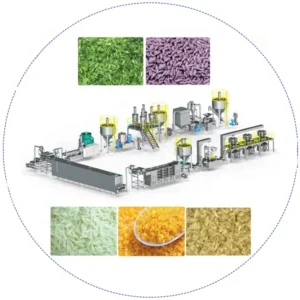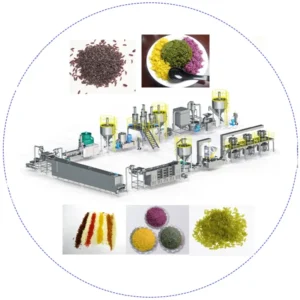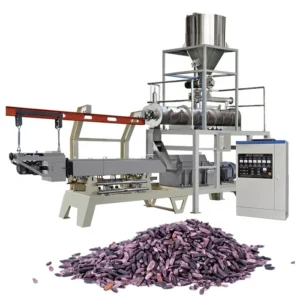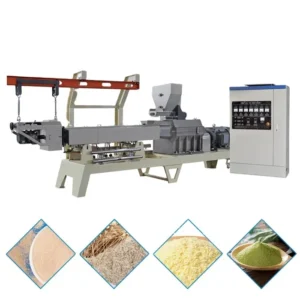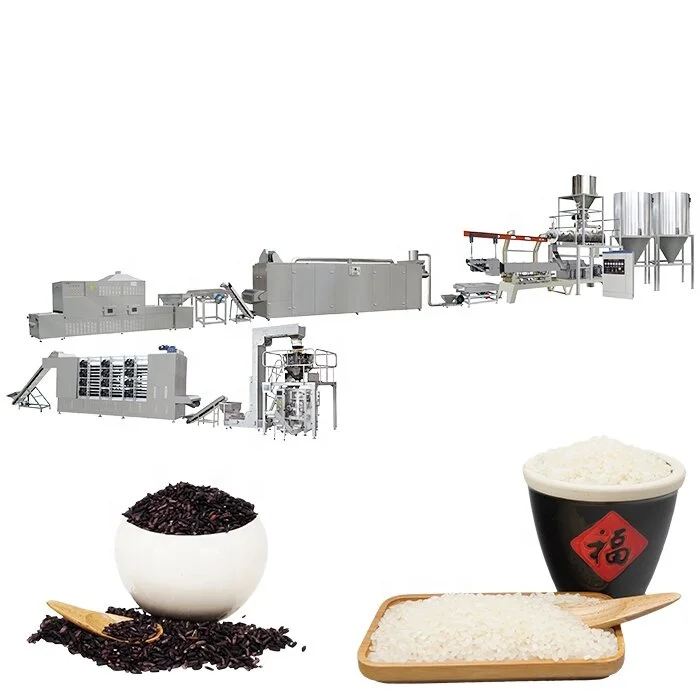
Complete Process Integration — every station from powder batching through extrusion to packing is matched in throughput so the twin-screw extruder never starves the dryer or overloads the cooler.
Technical Specifications
| Parameter | Value |
|---|---|
| Product Type | Fortified Rice Extrusion Production Line |
| Line Capacity | 200 kg/h (basis not stated in source — confirm raw material formulation and moisture content) |
| Extruder Type | Twin-screw (Double Screw) |
| Extruder Main Motor Power | 110 kW, frequency control |
| Extruder Feeder Power | 1.5 kW, frequency control |
| Extruder Cutting Power | 2.2 kW, frequency control |
| Extruder Screw Length | 2500 mm |
| Extruder Oil Pump Power | 0.75 kW |
| Mixer Power | 15 kW |
| Mixer Batch Capacity | 130 kg–150 kg/batch (basis not stated in source — confirm raw material density) |
| Mixer Tank Material | Stainless steel, 1.5 mm thickness (cover 1.2 mm) |
| Mixer Dimensions | 1450 × 1550 × 980 mm |
| Mixer Weight | Approx. 200 kg |
| Vibrating Screen Power | 0.2 kW |
| Vibrating Screen Dimensions | 1700 × 1210 × 740 mm |
| Dryer Heating Type | Electric heating (gas, diesel, steam options available on request) |
| Cooling Dryer Power | 2.2 kW |
| Cooling Dryer Dimensions | 5000 × 1500 × 1900 mm |
| Control System | Frequency control on feeder, extruder and cutter |
| Voltage & Frequency | Customizable (e.g., 3ph 380V 50Hz, 3ph 415V 60Hz, 3ph 220V 60Hz) |
| Line Stations | Powder mixer → Screw feeder → Twin-screw extruder → Vibrating screen → Air conveyor → Drying box → Lifting machine → Cooling drum → Air conveyor → Storage tank → Packaging machine |
| Assembly State | Complete line, multi-station |
| Standards | CE, ISO |
Application Suitability
| Application | Material or Output |
|---|---|
| Fortified rice production for nutrition programmes | Rice flour blended with micronutrient premix (iron, folic acid, vitamin B12, zinc) |
| Artificial rice from broken rice waste | Broken rice and rice flour reconstituted into uniform grains |
| Custom-shape nutritional rice for retail | Rice flour and starch blends formed through interchangeable die plates |
| Institutional and government food reserve supply | Fortified rice grains matching natural rice in cooking behaviour and appearance |
| Infant and weaning food base production | Pre-gelatinised rice flour with added nutritional powders |
What "200 kg/h Output" Actually Depends On
The rated capacity only holds when your raw material formulation, moisture content and local starch behaviour match the test conditions.
I once spent three days on a West African site re-tuning screw combinations and barrel temperatures because the local rice flour was cut with cassava starch — a detail that never came up during the quotation stage. The extruder choked, output dropped to a fraction of nameplate, and grain density was all over the place. That is why we now insist on knowing exactly what goes into the hopper before we finalise a line configuration. A fortified rice extrusion machine manufacturer that quotes capacity without asking about your blend is quoting a number that may not survive first contact with your actual raw material [NEED_CITE: raw material variability effects on extrusion throughput].
How Screw Geometry Governs Grain Density
The 2500 mm screw length inside this twin-screw extruder provides a long residence time, which is critical when working with rice flour blends that require thorough gelatinisation before the die plate. Shorter screws push material through before starch chains fully hydrate, resulting in grains that crumble during drying or cook unevenly. Frequency control on the feeder and main drive lets the operator fine-tune the feed-to-screw-speed ratio, adjusting shear input to hit the target grain density that your market expects.
Thermal Staging from Extruder to Packaging
Freshly extruded rice grains carry significant residual moisture and heat. Sending them directly into a single-pass dryer often causes surface case-hardening while the core stays wet, leading to cracking or re-absorption during storage. This line stages thermal treatment through a vibrating screen for initial surface moisture removal, a multi-zone drying box for bulk moisture reduction, and a dedicated cooling dryer that brings grain temperature down gradually before the polishing drum. This sequence mirrors the approach used in established cereal processing operations where moisture gradient control determines shelf stability [NEED_CITE: multi-stage drying principles in extruded cereal production].
Reading the Specs for Real-World Behaviour
The 110 kW main motor paired with a 2500 mm screw assembly indicates this extruder is built for high-shear, long-residence processing — the kind needed when rice flour must be fully gelatinised and micronutrient premix evenly distributed through the dough matrix. The 15 kW mixer with 130–150 kg batch capacity sets the batching rhythm; if your formulation includes low-density premix powders, actual batch weight may fall below the upper range, so confirming bulk density matters before committing to a shift schedule. Stainless steel contact surfaces at 1.5 mm thickness handle the abrasion of rice flour without contaminating the product stream. The customizable voltage specification — spanning 380V/50Hz through 415V/60Hz and 220V/60Hz — means the electrical schematic must be locked in before production begins, not after the machine arrives at a port with the wrong frequency rating [NEED_CITE: voltage and frequency standards by export market].
The Hidden Cost of Skipping the Trial Run
Buyers who accept shipment without a factory trial on their own raw material often discover formulation issues during commissioning — weeks after the line is installed and local electricians and plumbers have already left the site. By that point, changing screw elements or die geometry means flying in a technician and burning raw material in failed runs. We have seen lines sit idle for days while waiting for replacement screw segments that should have been identified during a pre-shipment test. The cost is never just the parts; it is the production schedule that slips and the buyer credibility that erodes with downstream customers.
Why Source This Line from MT Machinery
MT Machinery designs the full line from batching through packing under one supplier, so throughput at each station is calculated against the others rather than assembled from separate vendor catalogues. The in-house testing workshop runs your specific rice flour blend before the line ships, producing a trial report that documents actual output, grain shape and density. Screw configuration and die design are specified to your target grain size and raw material behaviour, not copied from a generic build. Electrical schematics and control panel language are confirmed against your local standards before production starts. Pre-sales engineering consultation carries through to on-site installation, commissioning and operator training on your actual product.
Documentation & Verification
- Line layout drawing with throughput calculation matched to your workshop dimensions
- Screw and die configuration record specific to your rice flour blend and target grain shape
- Trial run report on your raw material formulation documenting real output and grain density
- Electrical schematic with voltage and frequency confirmed to your local power supply standard
- CE declaration of conformity and ISO certificate for customs and regulatory clearance
- Operation and maintenance manual with wear parts list and replacement intervals
Installation, Commissioning & Support
- Foundation must accommodate the 5000 mm cooling dryer footprint and extruder vibration loads
- Dedicated power circuit sized for the 110 kW extruder main motor plus all auxiliary drives
- Line arrives in modular station sections requiring on-site assembly and belt alignment
- First-run commissioning includes screw speed, feeder rate and temperature profile tuning on your blend
- Operator training covers die changeover, screw element inspection and moisture monitoring
- Wear parts inventory includes screw segments and die plates with documented lead times for reorders
Before You Request a Quote
To configure a line that matches your actual production conditions, share your rice flour formulation and any cassava, starch or premix additives you plan to use, along with typical moisture content at batching. Confirm your workshop length, width and clear height so the layout fits the drying box and cooling drum in sequence. Specify your local three-phase voltage and frequency so the electrical package is built correctly from the start.
Frequently Asked Questions
Q: How is the 200 kg/h line capacity verified against my raw material?
A: We run a trial production in our testing workshop using your exact rice flour blend, including any cassava, starch or micronutrient premix you plan to use. The trial report documents actual throughput, grain shape, density and moisture content at each station, so you see real numbers before the line ships.
Q: Can voltage, frequency and control panel language match my local standards?
A: Yes. The electrical package is configurable across common three-phase standards such as 380V/50Hz, 415V/60Hz and 220V/60Hz. Control panel labels, HMI language and wiring colour codes are confirmed during the specification review stage, well before production starts.
Q: How do you select the screw and die configuration for my product?
A: Screw element arrangement and die hole geometry are chosen based on your raw material blend, target grain length, diameter and cooking behaviour. The configuration record is documented and included with your shipment so replacement parts can be ordered with certainty.
Q: Can I witness the factory trial run before the line ships?
A: Buyers are welcome to attend the trial in person or review it via live video call. The trial uses your supplied raw material, and the resulting report becomes part of your shipment documentation package.
Q: What wear parts ship with the line, and how fast can I get replacements?
A: The standard shipment includes a set of spare screw elements and die plates matched to your configuration. Replacement orders are processed from the same configuration record, with lead times confirmed at the time of your reorder request.