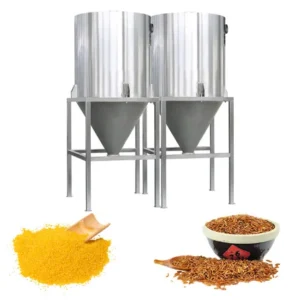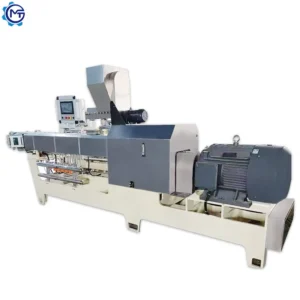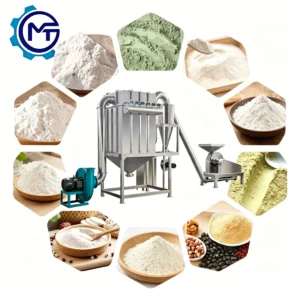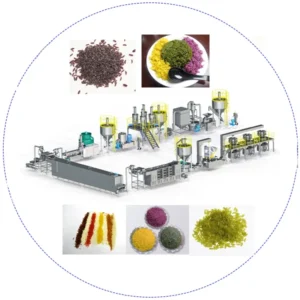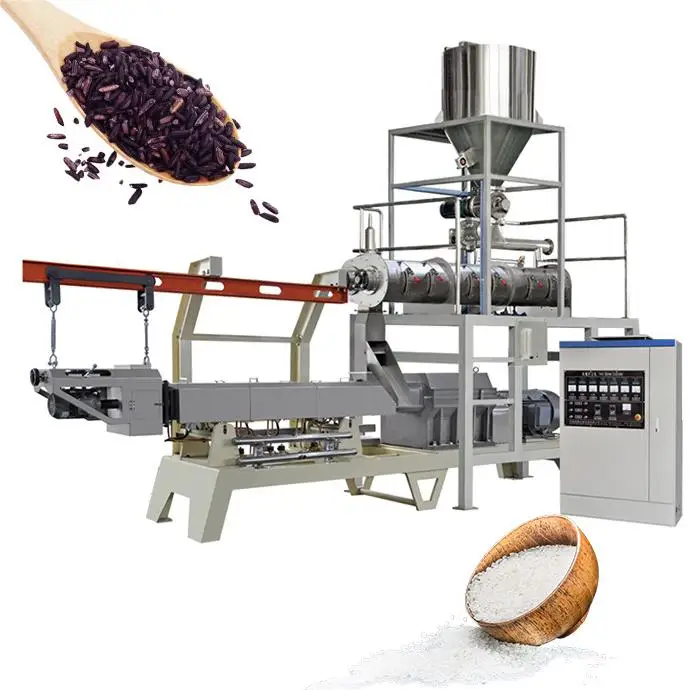
Five-model extruder range — every station from mixer to packing sized to the extruder’s throughput so no single machine holds back the line.
Technical Specifications
| Parameter | Value |
|---|---|
| Product Type | Fortified Artificial Rice Production Line |
| Models Available | MT65 / MT70 / MT75 / MT85 / MT95 |
| Screw Type | Twin-screw |
| Installed Power | 85 kW (MT65) / 120 kW (MT70) / 180 kW (MT75) / 235 kW (MT85) / 260 kW (MT95) |
| Power Consumption | 60 kW (MT65) / 85 kW (MT70) / 135 kW (MT75) / 165 kW (MT85) / 195 kW (MT95) |
| Output Capacity | 80–100 kg/h (MT65) / 100–120 kg/h (MT70) / 300–500 kg/h (MT75) / 200–300 kg/h (MT85) / 800–1000 kg/h (MT95) (basis not stated in source — confirm raw material formulation and moisture content) |
| Overall Dimensions (L×W×H) | 28×1.2×2.2 m (MT65) / 30×1.5×2.2 m (MT70) / 32×3.5×4.3 m (MT75) / 34×3.5×4.3 m (MT85) / 36×3.5×4.3 m (MT95) |
| Control System | Frequency speed controlling with high automation |
| Line Stations | Mixing → Extruding → Vibrating → Low Temperature Drying → Cooling → High Temperature Roasting → Cooling → Packing |
| Extruder Features | Automatic lubricating, cooling system, single or double screw feeding system option |
| Drying Oven Heating Source | Electric or gas |
| Standards | CE, ISO |
Application Suitability
| Application | Material or Output |
|---|---|
| Fortified rice kernel production | Broken rice, rice bran, corn, millet with vitamin and mineral additions |
| Artificial instant rice processing | Wheat, oats, buckwheat, bean and starch blends as base materials |
| Nutrition programme supply lines | Multi-grain formulations with controlled micronutrient fortification |
| Value-added rice conversion | Broken rice and milling by-products reprocessed into uniform rice kernels |
What "800 kg/h" Leaves Out About Fortified Rice Production Line Equipment Range
Rated throughput means nothing until you confirm the formulation running through the barrel.
I once watched a buyer commission a nutrition line based on a brochure capacity figure. The raw material formulation had higher protein content than the test sample, which changed the melt viscosity inside the barrel entirely. Output dropped to roughly half of what was quoted, and the downstream dryer was oversized for the actual throughput, wasting energy every shift. With a Fortified Rice Production Line Equipment Range, the capacity figure on the spec sheet is a starting point for conversation, not a guarantee. The starch-to-protein ratio, moisture percentage, and vitamin premix concentration all shift the real-world throughput. [NEED_CITE: effect of raw material composition on twin-screw extruder throughput]
Matching Every Station to the Extruder Output
A complete Fortified Rice Production Line Equipment Range covers mixing, extruding, vibrating separation, low-temperature drying, cooling, high-temperature roasting, secondary cooling, and packing. Each station must handle the extruder’s output without creating a bottleneck. If the dryer is undersized, wet kernels pile up on the conveyor; if the roaster is oversized, you burn energy heating empty tray space. The five extruder models — MT65 through MT95 — each have a corresponding downstream configuration so that the vibrating separator, drying oven, and cooling conveyors are scaled together.
How Heating Source Selection Affects the Drying Stage
The drying oven in this line is available with electric or gas heating. Electric heating suits facilities with stable grid supply and lower local gas prices, while gas-fired ovens often serve regions where electricity costs make continuous resistive heating uneconomical. The low-temperature drying phase removes surface moisture from freshly extruded kernels without case-hardening the exterior, which would trap internal moisture and cause cracking during storage. [NEED_CITE: low-temperature drying requirements for extruded rice kernels]
Reading the Screw and Power Specifications
The twin-screw configuration across all five models gives the barrel enough shear and mixing action to gelatinise starch uniformly, even when vitamin and mineral premixes are present. Installed power ranges from 85 kW on the MT65 to 260 kW on the MT95, with actual consumption lower — 60 kW to 195 kW respectively — reflecting typical operating load rather than peak draw. The automatic lubricating and cooling system inside the extruder maintains barrel temperature within a narrow band, which matters when you are running heat-sensitive vitamin-fortified formulations. Frequency speed control lets operators adjust screw RPM in real time, responding to changes in feed rate or raw material moisture without stopping the line.
When Station Mismatch Becomes a Production Problem
Buyers who source the extruder from one vendor and the dryer from another often discover the mismatch during commissioning. The extruder runs at capacity while the dryer falls behind, forcing the operator to slow the entire line. Kernels that should enter the roaster at a specific moisture level arrive too wet or too dry, changing the final texture and shelf stability. These issues surface only when production starts, meaning the fix involves either replacing equipment or accepting reduced throughput every single shift. [NEED_CITE: consequences of unmatched station capacity in extrusion lines]
Why Source the Full Range from One Supplier
Every station in this Fortified Rice Production Line Equipment Range is specified as a set, so throughput calculations are done across the entire sequence before the line ships. Screw configuration and die design are matched to the buyer’s raw material formulation rather than pulled from a generic build. An in-house testing workshop allows trial runs on the customer’s actual ingredients before dispatch, catching viscosity and expansion issues early. Pre-sales engineering covers line layout and utility planning, while on-site installation includes commissioning and operator training. Wear parts lists are provided so screws, dies, and seals are available when the first replacement cycle arrives.
Documentation & Verification
- Line layout drawing showing station sequence and throughput matching for your selected model
- Machine specification sheet with screw and die configuration matched to your raw material
- Electrical schematic with voltage and frequency confirmed for your local grid
- Trial run report produced on your actual formulation before shipment
- Factory test record documenting output and product quality at time of dispatch
- Operation and maintenance manual covering every station in the line
Installation, Commissioning & Support
- Foundation and floor space plan based on the overall dimensions of your chosen model (up to 36×3.5×4.3 m)
- Dedicated electrical circuit sized to the installed power of the extruder and dryer combined
- On-site assembly and alignment of all stations from mixer through packing conveyor
- First-run parameter setting including barrel temperature profile and screw speed calibration
- Operator training on frequency speed control interface and automatic lubricating system checks
- Wear parts supply covering screws, dies, and seals for the initial replacement cycle
What to Prepare Before Requesting a Quote
Before we configure a line, we need to know your base material formulation — which grains, starches, and vitamin premixes you plan to run — along with your target daily output and the moisture content of the incoming raw material. Confirm your local voltage and frequency so the extruder motor and dryer heating elements are wound correctly for your grid. If you have existing upstream milling or downstream packing equipment, share the specifications so we can size the interfaces accordingly.
Frequently Asked Questions
Q: How is each station sized to match the extruder’s rated capacity across the full line?
A: Every downstream station — vibrating separator, drying oven, roaster, cooling conveyor — is calculated against the extruder’s output for your specific model. The dryer tray area, roaster chamber volume, and conveyor speed are all set so that no station forces the line to run below the extruder’s throughput.
Q: What raw material formulations are compatible with these extruders?
A: The line handles broken rice, rice bran, corn, millet, wheat, oats, buckwheat, bean, and starch as base materials, with vitamin and mineral premixes added. Screw configuration and die design are adjusted to the specific formulation you provide, ensuring proper gelatinisation and kernel shape.
Q: What voltage and frequency configurations are available?
A: The extruder motor, dryer heating elements, and control system can be configured to match your local grid standard. Voltage and frequency must be confirmed before production so that all electrical components are wound and rated correctly for your market. [NEED_CITE: voltage and frequency standards by export market]
Q: How does the drying oven capacity correspond to extruder output?
A: The drying oven is sized so that its tray area and air circulation volume handle the full extruder output at the required residence time. This prevents wet kernels from accumulating on the conveyor and ensures uniform moisture reduction before the roasting stage.
Q: Is all supporting equipment included in the line or sourced separately?
A: The complete range includes mixing, extruding, vibrating, drying, cooling, roasting, secondary cooling, and packing stations. All equipment is specified and supplied together, so throughput is matched across every station rather than assembled from separate vendors.