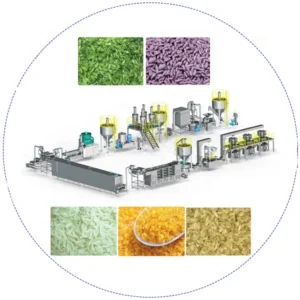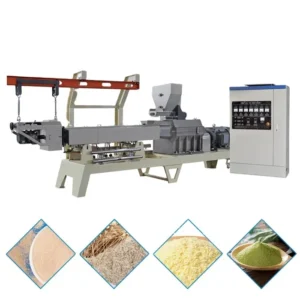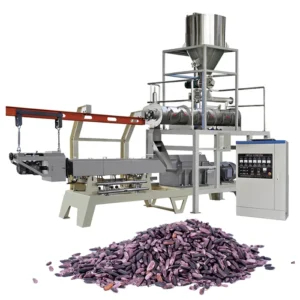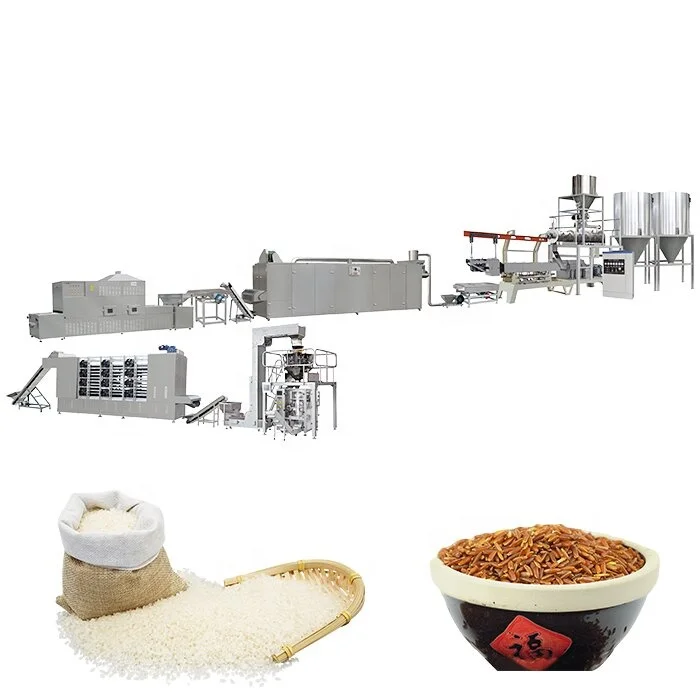
Turnkey Line Matching — Every station from batching to packing is engineered under one roof so throughput stays balanced across the entire fortified rice production line full equipment sequence.
Technical Specifications
| Parameter | Value |
|---|---|
| Product Type | Fortified Rice and Artificial Rice Extrusion Line |
| Model Options | MT65 / MT70 / MT85 / MT75 / MT95 |
| Screw Type | Twin-screw with single or double screw feeding system available |
| Installed Power | 85 kW (MT65) / 120 kW (MT70) / 180 kW (MT75) / 235 kW (MT85) / 260 kW (MT95) |
| Power Consumption | 60 kW (MT65) / 85 kW (MT70) / 135 kW (MT75) / 165 kW (MT85) / 195 kW (MT95) |
| Output Capacity | 80–100 kg/h (MT65) / 100–120 kg/h (MT70) / 300–500 kg/h (MT75) / 200–300 kg/h (MT85) / 800–1000 kg/h (MT95) (basis not stated in source — confirm raw material formulation and moisture content) |
| Overall Dimensions | 28 × 1.2 × 2.2 m (MT65) to 36 × 3.5 × 4.3 m (MT95) |
| Control System | Frequency speed control with high automation |
| Lubrication System | Automatic lubricating and cooling |
| Drying Oven Heating | Electric or gas |
| Drying Oven Feature | Circulation drying with frequency-controlled mesh belt |
| Line Stations | Mixing → Extruding → Vibrating → Low-temp Drying → Cooling → High-temp Roasting → Cooling → Packing |
Application Suitability
| Application | Material or Output |
|---|---|
| Fortified rice kernel production | Broken rice and rice bran blended with vitamin and mineral premix |
| Artificial rice manufacturing | Corn, millet, wheat, oats, buckwheat and starch bases |
| Instant rice processing | Pre-gelatinised rice flour and bean formulations |
| Staple food fortification programmes | Multi-grain blends with micro-nutrient enrichment |
Why "Nominal Capacity" Fails on Real Fortified Rice Formulations
A line rated at a round number on plain rice flour will choke the moment your recipe adds fat-soluble vitamins or mineral salts.
Most capacity figures quoted for a fortified rice production line full equipment package are generated on a basic starch matrix with no additives. Once a buyer introduces a vitamin-mineral premix, the gelatinisation window narrows, melt viscosity shifts, and the extruder barrel temperature profile that worked on white rice no longer holds. I have watched lines stall at well below their quoted throughput because the screw configuration was never re-tested on the actual target blend [NEED_CITE: starch gelatinisation behaviour with micronutrient premix additions]. Specifying the fortified rice production line full equipment against your real formulation — not a generic reference material — is the only way to know what the plant will actually produce on day one.
Matching Every Station to the Same Throughput Target
When the extruder, dryer and packing station come from different vendors, each one optimises for its own nameplate figure. The result is a bottleneck that surfaces only after commissioning. In this fortified rice production line full equipment layout, the mixing batch size is calculated against the extruder’s actual output on your blend, the drying oven length and mesh belt speed are sized to that same mass flow, and the cooling conveyor matches the dryer discharge rate. No station waits on another.
What the Screw and Die Record Tells You Before Shipment
The screw element sequence — how many conveying, kneading and reverse elements sit inside the barrel — decides residence time, shear intensity and ultimately the density of the extruded rice kernel. A configuration copied from a standard puffed snack build will produce a kernel that is too porous for rice enrichment programmes, where the grain must survive washing and cooking without disintegrating. Every screw and die combination we ship is documented in a configuration record that maps element positions to your target kernel shape [NEED_CITE: twin-screw element sequencing for dense extruded kernels].
Reading the Specs That Actually Matter
The installed power range — from 85 kW on the MT65 up to 260 kW on the MT95 — reflects motor sizing for different barrel volumes, not a simple "bigger is faster" rule. A 235 kW MT85 running a high-fibre rice bran blend may deliver less mass flow than the same motor on pure broken rice because fibre absorbs more water and increases melt viscosity. The automatic lubricating and cooling system keeps barrel temperature stable across long shifts, preventing the gradual viscosity drift that causes kernel weight to wander outside specification. Frequency-controlled motor drives on both the extruder main shaft and the dryer mesh belt allow fine throughput adjustments without stopping the line, which matters when you switch between a standard white rice formulation and a heavily fortified version in the same production day.
The Hidden Cost of Skipping the Trial Run
Sending an extruder to site without first running the buyer’s exact formulation in a testing workshop means all recipe development happens during commissioning — on the factory floor, with raw material already ordered and delivery deadlines ticking. I once spent a week in Colombia re-tuning barrel zones because the trial back in Jinan used plain rice flour, while the customer’s recipe included a lipid-coated vitamin premix that dropped expansion and made the output gummy. Every fortified rice production line full equipment package now ships with a trial run report generated on the customer’s own blend, so the screw configuration and temperature profile are locked before the machine leaves the workshop [NEED_CITE: on-site commissioning delays caused by untested formulations].
Why Buyers Spec the Whole Line From One Source
Sourcing the mixer, extruder, dryer and packing station from separate suppliers often means no single vendor takes responsibility when throughput does not match. Here, the line layout and capacity calculation are produced as one document covering every station, so the mass balance is verifiable before production starts. Screw and die configurations are specified against the buyer’s target kernel density rather than borrowed from a generic build. An in-house testing workshop allows trial runs on the customer’s raw material before shipment, catching formulation issues early. Electrical schematics, voltage and control language are confirmed against the destination facility before the first steel is cut, preventing the commissioning delays that arise from mismatched power supplies.
Documentation & Verification
- Line layout and capacity calculation matched to your raw material blend
- Screw and die configuration record mapped to target kernel density
- Electrical schematic with voltage and frequency confirmed before build
- Trial run report on customer-supplied formulation before dispatch
- CE declaration of conformity and ISO certificate for customs clearance
- Operation and maintenance manual with wear parts list included
Installation, Commissioning & Support
- Foundation plan accounts for MT95 line length of 36 m and dryer weight distribution
- Dedicated circuit sized to the 260 kW installed power of the MT95 extruder
- Machines ship in modular sections with matched flange connections for rapid assembly
- First-run parameters loaded from the pre-shipment trial report on your formulation
- Operator training covers screw element swaps and frequency drive adjustments
- Wear parts list includes screws, dies and dryer mesh belt segments for initial stock
- Preventive maintenance schedule aligned to automatic lubrication system intervals
What to Include in Your Enquiry
To size the line accurately, share the raw material formulation you plan to run — including the percentage of vitamin-mineral premix if applicable — along with your target kernel shape and daily output requirement. Specify the local voltage, frequency and the control language your operators need. If you already have upstream milling or downstream bagging equipment, provide the interface dimensions so the layout accounts for those connection points.
Frequently Asked Questions
Q: How is line capacity verified on my specific broken rice or starch formulation?
A: We run your exact blend — including any vitamin and mineral premix — in the testing workshop before shipment. The trial records actual mass flow, kernel density and moisture at the dryer exit. Those figures, not a generic nameplate number, become the basis for the capacity calculation in your line documentation.
Q: Which stations are included and how is throughput matched between extruder, dryer and packing?
A: The line covers mixing, twin-screw extrusion, vibrating separation, low-temperature drying, cooling, high-temperature roasting, a second cooling stage and packing. Each station is sized so its maximum throughput equals or slightly exceeds the extruder output on your formulation, eliminating bottlenecks.
Q: What voltage, frequency and control language options are confirmed before build?
A: We request your facility electrical specification during the proposal stage and reflect it in the confirmed electrical schematic. Motor ratings, control panel components and HMI language are all set before production starts, so there are no surprises at commissioning.
Q: Can the screw and die configuration be specified to my target kernel shape and density?
A: Yes. The screw element sequence and die geometry are selected to match your required kernel dimensions and density, whether the product must survive boiling or dissolve quickly in hot water. The configuration record ships with the line for future reference.
Q: What spare wear parts are supplied with the initial shipment?
A: Each line includes a documented wear parts list covering screw elements, die plates and dryer mesh belt segments. The quantity is calculated to cover typical consumption during the first production months so you can schedule replacements without emergency orders.