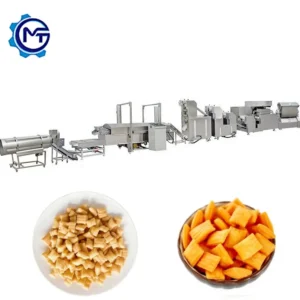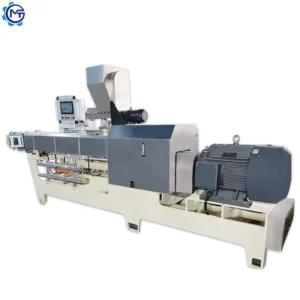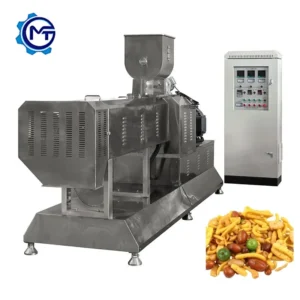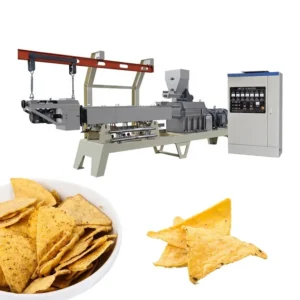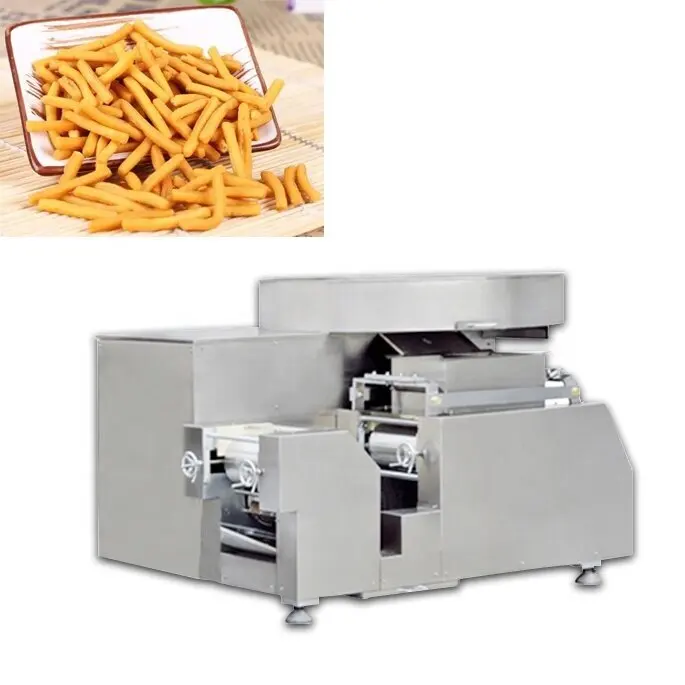
Integrated Line Throughput — continuous deep fryer specified to match upstream extrusion output across all frying stages rather than sized as standalone capacity.
Technical Specifications
| Parameter | Value |
|---|---|
| Product Type | Continuous Deep Frying Machine |
| Rated Heating Power | 60 kW |
| Drive and Control Power | 2.6 kW |
| Voltage and Frequency | 380 V / 50 Hz |
| Control System | PLC |
| Overall Dimensions (L × W × H) | 6700 × 2200 × 1200 mm |
| Net Weight | 2000 kg |
| Output Capacity | 100–1000 kg/h (basis not stated in source — confirm product format, moisture, and frying time) |
| Oil Tank Capacity | 320 L |
| Heating Method | Electricity or Gas |
| Construction Material | Food-grade 304 Stainless Steel |
| Mesh Belt Configuration | Upper and lower double-layer |
| Speed Regulation | Frequency conversion stepless speed control |
| Oil Filtration | Continuous circulation filtration system |
| Slag Discharge | Bottom-mounted automatic system |
| Lifting Mechanism | Automatic lifting of upper hood and mesh belt |
| Warranty | 1 year including core components |
| Factory Inspection | Machinery test report and video outgoing-inspection provided |
Application Suitability
| Application | Material or Output |
|---|---|
| Fried pasta snack production | Extruded pasta shapes such as shells, wheels, and tubes |
| Pellet chip frying | 2D and 3D starch-based snack pellets |
| Puffed snack finishing | Extruded corn, rice, or multigrain snack forms |
| Formed snack deep frying | Co-extruded or sheeted snack pieces requiring uniform oil immersion |
Why the Full Equipment Range Matters for Frying Chips Making Machine Buyers
A fryer that does not match upstream extruder throughput creates a bottleneck that no amount of operator adjustment can fix.
I have watched production lines stall because the frying chips making machine was selected on nominal capacity while the extruder was running a different raw material at a lower actual output. The fryer idles half-empty or the product piles up before the belt, burning oil and degrading colour consistency. [NEED_CITE: matching throughput between extrusion and frying stations in snack lines]
When buyers evaluate a frying chips making machine in isolation, the oil capacity and belt width look adequate on paper. But if the upstream extruder delivers 400 kg/h on wheat flour and only 250 kg/h on a chickpea-based formulation, the fryer’s thermal load and residence time shift dramatically. This mismatch is not visible until the line runs on the buyer’s actual raw material, which is exactly why the equipment range must be reviewed as a connected system.
Double-Layer Mesh Belt and Uniform Frying Depth
The upper and lower mesh belt configuration sandwiches the product during transit through the oil bath. This prevents lighter extruded pasta or pellet chips from floating to the surface, which would leave the top half under-fried and pale. For a frying chips making machine processing mixed-density products, this mechanical constraint ensures every piece receives the same oil contact time regardless of its buoyancy. The belt width accommodates full-width distribution from the upstream conveyor without product stacking.
Continuous Oil Filtration and Production Consistency
The circulation filtration system continuously removes particulate matter and fines from the oil during operation. Without this feature, crumb accumulation accelerates oil darkening and raises the free fatty acid value mid-shift, forcing an oil change that halts production. [NEED_CITE: oil degradation rates in continuous industrial frying operations] The 320-litre tank volume, combined with continuous filtration, supports sustained runs across the full equipment range without manual intervention between batches.
Reading the Specifications Beyond the Nameplate
The 60 kW heating element rating determines the fryer’s thermal recovery rate after cold product enters the oil bath. At higher throughput levels, cold extruded snacks absorb heat rapidly; insufficient heating power causes oil temperature to drop and recovery to lag, resulting in oily, under-crisped product. The 2.6 kW drive and control power covers the mesh belt motor, oil circulation pump, and PLC logic — separate from the heating circuit so that control stability is maintained even during peak thermal demand. Frequency conversion stepless speed regulation on the belt means frying time is not fixed; operators adjust residence time from the PLC screen to match different product moisture levels and target colour. The 6700 mm overall length reflects the tank length plus infeed and discharge zones, which must fit within the line layout between the extruder discharge conveyor and the downstream de-oiling station.
The Cost of Selecting a Fryer Outside the Line Context
When a frying station is sourced separately from the extruder, the belt speed range and oil volume are rarely checked against the actual extrusion rate on the buyer’s formulation. The result is a fryer that either runs starved — wasting energy heating empty oil — or overfed, with product tumbling off the belt edges. [NEED_CITE: production losses from mismatched line stations in food processing] The automatic lifting system for hood and mesh belt may still function, but cleaning frequency increases because overfed product generates more fines and sediment than the filtration system was sized to handle.
Why Procurement from a Full-Range Supplier Changes the Outcome
This continuous deep fryer is configured as one station within a complete snack production line, meaning throughput is matched across extrusion, drying, frying, de-oiling, flavouring, and packing rather than assembled from disconnected vendors. The screw configuration and die design on the upstream extruder are specified to the buyer’s raw material, so the product entering the fryer has a known density and moisture profile. An in-house testing workshop runs trial fries on the customer’s actual product format before shipment, validating colour, texture, and oil absorption. The full equipment range includes downstream de-oiling and flavouring stations designed around the same belt width and transfer height. Pre-sales engineering covers line layout, utility planning, and voltage confirmation before production begins.
Documentation & Verification
- Line layout showing throughput matching between extruder output and fryer belt capacity
- Machine specification sheet with confirmed voltage, frequency, and PLC language for target market
- Trial run report on buyer’s actual product format before dispatch
- Electrical schematic with circuit separation between heating and control systems
- Wear parts list covering mesh belt segments, heating tubes, and filter elements
- CE declaration of conformity and ISO certificate for the complete line scope
Installation, Commissioning & Support
- Floor plan confirming 6700 × 2200 mm footprint with clearance for hood lifting mechanism
- Dedicated 380 V three-phase circuit sized for 60 kW heating load plus 2.6 kW drive circuit
- Machine arrives fully assembled; position and connect utilities per electrical schematic
- PLC parameter setting for belt speed, oil temperature, and filtration cycle on buyer’s product
- Operator training on automatic lifting system for tank cleaning and mesh belt inspection
- Spare mesh belt segments and heating tubes staged for first scheduled replacement
What to Include in Your Inquiry
Share your target product format, the raw material formulation, and the upstream extruder’s actual output rate on that formulation. Specify the local voltage and frequency standard and the preferred PLC display language. If the frying chips making machine will join an existing line, provide the current conveyor heights and transfer points so the fryer integrates without modification.
Frequently Asked Questions
Q: How is frying capacity matched to the upstream extruder’s actual throughput on my raw material?
A: We calculate the fryer’s belt load based on the extruder’s verified output on your specific formulation, not nominal machine capacity. The 320-litre oil tank and 60 kW heating system are then confirmed sufficient for that actual throughput, ensuring oil temperature holds steady throughout the run.
Q: What voltage, frequency, and PLC language options are confirmed before shipment?
A: The standard configuration is 380 V at 50 Hz, but the electrical system is confirmed against your facility’s supply before production begins. PLC language is set to your operators’ preference and documented in the specification sheet provided with the machine.
Q: Does the fryer integrate with downstream de-oiling, flavouring, and cooling stations in a single line layout?
A: Yes. The fryer discharge height and belt speed are coordinated with downstream de-oiling and flavouring drums so product transfers without manual handling. The full line layout is engineered and documented before any station enters production.
Q: What spare parts are included, and what is the replacement schedule?
A: The wear parts list covers mesh belt segments, heating tubes, and oil filter elements. Replacement intervals depend on production hours and product type, and are documented in the operation manual provided at commissioning.
Q: Can a trial fry run be performed on my product format before the machine ships?
A: The in-house testing workshop conducts trial runs on your actual product format using matched upstream extrusion settings. The trial run report documents oil temperature, belt speed, colour, and texture results before the machine is cleared for shipment.