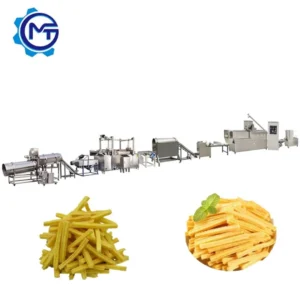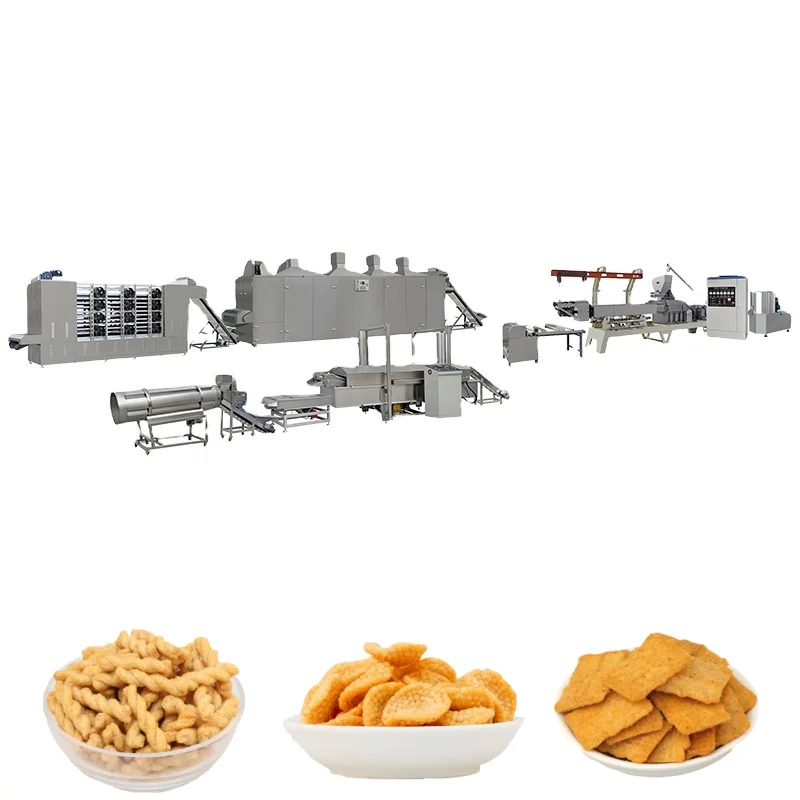
Line-Wide Throughput Matching — Every fried pellet snack production line from MT configures fryer belt speed and dryer retention time to the extruder output, preventing half-cooked product pile-ups at station transitions.
Technical Specifications
| Parameter | Value |
|---|---|
| Product Type | Fried Pellet Snack Food Production Line |
| Model | MT-65 / MT-70 / MT-85 / MT-75 / MT-95 |
| Screw Configuration | Twin screw, co-rotating, sectional modules |
| Main Motor Power | 100 kW (MT-65) / 130 kW (MT-70) / 180 kW (MT-85) / 185 kW (MT-75) / 280 kW (MT-95) |
| Output Capacity | 120–150 kg/h (MT-65) / 200–250 kg/h (MT-70) / 300–500 kg/h (MT-85) / 400–500 kg/h (MT-75) / 800–1000 kg/h (MT-95) (basis to be confirmed — depends on raw material formulation and moisture content) |
| Drying / Heating Method | Gas / Electric / Diesel heating options |
| Overall Dimensions (L×W×H) | 22000×1200×2200 mm (MT-65) / 24000×1500×2200 mm (MT-70) / 2600×1500×2300 mm (MT-85) / 2600×1500×2800 mm (MT-75) / 3000×1500×2800 mm (MT-95) (source value — verify against latest catalog, lengths for MT-85/75/95 may be incomplete) |
| Die System | Interchangeable dies for bugles, sticks, rib chips, diamond chips, wavy chips, pillow shapes, crisp pea, shell, screw, square tube, round tube, wave |
| Raw Material Compatibility | Corn powder, wheat flour, potato starch, potato powder, corn starch |
| Fryer Belt Width | 600 mm stainless steel mesh belt |
| Cutter Power / Dimensions | 1.47 kW / 2500×600×1100 mm |
| Mixer Power Options | 4 kW / 7.5 kW / 15 kW |
| Voltage & Frequency | Customizable (e.g., 3ph 380V 50Hz, 3ph 415V 60Hz, 3ph 220V 60Hz) |
| Control System | Basis to be confirmed — confirm PLC / MCC availability per station |
Application Suitability
| Application | Material or Output |
|---|---|
| Fried corn chip (Doritos-style) production | Corn powder and corn starch formulations |
| Bugle and cone-shaped pellet snack frying | Wheat flour and potato starch blends |
| Crispy sheet and rib chip extrusion | Potato powder with corn starch carriers |
| 2D and 3D specialty fried snack shapes | Blended grain flours with moisture adjustment |
| Contract manufacturing across multiple SKUs | Rapid die changeover on a single extruder platform |
Why Extruder Output Alone Tells You Nothing About Line Capacity
A published kg/h figure on the extruder means very little if the fryer downstream cannot absorb that throughput continuously.
I spent years commissioning snack extrusion lines across the Middle East, and the most expensive failures I witnessed had nothing to do with the extruder itself. On one Doritos-style line, the fryer simply could not keep pace with the twin-screw extruder feeding it. Half-cooked corn chips piled up on the transfer belt, moisture soaked back into the product, and the entire batch was scrapped before we even reached steady state. The extruder was rated at a perfectly reasonable output — the line was not balanced. [NEED_CITE: throughput matching between extruder and downstream fryer stations in snack food lines]
When evaluating any fried pellet snack production line for sale, the capacity question must be asked station by station, not just at the extruder barrel. Mixer batch cycle time, extruder screw speed, cutter feed rate, and fryer belt speed all have to align within a narrow window, or you end up with bottlenecks that no amount of operator tweaking can resolve.
Station-by-Station Equipment Range
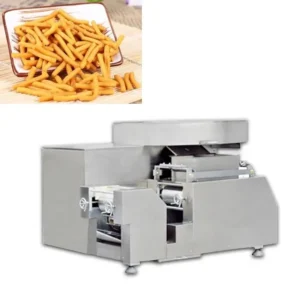
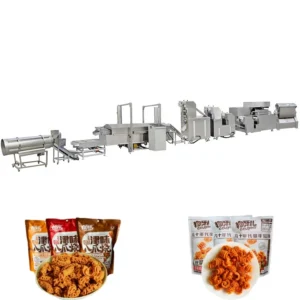
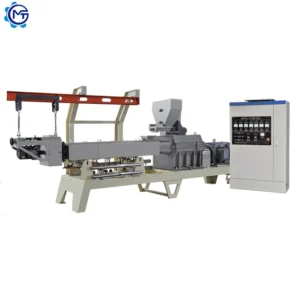
This fried pellet snack production line for sale covers the full equipment catalogue from raw material handling through to the fryer discharge. Each station — mixer, twin-screw extruder, cutting and forming unit, and continuous fryer — is listed with its own specification sheet so that buyers can compare dimensions, power draw, and throughput independently. The twin-screw extruder sits at the centre of the line, but the surrounding equipment determines whether that extrusion capacity actually translates into packed product.
How Die Selection Shapes the Product Catalogue
The interchangeable die system supports rapid changeover across a broad shape range: bugles, corn chip triangles, ribbed sheets, diamond cuts, wavy profiles, and tubular forms. For a snack manufacturer surveying equipment before specifying a line, the die catalogue is the first place to check whether the extruder can produce the formats your market demands. Die geometry also influences dough expansion, oil uptake during frying, and the final texture the consumer experiences — making die selection a process decision, not just a cosmetic one. [NEED_CITE: twin-screw extrusion die design and snack texture control]
Reading the Specification Sheet with a Process Engineer’s Eye
The co-rotating twin-screw design with sectional modules means the screw profile can be reconfigured for different raw materials — corn powder, wheat flour, potato starch, or blends — by rearranging forward and reverse conveying elements along the barrel. This directly affects residence time, shear intensity, and the degree of starch gelatinisation achieved before the dough reaches the die. Main motor power spans from 100 kW on the MT-65 up to 280 kW on the MT-95, and the selection here governs both the torque available for dense formulations and the energy cost per kilogram of extruded pellet. The fryer’s 600 mm stainless steel mesh belt width sets the maximum product layer thickness, which in turn constrains how much oil contact each pellet receives. Voltage and frequency are configurable across multiple three-phase standards, a critical detail for export installations where a mismatch between motor nameplate and site supply will stall commissioning before the first trial run.
What Happens When Stations Are Not Matched
When the mixer batch cycle is slower than the extruder consumption rate, the screw runs partially starved, causing surging output and inconsistent pellet density going into the fryer. When the fryer belt runs faster than the extruder can feed it, oil temperature drops as the loading thins out, and subsequent product absorbs oil unevenly. These are not theoretical failure modes — they show up as rejected product on the first production day. [NEED_CITE: impact of unbalanced station throughput on fried snack quality consistency] Selecting equipment from a single supplier who engineers the full line reduces this risk because every station’s capacity is calculated against the same output target rather than assembled from independent catalogues.
Why Source the Full Equipment Range Here
The complete equipment range from mixer through extruder, cutter, and fryer comes from one engineering team, so throughput calculations reference the same output basis across every station. Screw configuration and die design are specified against the buyer’s actual raw material formulation, not copied from a generic build. An in-house machine testing workshop allows trial runs on customer-supplied raw material before shipment, so product development begins before installation rather than after. Voltage, frequency, and control language are confirmed during the specification phase, preventing on-site commissioning delays. Wear parts including screws, dies, and fryer belt components are documented and available from the same source as the original line.
Documentation & Verification
- Line layout and capacity calculation showing station-by-station throughput matching for your selected model
- Screw and die configuration record written against your raw material formulation and target snack shape
- Electrical schematic with voltage and frequency confirmed for your site supply before production starts
- Factory test record from in-house trial run on your supplied raw material before dispatch
- CE declaration of conformity and ISO certificate for customs and regulatory filing
- Wear parts list covering screws, dies, cutter blades, and fryer belt components
Installation, Commissioning & Support
- Workshop floor plan review against overall line dimensions up to 24000×1500×2200 mm for the MT-70 configuration
- Dedicated three-phase electrical circuit sized to the main motor rating of your selected extruder model
- Station-by-station assembly sequence from mixer through fryer with utility connection schedule
- First-run parameter setting covering screw speed, barrel temperature profile, and fryer oil temperature
- Operator training on die changeover procedures across bugle, chip, and tube formats
- Scheduled wear parts replacement guidance for screw modules, die plates, and stainless steel fryer belt sections
What to Prepare Before Requesting a Quotation
To configure the right fried pellet snack production line for sale for your facility, share your target product shapes and the raw material formulation you intend to run, including moisture content if known. Provide your site voltage, phase configuration, and frequency so that motors and control panels can be specified correctly. Confirm available workshop length and ceiling height against the line dimensions of the model range you are considering. If you have existing upstream or downstream equipment such as seasoning drums or packing machines, note their throughput so the new line can be matched at the integration points.
Frequently Asked Questions
Q: How is output capacity verified and what raw material assumptions apply to the published kg/h figures?
A: Published output ranges for each model are based on specific formulations and moisture levels that may differ from your recipe. We run trial batches on your supplied raw material in the testing workshop before shipment, producing a test record that documents actual throughput under your conditions. This ensures the capacity figure you plan around reflects your product, not a generic benchmark.
Q: What voltage and frequency configurations are available for my target market?
A: The line supports multiple three-phase configurations including 380V 50Hz, 415V 60Hz, and 220V 60Hz among others. Voltage and frequency are confirmed during the specification phase before motor and control panel production begins, ensuring nameplate ratings match your site supply and avoiding commissioning delays.
Q: How do I choose the right model size when comparing capacity ranges across the MT-65 through MT-95?
A: Selection depends on your target hourly output, raw material formulation, available workshop footprint, and power supply capacity. We provide a line layout and capacity calculation document for the models under consideration, showing how each station’s throughput aligns so you can compare options on matched output rather than extruder rating alone.
Q: Can the fryer heating method be selected independently of the extruder model?
A: Gas, electric, and diesel heating options are available for the fryer station regardless of which extruder model is selected. The choice depends on your site’s available utility infrastructure and local fuel cost. We confirm the heating method during the line specification stage to ensure the fryer is built to match your facility.
Q: What spare wear parts should I order with the initial line?
A: We recommend ordering an initial set of replacement screw modules, die plates matched to your product shapes, cutter blades, and fryer belt components. The wear parts list provided with your documentation identifies the exact part numbers so that replacements are available before your first scheduled changeover or maintenance interval.