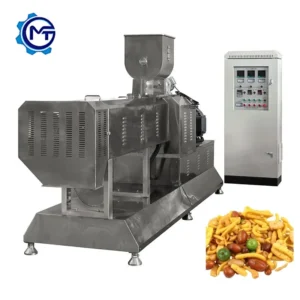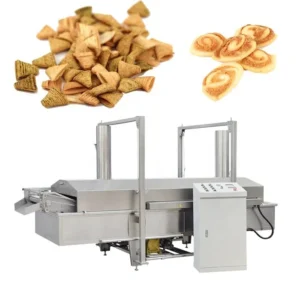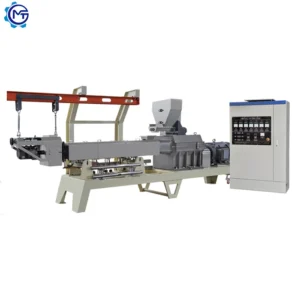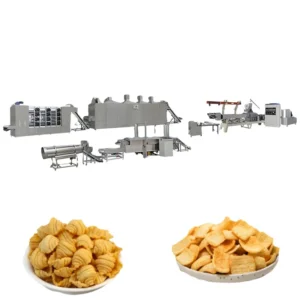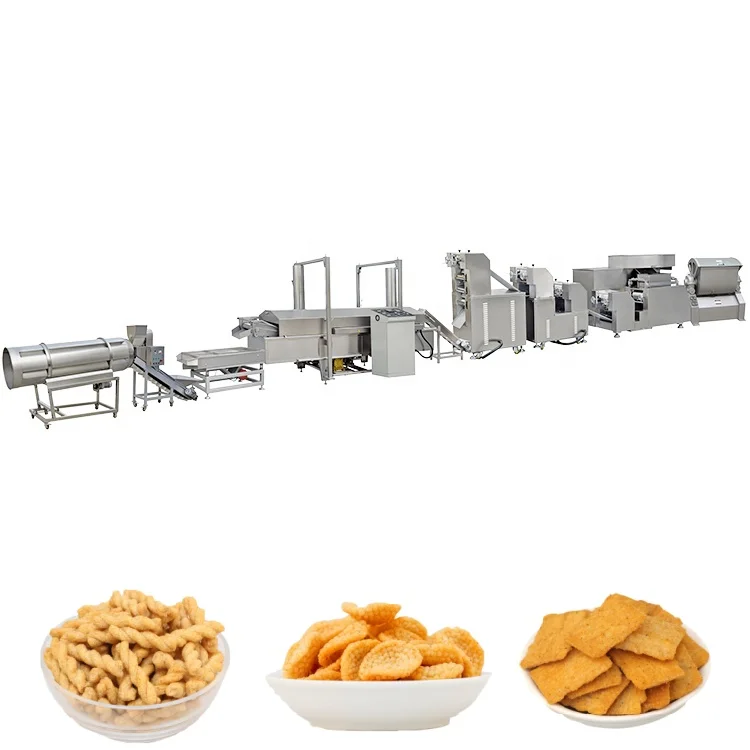
Complete Equipment Survey — Every station from mixing through extrusion, frying, flavoring, and cooling is catalogued in one place, so buyers specifying a fried puffed food production line for sale can match throughput across the entire flow before placing orders.
Technical Specifications
| Parameter | Value |
|---|---|
| Product Type | Fried Puffed Snack Food Production Line |
| Extruder Type | Single Screw Extruder |
| Screw Configuration | High and low pressure screw |
| Output Capacity | 120 kg/h (basis not stated in source — confirm raw material blend / moisture content / product shape) |
| Power (Electric Heating) | 50–70 kW |
| Power (Gas / Diesel Heating) | 50–60 kW |
| Voltage & Frequency | Three phases 380V/50Hz, Single phase 220V/50Hz (customizable to local voltage) |
| Energy Options | Electricity / Gas / Diesel / Steam |
| Raw Materials | Wheat flour, corn starch, potato starch |
| Overall Dimensions (L×W×H) | 12000–26000 × 1200 × 2200 mm |
| Contact Material | Food grade stainless steel 201/304 |
| Control System | Standard electrical components (Siemens or China top brand motor, Delixi or Delta inverter) |
| Line Stations | Mixer → Screw Conveyor → Single Screw Extruder → Pulling and Cutting Machine → Automatic Fryer → Automatic Flavoring Line → Cooling |
| Die Configuration | Adjustable dies for multiple shapes (screw shell, round tube, square tube, ring, cartoon shapes) |
| Certification | CE / ISO 9001 |
Application Suitability
| Application | Material or Output |
|---|---|
| Salad sticks and corn curls | Wheat flour and corn starch blends |
| Golgappa / Pani Puri shells | Wheat flour with potato starch |
| Screw shells and tube snacks | Corn starch and potato starch mixes |
| Ring and cartoon-shaped puffed snacks | Multi-grain starch formulations |
| Secondary puffing fried formats | Pre-extruded pellets fried to final expansion |
Why Matching Fryer Capacity to Extruder Output Matters
A fryer that cannot keep pace with the extruder turns a rated line into a bottleneck.
When a fried puffed food production line for sale is quoted at a nominal capacity, buyers often discover during commissioning that the fryer or flavoring drum was sized for a different throughput than what the extruder actually delivers on their raw material. The extruder pushes product forward, but the fryer basket cycle time or the oil recovery rate falls behind. Product piles up on the conveyor, moisture content drifts, and the final snack texture misses the crunch specification the market expects. This mismatch is one of the most common reasons buyers return to reconfigure a line within the first year of operation [NEED_CITE: common causes of extrusion line throughput mismatch in snack food manufacturing].
Surveying the Full Equipment Range Before Committing
The purpose of this catalogue is to let buyers see every station in a fried puffed food production line for sale as a single set. The mixer feeds the screw conveyor, which meters material into the single screw extruder. The extruder output passes through the pulling and cutting machine, then enters the automatic fryer, moves on to the flavoring drum, and finishes at the cooling conveyor. Each station’s throughput, power draw, and footprint are documented so buyers can verify the entire chain balances before any purchase order is issued.
Energy Source Flexibility Across Line Stations
Different markets have different utility costs and availability. This line is configurable with electric, gas, diesel, or steam heating for the fryer and dryer stations. A buyer in a region where industrial electricity is expensive might choose gas-fired frying while keeping electric motors on the extruder and conveyor drives. The control panel integrates whichever combination is selected, and the electrical schematic is confirmed to the buyer’s local voltage and frequency before production begins [NEED_CITE: industrial energy source selection for food processing equipment in emerging markets].
Reading the Specifications That Matter
The single screw extruder uses a high and low pressure screw configuration rather than a uniform flight design. This means the screw compresses the dough progressively, building internal pressure before the die plate. The pressure differential at the die is what drives the initial expansion of wheat flour, corn starch, or potato starch blends — a flat-pressure screw would produce a dense pellet with poor secondary puffing in the fryer. The adjustable die system lets operators switch between screw shell, round tube, square tube, ring, and cartoon shapes by changing die inserts, so one extruder covers multiple product formats without a second machine. Food grade stainless steel 201 or 304 contact surfaces are specified based on the buyer’s local food safety requirements, with 304 typically chosen for markets enforcing stricter corrosion resistance standards. Power draw spans 50–70 kW for electric heating configurations and 50–60 kW where gas or diesel replaces the electric fryer elements, which affects the transformer sizing and dedicated circuit planning at the installation site.
The Cost of Ordering Stations Separately
Buyers who source the extruder from one vendor and the fryer from another often face interface problems that no single supplier takes responsibility for. The conveyor height between the cutting machine and the fryer inlet may not align, causing product spillage. The flavoring drum speed may not match the fryer discharge rate, leading to uneven seasoning coverage. When these issues surface during commissioning, each vendor points to the other’s equipment, and the buyer funds the modifications [NEED_CITE: integration risks when sourcing food processing line stations from multiple vendors].
Why Procure the Complete Line Here
Every station from mixer to cooling is designed and built within one facility, so throughput calculations across the chain use the same raw material assumptions rather than separate vendor estimates. The screw configuration and die design are specified to the buyer’s target product shape and starch blend, not copied from a generic template. An in-house testing workshop runs the buyer’s actual raw material before shipment, catching expansion or density issues while adjustments are still inexpensive. Voltage, frequency, and control language are confirmed during the specification stage so the electrical panel arrives ready for local connection. CE and ISO 9001 certification documentation ships with every line, supporting customs clearance and local regulatory compliance.
Documentation & Verification
- Line layout with matched throughput for every station from mixer to cooling conveyor
- Screw and die configuration record matched to buyer’s starch blend and target snack shape
- Electrical schematic confirming voltage, frequency, and control language for destination market
- Factory test record on buyer’s raw material with extrusion and frying parameters logged
- CE declaration of conformity and ISO 9001 certificate for import clearance
- Operation and maintenance manual covering all line stations with wear parts list
Installation, Commissioning & Support
- Foundation and floor space planning based on the 12000–26000 mm line length and 2200 mm height clearance
- Dedicated circuit sizing for 50–70 kW electric heating or gas supply routing for fryer stations
- Assembly from shipping sections with station-by-station alignment verification on site
- First-run parameter setting including screw speed, barrel temperature profile, and fryer oil temperature
- Operator training covering die changeover, screw configuration adjustments, and daily cleaning procedures
- Wear parts list with recommended spare screws, die inserts, and conveyor belt sections
What to Share With Your Inquiry
To configure the right fried puffed food production line for sale for your facility, provide your raw material formula and moisture content, the snack shapes you intend to produce, your target daily output, and your workshop dimensions. Include your local voltage and frequency standard, preferred control panel language, and whether you need energy source options other than electric heating. If you have existing upstream or downstream equipment that must integrate with the new line, share those specifications as well.
Frequently Asked Questions
Q: How do I choose between the MT100 and MT120 extruder models?
A: Selection depends on your target output and raw material blend. Share your starch formulation, moisture content, and desired snack shape. The MT100 suits lower-capacity runs or pilot production, while the MT120 handles higher volumes. A trial run in the testing workshop on your actual raw material confirms which model holds your required throughput.
Q: What voltage and control options are available for export markets?
A: Standard configurations include three-phase 380V/50Hz and single-phase 220V/50Hz. Voltage is customizable to match local supply standards. Control panel language, motor brand preference such as Siemens or a China top brand, and inverter selection from Delixi or Delta are all confirmed before production begins.
Q: How does die configuration determine the final snack shape?
A: The adjustable die system uses interchangeable inserts to produce screw shell, round tube, square tube, ring, and cartoon shapes. The die opening geometry and pressure profile together control expansion and wall thickness. The configuration record documents which dies are included and how each maps to a specific product format.
Q: Can I purchase the fryer or flavoring station separately?
A: Yes, individual stations such as the automatic fryer or flavoring drum can be supplied to upgrade an existing extrusion line. Throughput matching between the new station and your current equipment is verified during the specification stage to avoid bottlenecks or product accumulation on conveyors.
Q: What energy sources can heat the frying and drying stations?
A: Electric, gas, diesel, and steam heating are all available. The choice affects total power draw, utility infrastructure requirements, and operating cost in your region. The line specification confirms which energy source each station uses so your facility’s electrical and fuel systems are prepared before delivery.