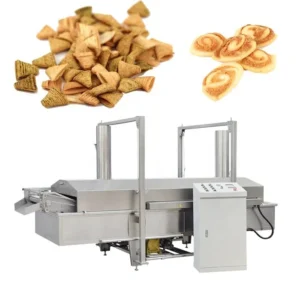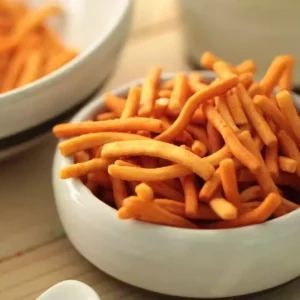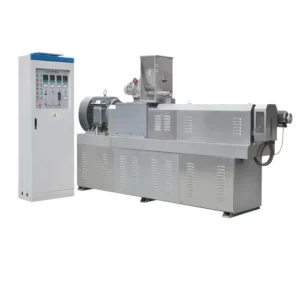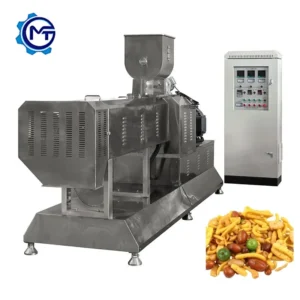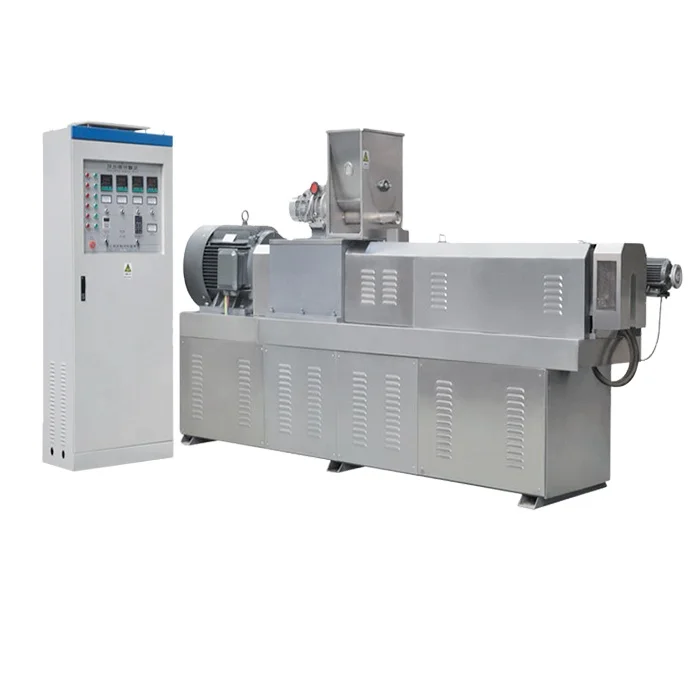
Screw Configuration Matched to Recipe — Every MT65 build starts with the buyer’s actual flour blend and target chip density, not a generic screw stack copied from a catalog.
Technical Specifications
| Parameter | Value |
|---|---|
| Model | MT65 |
| Product Type | Twin Screw Extruder Fried Snack Processing Line |
| Screw Type | Twin-screw |
| Main Motor Power (Extruder) | 30 kW |
| Installed Power (Full Line) | 142 kW |
| Real Power Consumption | 100 kW |
| Output Capacity | 120–150 kg/h (basis not stated in source — confirm raw material and moisture content) |
| Mixer Tank Volume | 150 kg |
| Mixer Rotary Speed | 385 rpm |
| Mixer Mixing Time | 10 min per batch |
| Mixer Power | 4 kW |
| Mixer Output | 300–600 kg/h (basis not stated in source — confirm batch material) |
| Fryer Temperature Range | 0–260 °C |
| Fryer Capacity | 200–300 kg/h (basis not stated in source — confirm product type) |
| Flavor Line Output | 400 kg/h |
| Flavor Line Power | 1.5 kW |
| Line Stations | Mixing → Extrusion → Frying → Flavoring |
| Construction Material | Stainless steel |
| Extruder Dimensions | 2800 × 830 × 1875 mm |
| Mixer Dimensions | 1000 × 630 × 1100 mm |
| Fryer Dimensions | 4500 × 1350 × 2350 mm |
| Flavor Line Dimensions | 3000 × 1650 × 1800 mm |
| Overall Dimensions | 22000 × 1200 × 2200 mm |
| Warranty | 1 year |
| Certification | CE, ISO |
Application Suitability
| Application | Material or Output |
|---|---|
| Bugles (crisp corners) | Corn flour, rice flour blends |
| Tortilla chips | Corn masa, wheat-corn composite flour |
| Rice crust snacks | Glutinous rice flour, starch-based mixes |
| Triangle and shell shapes | Wheat flour, potato starch blends |
| Small fish crisps and golden corners | Flour-starch composite with seasoning pre-mix |
| Pasta-based fried snacks | Durum wheat semolina, modified starch |
Why "Nominal Capacity" Means Nothing Without Your Raw Material
A Fried Snack Processing Line rated at a fixed output on standard corn flour may produce half that volume on your actual recipe.
I learned this the hard way. Last year I shipped a fried snack extrusion line to a Middle East customer. We ran the factory trial on standard corn flour and the bugles came out perfectly — crisp, uniform expansion, clean corners. Then the customer started production with their own flour blend and the forming rate dropped sharply. The screw configuration, barrel temperatures, and moisture targets all had to be reworked from scratch. That is the gap between a catalog number and a working production line. When buyers evaluate a Fried Snack Processing Line, the first question should never be "what is the maximum output" but "what is the output on my specific flour, at my target moisture, through my chosen die shape" [NEED_CITE: importance of raw material validation in extrusion throughput].
How Each Station’s Throughput Must Align
On any fried snack line, the extruder sets the pace but the fryer and flavoring drum must keep up. The MT65 extruder is rated for a specific throughput range, yet the continuous fryer and the flavoring station each carry their own capacity figure. If the fryer cannot handle the extruder’s output, product backs up, cools unevenly, and oil absorption becomes inconsistent. This catalogue approach lets you compare every station’s rated figure side by side before the line is built, rather than discovering a bottleneck during commissioning.
Matching Screw Geometry to Snack Density and Expansion
Twin-screw extrusion for fried snacks depends on the interplay between screw pitch, kneading block arrangement, and barrel temperature zones. Bugles require a different expansion profile than flat tortilla chips — one needs high radial expansion before frying, the other needs controlled sheet density. The screw configuration on the MT65 is selected based on the buyer’s target product and flour composition. Using a generic screw stack across all snack formats leads to under-expanded product or excessive shear that degrades starch structure before the material even reaches the die [NEED_CITE: twin screw configuration principles for puffed snack extrusion].
Reading the Specification Table Beyond the Headline Numbers
The 30 kW main motor on the MT65 extruder provides the torque needed for high-viscosity dough at low moisture — typical for corn-based bugle production where the material must hold shape through the die before frying. The mixer’s 150 kg tank volume and 385 rpm rotary speed define batch cycle time: with a 10-minute mixing cycle, you can calculate how many batches per hour feed the extruder continuously. The fryer’s 0–260 °C range covers everything from low-temperature drying-type frying for delicate rice crust to high-temperature flash frying for thick tortilla chips. The full line installed power of 142 kW with real consumption around 100 kW tells you the electrical infrastructure requirement — useful when planning transformer capacity and dedicated circuits in a new facility.
The Hidden Cost of Undersized Supporting Stations
A fryer that cannot match extruder output forces operators to slow the screw speed, which changes residence time inside the barrel and alters product texture. A flavoring drum that is too small means snacks cool before coating, so seasoning adhesion drops and you waste powder. These are not theoretical problems. I have seen lines where the extruder was correctly specified but the downstream stations were selected from a different catalogue page without checking throughput alignment. The result is a Fried Snack Processing Line that never reaches its intended daily volume and produces inconsistent product across shifts [NEED_CITE: consequences of mismatched station capacity in food processing lines].
What This Supplier Brings to Your Line Build
Every station in the MT65 line — mixer, extruder, fryer, flavoring drum — is specified under one supplier, so throughput is calculated across the full chain rather than assembled from separate vendors who each guarantee only their own machine. The screw and die configuration is designed around your raw material and target snack shape, not copied from a reference build. Before shipment, trial runs on the buyer’s actual flour blend take place in the in-house testing workshop so that forming rate, expansion, and frying behavior are validated before the line leaves the factory. All contact surfaces are stainless steel, meeting food-grade requirements for export markets that enforce strict sanitation standards. The CE and ISO certifications are maintained across the product range, supporting customs clearance and regulatory compliance in regulated markets.
Documentation & Verification
- Line layout drawing showing station placement and utility connection points for the MT65 configuration
- Machine specification sheet for each station with rated throughput and dimensional data
- Screw and die configuration record matched to your flour blend and target snack shape
- Electrical schematic with voltage and frequency confirmation for your facility
- Factory test record from trial run on your raw material before shipment
- CE declaration of conformity and ISO certificate for the complete line
Installation, Commissioning & Support
- Foundation and floor space planning based on the 22000 × 1200 × 2200 mm overall line footprint
- Dedicated electrical circuit design for 142 kW installed power with voltage confirmation before production
- Station-by-station assembly sequence for mixer, extruder, fryer, and flavoring drum
- First-run parameter setting for barrel temperature zones and fryer temperature profile
- Operator training on screw speed, mixer batch timing, and fryer belt speed adjustment
- Wear parts list covering extruder screws, die plates, and fryer belt segments with replacement intervals
What to Include in Your Inquiry
Share the specific flour or starch blend you plan to run, including moisture content and any additives. Provide your target daily output and the snack shapes you intend to produce — bugles, tortilla chips, rice crust, or a combination. Confirm your facility’s voltage, frequency, and available floor space so the line layout and electrical configuration match your local infrastructure from the start.
Frequently Asked Questions
Q: How do I confirm that the fryer and flavoring drum can actually keep up with the extruder output on my flour?
A: Each station carries its own rated capacity figure. We calculate line throughput based on your specific raw material and product shape, then verify through a trial run in our testing workshop before shipment. This ensures the fryer belt speed and flavoring drum cycle match actual extruder output rather than a generic catalog number.
Q: What voltage and control system options are available for this fried snack line?
A: Voltage and frequency are configured to match your facility’s electrical supply. The control system options should be confirmed during the specification stage. We provide a full electrical schematic and voltage confirmation document before production begins so there are no surprises during commissioning.
Q: How do the station dimensions affect my factory layout planning?
A: The overall line stretches approximately 22 meters long. Each station — mixer, extruder, fryer, flavoring drum — has published dimensions so your engineering team can plan utility drops, access aisles, and ventilation requirements before the equipment arrives on site.
Q: Will you run a trial on my actual raw material before shipping the line?
A: Yes. The in-house testing workshop conducts trial runs using the buyer’s flour blend and target recipe. We document forming rate, expansion behavior, and frying results, then adjust screw configuration or barrel settings if needed before the line is packed for dispatch.
Q: What spare and wear parts should I plan for in the first year of operation?
A: The wear parts list covers extruder screw elements, die plates, and fryer belt components. We provide a recommended spare parts package based on your planned production volume so that first replacements are available before the original parts reach end of service life.