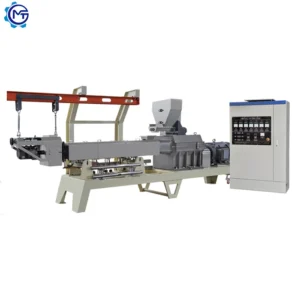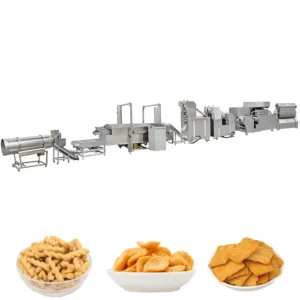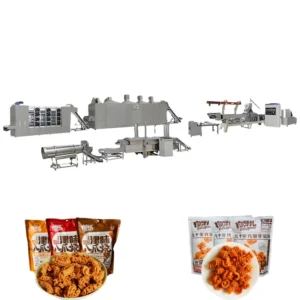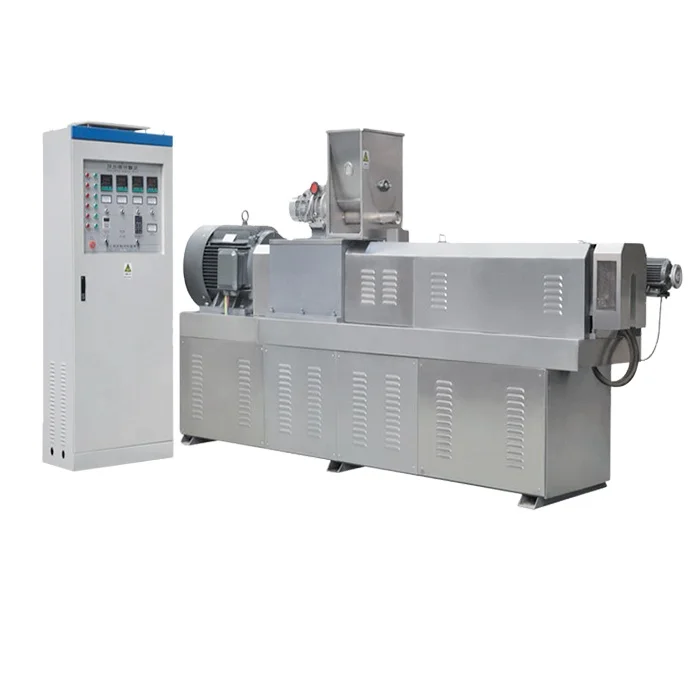
Throughput-Matched Stations — Every module from mixer to flavouring is balanced against the extruder’s actual output, preventing bottlenecks that typically emerge when a line is assembled from independent vendors.
Technical Specifications
| Parameter | Value |
|---|---|
| Model Options | MT65 / MT70 / MT85 / MT75 / MT95 |
| Product Type | Fried Snack Processing Line (Bugles / Crisp Corn Chips) |
| Extruder Type | Double Screw Extruder |
| Installed Power | 142 kW (MT65) / 185 kW (MT70) / 240 kW (MT85) / 245 kW (MT75) / 370 kW (MT95) |
| Real Power Consumption | 100 kW (MT65) / 130 kW (MT70) / 180 kW (MT85) / 185 kW (MT75) / 280 kW (MT95) |
| Output Capacity | 120–150 kg/h (MT65) / 200–250 kg/h (MT70) / 300–500 kg/h (MT85) / 400–500 kg/h (MT75) / 800–1000 kg/h (MT95) (basis not stated in source — confirm raw material formulation, moisture content and product shape) |
| Mixer Tank Volume | 150 kg |
| Mixer Rotary Speed | 385 rpm |
| Mixer Power | 4 kW |
| Fryer Temperature Range | 0–260 °C |
| Fryer Capacity | 200–300 kg/h (basis not stated in source — confirm product shape and oil type) |
| Flavor Line Output | 400 kg/h (basis not stated in source — confirm seasoning type and coating rate) |
| Product Shapes | Bugles, crisp corners, small fish crisps, golden corners, small gourds, ducks, Christmas trees, triangles |
| Construction Material | Stainless steel (food-grade contact parts) |
| Line Stations | Powder Mixer → Double Screw Extruder → Forming/Cutting → Fryer → Flavoring/Seasoning → Drying |
| Overall Dimensions | 22000×1200×2200 mm (MT65) to 30000×1500×2800 mm (MT95) |
| Warranty | 1 year complete warranty, life-time maintenance service |
Application Suitability
| Application | Material or Output |
|---|---|
| Bugles and horn-shaped snacks | Corn flour, wheat flour, cassava starch blends |
| Tortilla chips and corn chips | Corn masa, corn grits with moisture conditioning |
| Shaped pasta snacks and rice crust | Rice flour, wheat semolina, mixed grain formulations |
| 3D-formed crisps (fish, ducks, trees) | Multi-grain flour blends with starch modifiers |
| Non-fried puffed pellets | Flour-based doughs for secondary baking or air-puffing |
Why Your Actual Flour Blend Determines True Line Output
A frying chips making machine manufacturer must validate capacity against your recipe, not a generic datasheet.
I remember a project in Lagos where the buyer’s local corn flour had higher fibre and lower starch than the reference material we used during factory acceptance. The extruder ran fine, but the Bugles came out with uneven wall thickness and collapsed after frying. Two weeks of scrap before we re-profiled the screw elements and adjusted barrel moisture injection. [NEED_CITE: starch gelatinisation behaviour in twin-screw extrusion with varying amylose ratios] When the raw material changes, the shear profile, residence time and expansion ratio all shift — and a line tuned for one flour can fall well short of its nameplate capacity on another.
Matching Screw Geometry to Snack Shape and Dough Rheology
The double screw extruder in this frying chips making machine range uses configurable screw elements and die plates. For thin-wall Bugles, the compression ratio and kneading block arrangement differ from those needed for solid triangles or small fish crisps. Each shape demands a specific balance between shear energy and dough residence time inside the barrel. Selecting the correct configuration before production begins avoids the trial-and-error waste that plagues lines shipped with generic screw sets.
Barrel Temperature Profiling Across the Extrusion Zones
Heat is introduced in stages along the barrel, with independent heating and cooling circuits for each zone. Starch gelatinisation in corn-based doughs typically requires a controlled temperature ramp — too steep and the dough skins over before expansion; too flat and the product exits undercooked. The fryer downstream then completes moisture removal and surface browning. Getting the barrel profile right is what separates a crisp, uniform chip from one that fractures or blisters irregularly during the frying chips making machine process. [NEED_CITE: temperature zone control in food-grade twin-screw extruders]
Reading the Power and Capacity Tiers
The five models span installed power from 142 kW to 370 kW, with real consumption figures roughly 70–75 % of installed capacity — a typical ratio for extrusion lines running steady-state production. The mixer’s 385 rpm rotary speed and 150 kg tank volume provide batch conditioning upstream, while the fryer’s 0–260 °C range covers most vegetable oil frying requirements. What matters for your selection is not the peak number on the nameplate but whether the mixer cycle time, extruder throughput and fryer dwell time are balanced for your specific product shape and dough moisture at your target hourly output.
What Happens When Stations Are Not Throughput-Matched
An extruder that outpaces its fryer forces operators to throttle the screw speed, wasting motor capacity and altering dough shear history. Conversely, a fryer idling below its design load burns oil unnecessarily and degrades product colour consistency. I have seen seasoning drums overloaded because the upstream line was upsized without recalculating coating rate, leaving chips unevenly dusted. [NEED_CITE: throughput balancing in continuous food processing lines] These mismatches rarely appear on a quotation — they surface weeks after commissioning when the buyer realises the bottleneck is not where they expected.
Why Buyers Source This Line from a Single Supplier
Every station — mixer, extruder, forming unit, fryer, flavouring drum, dryer — is specified together so throughput calculations hold across the entire chain. Screw and die configurations are documented against the buyer’s target shape rather than copied from a default build. The in-house testing workshop allows trial runs on the buyer’s actual flour blend before the line leaves the factory, catching formulation issues early. Food-grade stainless steel contact surfaces and modular pre-assembled sections simplify installation on site. Electrical schematics, voltage and control language are confirmed against the destination market’s utility standard before production begins. [NEED_CITE: CE machinery directive documentation requirements for food processing equipment]
Documentation & Verification
- Line layout drawing showing station spacing and utility connection points for your selected model tier
- Screw and die configuration record matched to your target snack shape and dough formulation
- Factory trial run report produced on your raw material before dispatch approval
- Electrical schematic with confirmed voltage, frequency and control panel language
- CE declaration of conformity and ISO certificate included with shipping documentation
- Wear parts list specifying screw elements, die plates and seal kits for first-year maintenance
Installation, Commissioning & Support
- Foundation plan accounts for the full line length up to 30 m and fryer ventilation requirements
- Dedicated electrical circuit sized to the model’s real power draw, up to 280 kW for MT95
- Modular pre-assembled stations reduce on-site assembly to mechanical and utility connections
- First-run parameter setting covers barrel temperature zones, screw speed and fryer oil temperature
- Operator training includes screw changeover procedure and die plate replacement for shape switching
- Spare screw elements and die plates shipped with initial order to cover early wear replacement
Before You Request a Quotation
Share your primary flour type, any secondary starches or additives, and the moisture range you typically work with. Specify the snack shapes you plan to produce and your target daily output in kilograms. Include your factory’s available floor length, ceiling height, and local voltage and frequency standard. If you can send a sample of your raw material, a trial run in the testing workshop will give you verified capacity figures before the line is built.
Frequently Asked Questions
Q: How is output capacity verified against my specific flour formulation and moisture content?
A: We conduct a trial run in the in-house testing workshop using your actual raw material. The screw speed, barrel temperature profile and moisture injection are adjusted until the target product shape and texture are achieved. A written report documents the verified output rate and process parameters, giving you a realistic capacity figure rather than a generic nameplate number.
Q: What screw and die configuration is selected for my target snack shape?
A: Each shape — whether Bugles, triangles, fish crisps or 3D forms — requires a distinct compression ratio and die geometry. We select screw elements and die plates based on your product specification and dough rheology, then record the configuration so replacements can be ordered with exact part numbers when wear parts are due.
Q: How is fryer capacity matched to extruder output to avoid line bottlenecks?
A: The fryer’s belt speed, oil volume and heating capacity are calculated against the extruder’s verified output on your formulation. This ensures chips enter the oil at a consistent rate, maintaining uniform colour and moisture removal without the fryer running below design load or becoming a throughput constraint.
Q: Can a trial run on my raw material be conducted before shipment?
A: Yes. Buyers are encouraged to send a representative batch of their flour blend to the testing workshop. The trial confirms expansion behaviour, wall thickness and post-fry texture, and the resulting parameters are locked into the machine specification before the line enters final assembly.