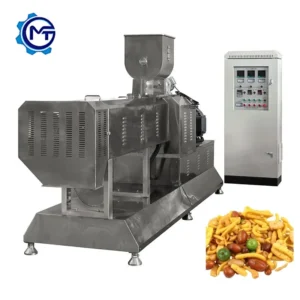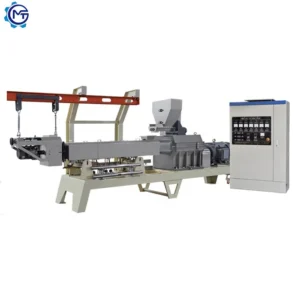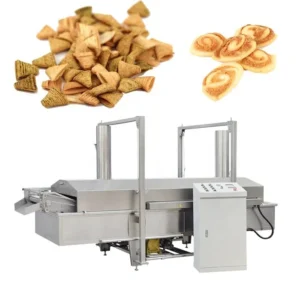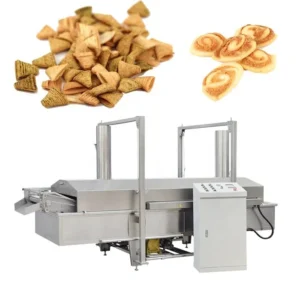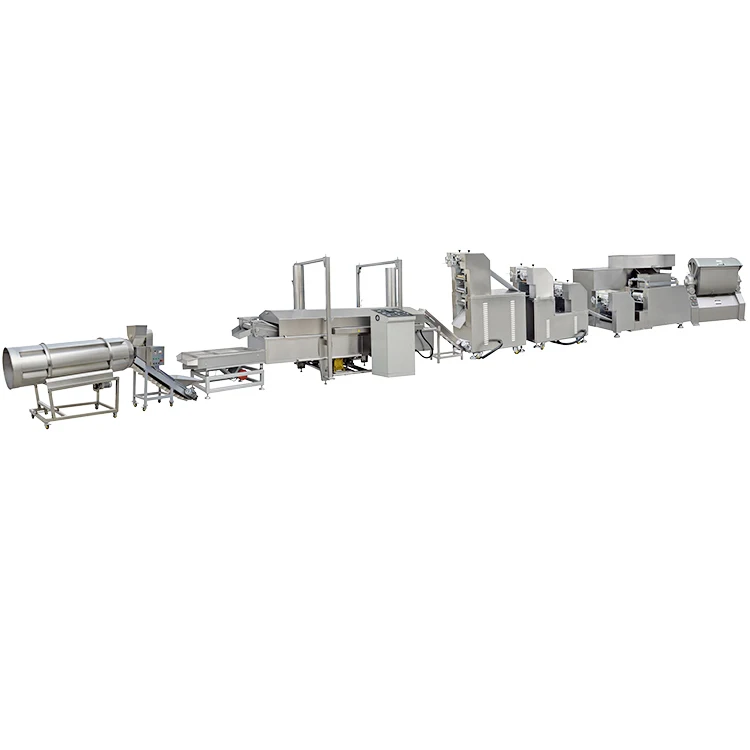
Single-screw extrusion line with matched throughput at every station — The MT100/MT120 line is configured as a complete sequence from mixing through packing, so the fryer, flavoring drum and cooler are each sized to the extruder’s output rather than sourced as standalone units that create bottlenecks.
Technical Specifications
| Parameter | Value |
|---|---|
| Model | MT100/MT120 |
| Product Type | Single Screw Snack Extrusion Production Line |
| Extruder Type | Single screw with high and low pressure screw configuration |
| Rated Power | 50–70 kW (electricity); 50–60 kW (gas or diesel) (basis not stated in source — confirm energy type and configuration) |
| Voltage & Frequency | Three phases 380V/50Hz, Single phase 220V/50Hz (customizable to local voltage) |
| Output Capacity | 120 kg/h (basis not stated in source — confirm raw material formulation and moisture content) |
| Overall Dimensions (L×W×H) | 12,000–26,000 × 1,200 × 2,200 mm (source value — verify against manufacturer catalog) |
| Contact Material | Food-grade stainless steel 201/304 |
| Electrical Components | Siemens (China) or China top brand motors; Delixi or Delta inverters |
| Energy Options | Electricity / Gas / Diesel / Steam |
| Process Flow | Mixer → Screw Conveyor → Single Screw Extruder → Pulling and Cutting Machine → Automatic Fryer → Automatic Flavoring Line → Cooling |
| Line Stations | Mixing system, Extrusion system, Cutting system, Drying system, Frying system, Flavoring system, Packing system |
| Standards | CE, ISO 9001 |
| Warranty | One year |
Application Suitability
| Application | Material or Output |
|---|---|
| Secondary puffing snacks | Potato starch, corn starch, wheat flour formulations |
| Shaped puffed formats | Screw shell, round tube, square tube, ring, cartoon shapes |
| Golgappa / pani puri production | Starch-based dough sheets for frying and puffing |
| Multi-layer crispy snacks | Layered starch extrusion with post-frying expansion |
| Turtle chips and novelty formats | Die-cut shapes from single-screw extrusion and cutting |
Why the Snack Extrusion Production Line for Sale Must Match Every Station’s Capacity
A line is only as fast as its slowest station, and mismatched throughput between the extruder, fryer and flavoring drum is the most common reason installed lines fail to reach nameplate output.
When I was commissioning a puffed snack line in a workshop outside Lahore, the extruder was pushing product faster than the fryer could handle. Half-formed pieces piled up on the conveyor, oil temperature dropped every time a batch overloaded the tank, and the flavoring drum could not keep the seasoning coat even. The Snack Extrusion Production Line for sale had been quoted as a set of individual machines rather than a matched system [NEED_CITE: throughput matching between extrusion and downstream frying stations]. The buyer spent weeks re-engineering conveyor speeds and batch timers just to reach a stable rhythm. Sizing the fryer, cooler and flavoring drum to the single-screw extruder’s actual output from the start avoids that cascade of compromises.
Screw Configuration and Raw Material Flexibility
The single-screw extruder in the MT100/MT120 line ships with interchangeable high and low pressure screw configurations. A high-pressure setup works well with dense starch blends like potato starch, where the material needs more shear to gelatinise fully before it reaches the die. A low-pressure configuration suits lighter corn starch or wheat flour mixes that expand quickly and can scorch if held under pressure too long. Switching between these configurations lets a producer test different formulations on the same Snack Extrusion Production Line for sale without changing the barrel or motor.
How Die Design Shapes the Final Snack Format
The die plate at the extruder discharge determines the cross-section of every piece — round tube, square tube, ring, screw shell or custom cartoon shapes. Combined with the pulling and cutting machine downstream, the die sets both the profile and the length of each snack before it enters the fryer. For golgappa or pani puri, a flat sheet die feeds a cutting station that stamps circular discs. The die and screw configuration together control wall thickness, which directly affects how the piece puffs in hot oil and how evenly seasoning adheres in the flavoring drum [NEED_CITE: die geometry and expansion ratio in single-screw extrusion of starch-based snacks].
Reading the Power and Dimension Specs for Your Workshop
The rated power range of 50–70 kW for electric heating and 50–60 kW for gas or diesel heating tells you the utility infrastructure the line demands. A workshop running the electric configuration needs a dedicated three-phase 380V/50Hz circuit with enough headroom for the extruder motor, fryer heaters and conveyor drives simultaneously. The overall line length of 12,000–26,000 mm means the footprint varies with the number and size of downstream stations — a longer line typically includes a larger fryer or an extended cooling conveyor. Food-grade stainless steel 201/304 on all contact surfaces meets the sanitary expectations of most export markets, and the choice between 201 and 304 grades affects corrosion resistance in high-humidity frying environments. The Delixi or Delta inverters on the drive motors allow speed adjustment across the extruder and cutting stations to fine-tune piece length without mechanical changeover.
The Hidden Cost of Undersized Downstream Equipment
When a fryer is rated below the extruder’s actual output, oil temperature swings become unavoidable. Each overload batch cools the oil, the next batch absorbs more fat, and product colour drifts across the run. A flavoring drum that turns too slowly for the incoming flow leaves some pieces bare while others get clumps of seasoning. In the field I have seen these mismatches blamed on the extruder, when the real problem was a Snack Extrusion Production Line for sale that was never balanced as a system [NEED_CITE: effect of oil temperature fluctuation on fat absorption in continuous frying]. Replacing one undersized station after installation costs more than specifying the correct capacity up front.
Why Procurement Through a Full-Range Equipment Supplier Matters
Every station on this line — mixer, screw conveyor, single-screw extruder, pulling and cutting machine, automatic fryer, automatic flavoring line and cooler — is sourced and configured under one supplier, so the throughput calculation starts at the mixer and carries through to packing. The screw and die configuration is specified against the buyer’s actual raw material formulation rather than copied from a generic build. Energy source flexibility across electricity, gas, diesel and steam lets buyers align the line with local utility costs instead of adapting the workshop to a fixed heating type. The in-house testing workshop runs trial production on customer-supplied raw material before shipment, so formulation adjustments happen before the line is crated. Electrical schematics and voltage confirmation are reviewed with the buyer before production begins, preventing the delays that come from discovering a frequency mismatch on commissioning day.
Documentation & Verification
- Line layout drawing with each station’s throughput matched to the MT100/MT120 extruder output
- Screw and die configuration record tied to the buyer’s starch formulation and target snack shape
- Electrical schematic confirming voltage, frequency and control language for the destination market
- Factory test record from trial runs on customer-supplied raw material before dispatch
- CE declaration of conformity and ISO 9001 certificate for customs and regulatory clearance
- Wear parts list covering screws, dies and fryer mesh belts with replacement intervals
Installation, Commissioning & Support
- Foundation and floor space plan based on the 12,000–26,000 mm line length and station arrangement
- Dedicated three-phase 380V/50Hz circuit sized for the 50–70 kW electric heating load
- On-site assembly of extruder, fryer and conveyor sections with alignment verification
- First-run parameter setting for screw speed, barrel temperature and fryer oil temperature
- Operator training on die changeover and high/low pressure screw configuration switching
- Spare screw, die and fryer belt supply scheduled around the first replacement cycle
What to Include in Your Inquiry
Share the specific starch or flour formulation you plan to run, including moisture content and particle size, so the screw and die configuration can be matched before quotation. Provide your workshop’s available voltage, frequency and maximum connected load so the electrical design aligns with local supply. If you have an existing upstream mixer or downstream packing machine, note the model and throughput so the Snack Extrusion Production Line for sale can be configured to integrate without redundant stations.
Frequently Asked Questions
Q: How is the 120 kg/h output capacity verified, and what raw material formulation is it based on?
A: The capacity figure depends on the raw material blend, moisture content and die configuration used during testing. We run trial production in our workshop using your actual starch or flour formulation to confirm throughput before finalising the line configuration. The verified output is documented in the factory test report shipped with the equipment.
Q: How are the fryer, flavoring drum and cooler sized to match the extruder?
A: Each downstream station is calculated against the extruder’s confirmed output on your raw material. The fryer tank volume, oil heating capacity and conveyor speed are set so that product enters at a steady rate without overloading the oil bath. The flavoring drum diameter and rotation speed are matched to the same flow rate to ensure even seasoning coverage.
Q: What voltage, frequency and control language options are confirmed before shipment?
A: We review the electrical schematic with you before production begins. The line supports three-phase 380V/50Hz and single-phase 220V/50Hz as standard, with custom configurations available. Control panel labels and inverter settings are prepared in the language required for your operators, and a voltage confirmation document is signed off before the line is crated.
Q: Which die shapes and screw configurations are available for starch-based raw materials?
A: The single-screw extruder accepts interchangeable dies for screw shell, round tube, square tube, ring, cartoon shapes and flat sheet formats for golgappa production. High and low pressure screw configurations are available to suit dense potato starch blends and lighter corn or wheat flour mixes, allowing texture and expansion adjustment on the same machine.
Q: What spare wear parts are included, and how is the first replacement cycle managed?
A: The line ships with a wear parts list covering screws, dies, fryer mesh belts and cutting blades. A starter set of spares is included with the initial shipment. Replacement intervals are documented in the operation manual based on the trial run data, so you can plan procurement before the first changeover is due.