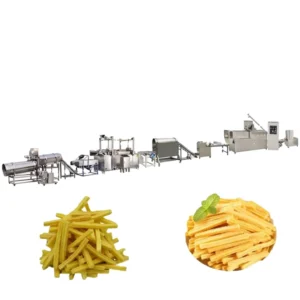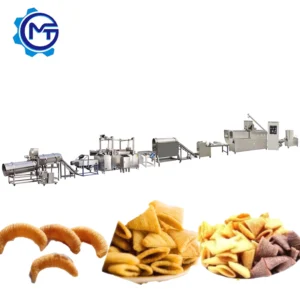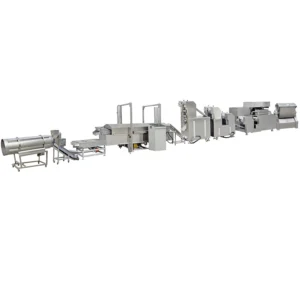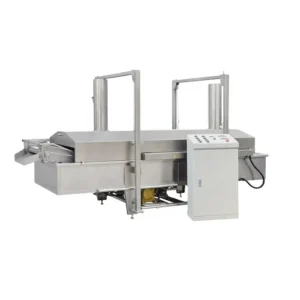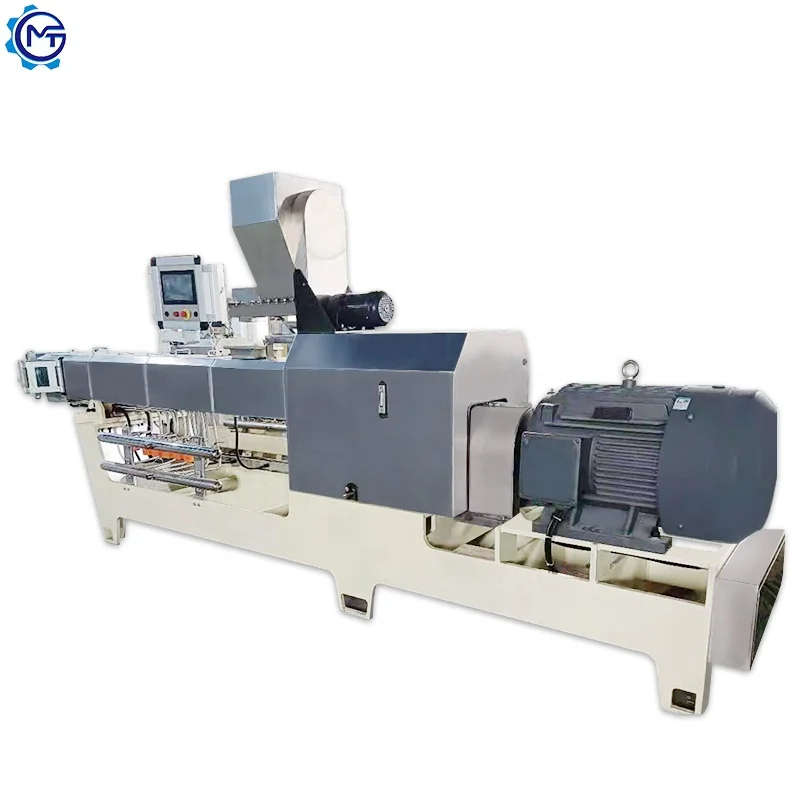
Line Balance Across Stations — every station from the extruder to the flavouring drum is sized so throughput holds without one unit throttling another.
Technical Specifications
| Parameter | Value |
|---|---|
| Product Type | Twin Screw Extruder Nacho Chips / Tortilla / Doritos Making Machine |
| Models Available | MT65 / MT70 / MT70c / MT75 |
| Screw Type | Twin-screw, 38CrMoAl alloy, nitriding process, self-cleaning |
| Main Motor Power | 22 kW (MT65) / 30 kW (MT70) / 45 kW (MT70c) / 55 kW (MT75) |
| Actual Power Consumption | 22 kW (MT65) / 30 kW (MT70) / 55 kW (MT70c) / 55 kW (MT75) |
| Output Capacity | 100–150 kg/h (MT65), 150–200 kg/h (MT70), 200–250 kg/h (MT70c), 200–300 kg/h (MT75) (basis not stated in source — confirm raw material type, moisture content, die configuration) |
| Overall Dimensions | 22000×1200×2200 mm (MT65) to 33000×3500×4300 mm (MT75) |
| Main Motor Brand | Siemens |
| Gearbox | Automatic lubrication function |
| Feeding System | Food-grade stainless steel twin-screw feeder with speed-adjusted converter |
| Cooling | Increased radiator on driving part for forced cooling |
| Cutting System | Rotary cutting knife fixed on die head seat, V-belt drive |
| Die System | High pressure double crank for die opening and closing |
| Fryer Heating Options | Electric / diesel / gas |
| Flavouring Station | Double-drum system with conveyor and sprayer |
| Line Assembly State | Complete line — extruder, fryer, flavouring system included |
| Warranty | 1 year from equipment arrival at customer site |
Application Suitability
| Application | Material or Output |
|---|---|
| Nacho chip production | Corn flour dough, extruded then fried and seasoned |
| Tortilla chip manufacturing | Corn masa or corn flour blend, sheeted or extruded format |
| Doritos-style triangular chips | Corn flour base with post-fry seasoning application |
| Bugles and cone-shaped snacks | Corn flour extrusion through shaped die, fried to crisp texture |
| Savory extruded snack lines | Corn, rice, or wheat flour blends for fried and coated formats |
Why Matching Fryer Capacity to the Extruder Matters More Than You Think
A twin screw extruder nacho chips making machine full equipment range only delivers rated output when every downstream station can keep pace — an undersized fryer or a single-drum flavouring unit will choke the line no matter what the extruder nameplate says.
The bottleneck is almost never the extruder itself — it is the station nobody checked for throughput match.
I have seen buyers focus all their attention on screw diameter and motor kilowatts, then watch a perfectly capable extruder idle while a fryer basket cycle falls behind. The corn-based dough arrives at the fryer faster than the oil can recover temperature, moisture drops unevenly, and half the batch comes out under-crisped. That is not a machine defect — it is a line design gap. [NEED_CITE: thermal recovery rate and oil volume requirements for continuous frying lines]
Extrusion Station: Screw Geometry and Self-Cleaning Design
The twin-screw configuration in this line uses 38CrMoAl alloy screws treated with nitriding, giving the contact surfaces the hardness needed to handle abrasive corn flour without accelerated wear. The self-cleaning profile means operators do not have to open the barrel when switching between a nacho chip die and a tortilla chip die — residual dough is wiped from the barrel wall by the intermeshing screw flights as the machine runs. A twin screw extruder nacho chips making machine full equipment range built around this screw design cuts changeover time between product formats on the same line.
Fryer and Flavouring: Where Texture and Taste Are Decided
The fryer downstream of the extruder is available with electric, diesel, or gas heating, and the choice directly affects oil temperature recovery between batches. Corn dough enters the oil at high moisture, pulling thermal energy from the oil fast — a heating source that cannot restore temperature quickly will produce chips that absorb excess oil and feel greasy. After frying, the double-drum flavouring system applies seasoning through a sprayer while the chips tumble, ensuring coating coverage on both sides. The conveyor between fryer and drum controls residence time so chips reach the drum at the right surface temperature for seasoning adhesion. [NEED_CITE: seasoning adhesion and surface temperature relationship in fried snack production]
Reading the Spec Sheet for What It Actually Tells You
The motor power steps across the four models — from 22 kW on the MT65 to 55 kW on the MT75 — indicate how much mechanical energy is available for dough shear inside the barrel. Higher kilowatt capacity supports greater throughput of viscous corn masa, but only when the die configuration and screw profile are matched to that throughput. The overall dimensions, stretching up to 33 metres for the MT75 line, tell buyers the floor length required from feeding hopper to flavouring discharge — a critical input for workshop layout planning. The food-grade stainless steel twin-screw feeder with speed-adjusted converter means dough delivery rate can be dialed in independently of screw speed, giving operators a second variable to control expansion and density at the die face. The gearbox with automatic lubrication and the increased radiator for forced cooling on the drive section address two of the most common unplanned stoppages on continuous extrusion lines — bearing seizure and thermal shutdown during long production runs.
What Happens When Downstream Stations Are Sized Wrong
A fryer with insufficient oil volume relative to extruder output causes oil temperature to sag with every basket load, producing chips with inconsistent colour and moisture content. A single-drum flavouring unit cannot keep up with a high-output extruder, forcing the line to run below capacity or leaving chips under-seasoned on one side. These mismatches do not show up in a single-machine quotation — they surface only when the full line is running under load. [NEED_CITE: throughput matching between extrusion, frying, and coating stations in snack food lines]
Why Buyers Source This Range Here
The line is specified as a complete sequence — extruder, fryer, double-drum flavouring — so throughput calculations account for every station rather than treating each as an isolated purchase. Screw configuration and die design are selected against the buyer’s actual corn flour formulation and target chip shape, not copied from a generic build. The in-house testing workshop runs trial production on customer-supplied raw material before shipment, so die pressure and expansion behaviour are documented before the line leaves the factory. Pre-sales consultation covers line layout and utility planning, and the engagement continues through on-site installation, commissioning, and operator training. Wear parts — screws, dies, cutting knives — are catalogued with the line so replacements are available when the first service interval arrives.
Documentation & Verification
- Line layout showing throughput match between extruder, fryer, and flavouring stations
- Screw and die configuration record specific to your corn flour formulation and chip shape
- Machine specification sheet with motor power, dimensions, and control details for chosen model
- Factory test record from trial run on your raw material before dispatch
- Electrical schematic with voltage and frequency confirmation for your facility
- Wear parts list identifying screws, dies, and knives with replacement intervals
Installation, Commissioning & Support
- Floor length up to 33 metres required — confirm workshop dimensions before finalising line layout
- Dedicated electrical circuit sized for 22–55 kW main motor plus fryer heating load
- Line ships in station modules — on-site assembly includes alignment of extruder die to fryer infeed
- First-run commissioning covers screw speed, feeder rate, and oil temperature calibration
- Operator training addresses die changeover, fryer oil management, and flavouring drum adjustment
- Wear parts stock recommended at installation — screws, dies, and rotary cutting knives
What to Share When Requesting a Quotation
Provide the specific corn flour type, moisture content, and any additives in your formulation so the screw profile and die can be matched before build. Confirm your workshop floor length, ceiling height, and available voltage and frequency so the line layout and electrical package are correct for your site. State your target hourly output and which chip formats you plan to run — nacho, tortilla, Bugles, or a combination — so the right model tier and die set are included.
Frequently Asked Questions
Q: How is output capacity verified against actual corn flour raw material and moisture level?
A: Capacity figures listed for each model are reference ranges. Before build, we run your corn flour sample in the testing workshop using the intended die configuration, recording actual throughput, expansion ratio, and product density. The trial run report becomes part of your documentation package, so you know what the line produces on your material before it ships.
Q: Which fryer heating option suits my facility?
A: The choice between electric, diesel, and gas heating depends on your site’s utility infrastructure and local energy cost structure. Electric heating gives precise temperature control but demands significant installed capacity. Gas and diesel offer faster thermal recovery for high-throughput frying. Share your available supply specifications so the correct unit is specified.
Q: How are the extruder, fryer, and flavouring drum sized to avoid bottlenecks?
A: Each station’s throughput rating is calculated against the extruder’s output on your specific formulation. The fryer oil volume and conveyor speed are matched so chips spend the correct time in oil without queuing. The double-drum flavouring system is sized to handle the full line output with even seasoning coverage.
Q: What die and screw configurations are available for different chip shapes?
A: Nacho, tortilla, Doritos-style, and Bugles shapes each require a specific die geometry and screw profile to control dough expansion and wall thickness. The die and screw configuration record in your documentation set documents the exact combination installed, and alternative dies can be supplied for format changes on the same extruder.
Q: What spare wear parts are included and how are replacements supplied?
A: The wear parts list shipped with your line identifies screws, dies, and rotary cutting knives with part numbers and expected service life. Replacement components are manufactured to the same 38CrMoAl nitrided specification and can be ordered using the recorded part numbers for direct fit without re-engineering.