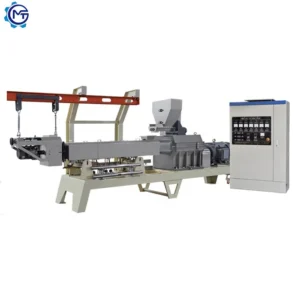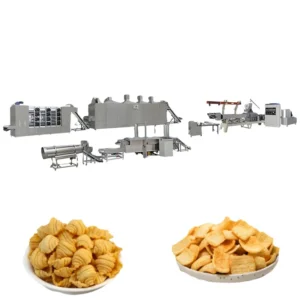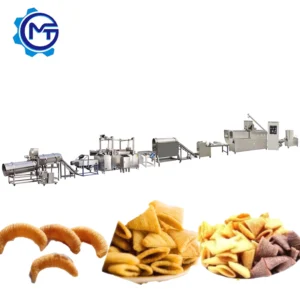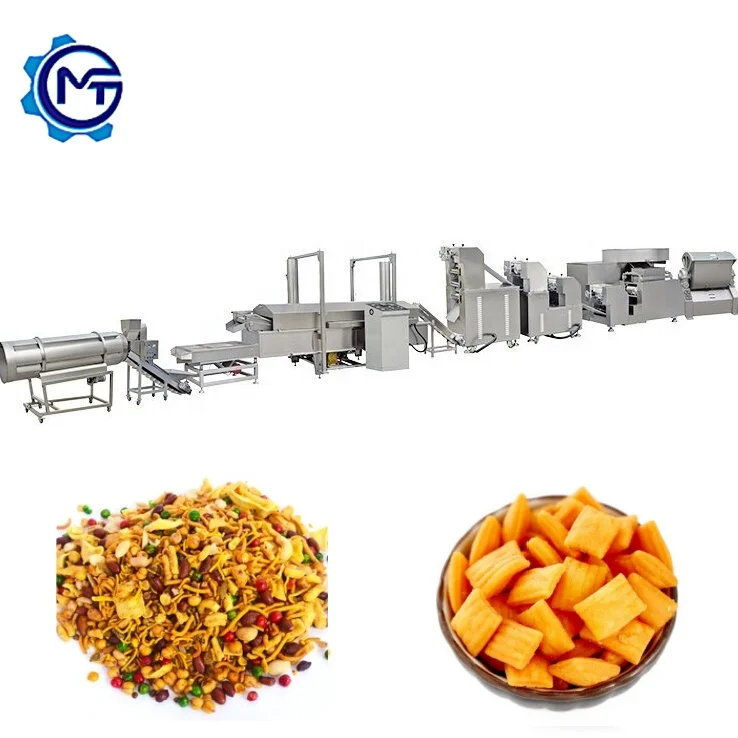
Throughput-Matched Integration — Every fryer in the MT full equipment range is sized against the upstream extruder and downstream cooling stations, so a continuous frying machine for snack production line runs at steady pace without material pile-up or moisture reabsorption before oil immersion.
Technical Specifications
| Parameter | Value |
|---|---|
| Product Type | Continuous Deep Fryer for Snack Production Line |
| Rated Power | 2.6 kW (conveying/control); 60 kW (heating tube) |
| Voltage & Frequency | 380V / 50Hz (configurable per destination market) |
| Control System | PLC |
| Overall Dimensions (L×W×H) | 6700 × 2200 × 1200 mm |
| Net Weight | 2000 kg |
| Capacity Range | 100–1000 kg/h (basis not stated in source — confirm product type, moisture, and frying time) |
| Oil Capacity | 320 L |
| Heating Method | Electric heating or gas heating (options) |
| Construction Material | Food-grade 304 stainless steel |
| Conveyor Type | Upper and lower double-layer mesh belt, frequency conversion stepless speed regulation |
| Oil Filtration | Continuous oil circulation filtration system |
| Slag Discharge | Bottom slag discharge system |
| Lifting System | Automatic lifting for upper hood and mesh belt |
| Key Features | Fully assembled continuous line fryer, PLC-controlled, CE certified |
Application Suitability
| Application | Material or Output |
|---|---|
| Fried pellet chips | 2D/3D pellet semi-finished snacks from potato or corn starch base |
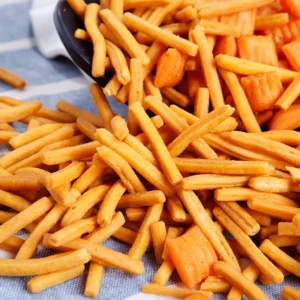
| Corn curls and fried sticks | Extruded corn grits or rice-based curls requiring secondary frying |
| Bugles and corn rolls | Formed corn dough pieces fried to final crispness and color |
| Puffed snack finishing | Pre-extruded or pre-dried snack items needing oil immersion for texture and shelf life |
What "1000 kg/h Capacity" Leaves Out for Snack Frying
A fryer rated at peak throughput means nothing if the extruder upstream cannot sustain that feed rate on your actual recipe.
I once watched a Southeast Asian customer lose an entire batch of corn curls because the extruder was quoted at a nominal output, but the fryer and flavouring drum could not keep tempo. Material sat between stations, absorbing ambient moisture before it ever hit the oil, and the final texture was completely off-spec. When evaluating a continuous frying machine for snack production line integration, the real question is whether the frying belt speed, oil volume, and thermal recovery rate hold steady at the exact throughput your extruder actually delivers on your raw material [NEED_CITE: throughput matching between extrusion and frying stations in snack lines]. That matching is where most line failures originate — not in individual machine quality, but in the gap between stations.
Matching Belt Speed to Extruder Discharge Rate
The double-layer mesh belt with frequency-controlled stepless speed regulation is the primary mechanism for controlling frying residence time. When the upstream twin-screw extruder discharges corn curls at a steady rate, the belt speed must be tuned so that each piece spends enough time submerged for full oil penetration and moisture flash-off without over-browning. This continuous frying machine for snack production line adjusts belt velocity across its full range, allowing operators to fine-tune the fry window as raw material moisture or ambient humidity shifts between production runs.
Thermal Recovery and Oil Volume Management
The 320-litre oil capacity paired with 60 kW heating tube power determines how quickly the oil recovers temperature after cold product enters the bath. In high-throughput snack lines, product enters the fryer continuously, and the oil temperature must rebound within seconds to maintain consistent crust formation and prevent oil absorption beyond specification. The continuous oil circulation filtration system removes particulate debris and free fatty acids throughout the run, which slows the rise in acid value and extends the interval between full oil changes [NEED_CITE: oil acid value accumulation rates in continuous snack frying operations].
How 304 Stainless Steel Construction Affects Line Hygiene
Food-grade 304 stainless steel throughout the fryer body, hood, and mesh belt resists corrosion from hot oil, salt, and cleaning agents used during washdowns. The automatic lifting system for the upper hood and mesh belt allows full access to the oil pan interior without manual disassembly, which matters when production schedules require rapid changeovers between different snack formats. This construction standard aligns with hygiene expectations in export markets where food safety audits inspect frying equipment surfaces directly.
Reading the Spec Sheet Against Your Actual Production Target
The rated power split — 2.6 kW for conveying and control versus 60 kW for the heating tubes — reveals where energy is actually consumed. Buyers comparing fryers should check whether the heating capacity matches their target frying temperature at their intended throughput, since undersized heaters will struggle to maintain set-point on high-moisture products like fresh-extruded corn curls. The PLC control system manages temperature zones, belt speed, and filtration cycle timing from a single interface, and its language and voltage configuration must be confirmed before production begins to avoid commissioning delays [NEED_CITE: PLC programming language and HMI localization for export food machinery]. The bottom slag discharge system continuously removes carbonized particles from the oil pan floor, preventing burnt spots on the product and reducing the frequency of full oil drainage for cleaning.
The Hidden Cost of Undersized Downstream Stations
When a fryer is selected based on catalogue capacity alone, the downstream cooling conveyor and flavouring drum often cannot absorb the discharged volume. Product backs up at the fryer exit, retains residual heat unevenly, and arrives at the seasoning station in clumps rather than a spread layer. I have seen this bottleneck force operators to slow the entire line, which then starves the fryer and causes the oil to overheat during idle periods — degrading oil quality and shortening its usable life before the next scheduled change [NEED_CITE: thermal degradation of frying oil during intermittent production cycles].
Why Sourcing the Frying Station Within a Complete Line Matters
Every station from the batching system through extrusion, frying, cooling, flavouring, and packing is configured under a single supplier, so throughput calculations account for the actual product density and moisture content at each transfer point rather than nominal machine ratings. Screw configuration and die design on the upstream extruder are specified to the buyer’s raw material, which means the product entering the fryer has predictable geometry and water content. An in-house testing workshop runs trial production on the customer’s actual raw material before shipment, generating a trial run report that confirms frying time and temperature settings. The electrical schematic and voltage confirmation are prepared for the destination market, preventing the kind of commissioning delay that happens when a 50 Hz machine arrives at a 60 Hz facility. Documentation covering line layout, capacity calculation, and wear parts lists travels with the shipment so the installation team has every reference needed before the first production day.
Documentation & Verification
- Line layout and capacity calculation confirming fryer throughput against upstream extruder output
- Machine specification sheet with voltage, frequency, and PLC language confirmed to destination
- Electrical schematic and utility requirement documentation for site preparation
- Factory test record and trial run report on customer raw material before shipment
- Wear parts list covering mesh belt sections, heating tubes, and filtration elements
Installation, Commissioning & Support
- Floor space allocation based on the 6700 × 2200 mm footprint plus clearance for hood lifting and maintenance access
- Dedicated electrical circuit rated for the combined 62.6 kW load at confirmed local voltage and frequency
- Fully assembled delivery requiring utility hookups and leveling rather than structural reassembly
- First-run commissioning with PLC parameter tuning for belt speed, oil temperature, and filtration timing
- Operator training on hood lifting procedures, bottom slag discharge, and mesh belt tension adjustment
- Spare mesh belt sections and heating tubes identified in the wear parts list for first replacement cycle
Preparing Your Inquiry for Accurate Line Configuration
To size the frying station correctly against your existing or planned extruder, share the raw material composition, the target product format, and the actual output you expect from upstream equipment. Specify your local voltage and frequency standard, the preferred PLC display language, and whether electric or gas heating suits your facility’s utility setup. If you are integrating this fryer into an existing line, provide the model and output rating of your current extruder and any downstream cooling or flavouring equipment already in place.
Frequently Asked Questions
Q: How is frying capacity verified against the actual snack product and upstream extruder output?
A: Capacity is confirmed through a trial run in our testing workshop using your raw material. We measure the actual extruder discharge rate, then set the fryer belt speed and oil temperature to match that throughput, documenting the results in a trial run report before the machine ships.
Q: What voltage, frequency, and PLC language options are available for the destination market?
A: The standard configuration is 380V/50Hz, but voltage and frequency are configurable to match your local supply. The PLC interface language is set during production based on your specification, ensuring operators can read all parameters and alarms in their working language from day one.
Q: How does the fryer integrate with upstream extruders and downstream flavouring and cooling stations?
A: Throughput is calculated across every station so that the fryer belt speed, oil recovery rate, and discharge volume align with the extruder output and the cooling conveyor capacity. This prevents material pile-up between stations and maintains product temperature and texture consistency.
Q: What is the scope of the oil filtration system and how does it affect oil replacement intervals?
A: The continuous oil circulation filtration system removes particulate debris and reduces free fatty acid accumulation during production. This slows acid value rise and extends the usable life of the oil between full changes, though exact intervals depend on product type and frying temperature.
Q: What installation conditions, utility hookups, and floor space are required for this fryer?
A: The unit requires a level floor accommodating the 6700 × 2200 mm footprint plus access clearance for the automatic hood lifting system. A dedicated electrical circuit matching the confirmed voltage and the combined 62.6 kW load is needed, along with oil filling and drainage provisions near the installation point.