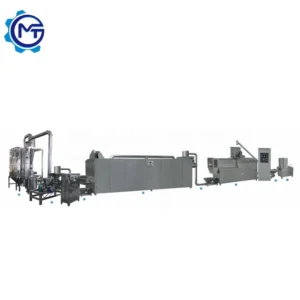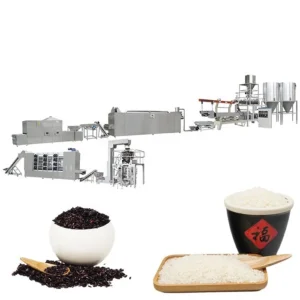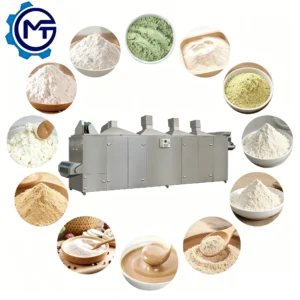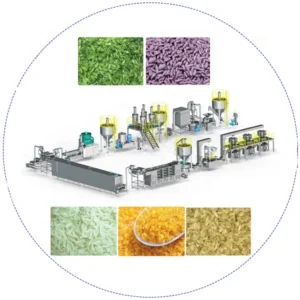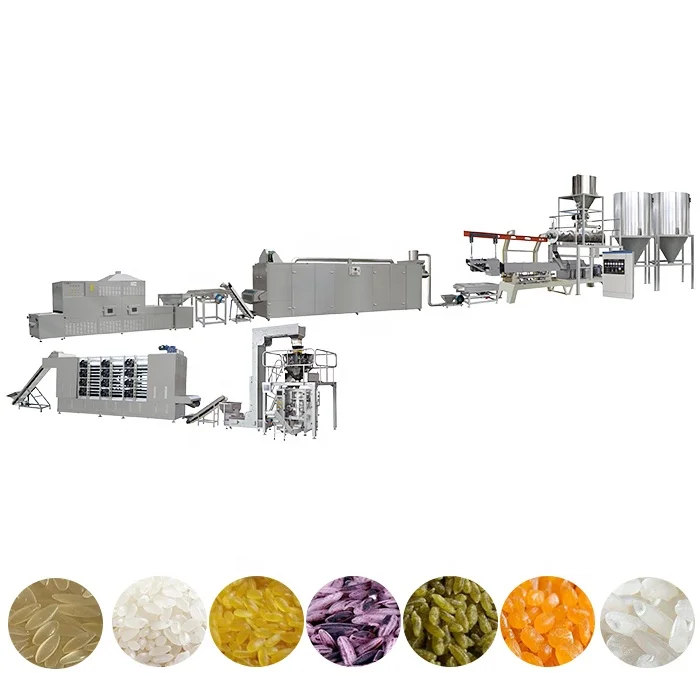
Full Equipment Range — Every station from powder mixing through twin-screw extrusion, screening, drying, cooling, and packing is throughput-matched under one supplier, eliminating multi-vendor integration gaps on your instant noodle line.
Technical Specifications
| Parameter | Value |
|---|---|
| Product Type | Instant Noodle Production Line |
| Extruder Type | Twin-screw extruder |
| Line Configuration | Full automatic (mixing, feeding, extruding, screening, drying, cooling, packing) |
| Mixing System | Powder mixer with preset ratio blending |
| Drying System | Vibrating screen with fan and drying box |
| Cooling System | Integrated cooling station |
| Conveying System | Feeder, air conveyor, lifting machine |
| Material Contact Parts | Food grade |
| Assembly State | Complete integrated line |
| Output Capacity | (basis to be confirmed) |
| Voltage & Frequency | (configurable — confirm for target market) |
| Control System | (basis to be confirmed) |
| Overall Dimensions | (basis to be confirmed) |
| Net Weight | (basis to be confirmed) |
Application Suitability
| Application | Material or Output |
|---|---|
| Instant noodle and ramen production | Wheat flour, starch blends, alkaline powder mixes |
| Compact noodle formats for food service | High-gluten flour with controlled hydration ratios |
| Fortified or nutrition-enhanced noodles | Flour blended with vitamin premix, protein isolate, or fiber powder |
What the Quoted Capacity Figure Actually Depends On
Your raw material recipe determines the real throughput — not the nameplate.
When I was commissioning a nutritional powder extrusion line in India, the customer ran the factory-standard flour blend during acceptance and saw full output. The day they switched to their own high-protein recipe with different starch ratios, the screw speed that worked at the factory caused the dough to stall in the barrel. Production dropped to roughly half what they planned for. This is not a defect — it is a mismatch between the quoted capacity basis and the buyer’s actual formulation [NEED_CITE: twin-screw extrusion behavior across varying starch-protein ratios]. Any instant noodle production line manufacturer quoting a single throughput number without stating the flour type, moisture content, and screw configuration is leaving out the variable that matters most.
How Each Station’s Throughput Must Align
An extruder running at full output is useless if the drying box downstream cannot handle the volume. Noodles arriving at the dryer faster than the residence time allows will exit with uneven moisture, sticking together or breaking during cooling. The vibrating screen, fan, and drying box on this line are sized to the extruder’s discharge rate so the moisture gradient stays controlled from entry to exit. That matching extends to the air conveyor and lifting machine — if the conveying speed lags, material backs up at the extruder die and forces unplanned stops.
Why Preset Ratio Blending Matters Before Extrusion
The powder mixer blends flour, starch, alkaline salts, and any fortification premix at ratios set before the material reaches the feeder. Inconsistent blending shows up downstream as noodles with variable color, texture, or cooking time. When running fortified noodle products, even a small deviation in premix distribution means some strands carry more nutritional additive than others, which becomes a compliance issue for buyers selling into regulated markets [NEED_CITE: nutritional fortification consistency standards for extruded food products].
Reading the Specification Sheet with an Engineer’s Eye
The twin-screw extruder in this line provides continuous kneading and shearing across the barrel length, which is what gelatinizes the starch uniformly before the die forms the noodle strands. Barrel temperature profile — typically divided into multiple heating zones — controls how aggressively the starch opens up. Too cool in the early zones and the dough arrives at the die under-worked, producing brittle noodles that fracture during drying. The screw configuration and die geometry together set the strand diameter, surface texture, and density. Food-grade contact materials throughout the wetted path prevent metallic contamination, which matters for buyers exporting to markets with strict food safety import checks.
The Cost of Undersized Supporting Equipment
A buyer who sources the extruder from one vendor and the dryer from another often discovers at commissioning that the two units disagree on throughput. The extruder pushes material faster than the dryer can remove moisture, or the dryer sits idle waiting for the extruder to catch up. Both scenarios burn production hours. I have walked into facilities where the cooling station was specified for a different product entirely, and noodles were arriving at the packing station too warm, causing condensation inside sealed bags [NEED_CITE: moisture migration and condensation in packaged extruded food products]. Fixing these mismatches after installation means either replacing equipment or accepting a lower line speed permanently.
Why Sourcing the Full Range Here Reduces Integration Risk
Every station on this instant noodle production line is specified against the same throughput target, so the mixer batch size, extruder discharge rate, dryer residence capacity, and packing speed all align from the layout stage. The screw configuration and die design are selected based on your actual flour blend and target noodle format rather than copied from a generic build. An in-house testing workshop allows trial runs on your raw material before the line ships, so formulation adjustments happen at the factory — not on your floor during commissioning. Twin-screw expertise across snack, cereal, and noodle applications means the barrel profile and screw elements are chosen from experience with similar dough rheology. Pre-sales consultation carries through to on-site installation, operator training, and ongoing wear part supply.
Documentation & Verification
- Line layout drawing showing throughput matching across every station
- Machine specification sheet with screw configuration and die design record
- Electrical schematic confirming voltage and frequency for your market
- Trial run report produced on your flour blend before dispatch
- CE declaration of conformity and ISO certificate for import clearance
- Operation and maintenance manual with wear parts list
Installation, Commissioning & Support
- Foundation and floor space plan based on the full line footprint and utility connections
- Dedicated electrical circuit sized to the twin-screw extruder motor and dryer heating load
- Line arrives in modular station groups requiring on-site assembly and belt alignment
- First-run commissioning includes screw speed, barrel temperature, and die gap setting on your material
- Operator training covers preset ratio blending, screen cleaning, and drying box fan adjustment
- Wear parts list specifies screws, dies, and screen panels with reorder lead time
What to Prepare Before Requesting a Quotation
Provide the flour type and any secondary starches or protein isolates in your recipe, along with the target noodle strand diameter and format. Confirm your workshop’s voltage, frequency, and available floor length so the layout can be drawn without rework. If you are integrating this line with existing packing equipment upstream or downstream, share the interface specifications so the conveyor and lifting machine can be matched. A raw material sample sent for trial run before shipment will reveal any formulation adjustments needed before the line leaves the factory.
Frequently Asked Questions
Q: What noodle format and raw material is the quoted capacity based on?
A: The throughput figure is tied to a specific flour blend, moisture percentage, and strand format. If your recipe differs — especially on protein content or starch type — the actual output will shift. We confirm capacity against your material during the pre-shipment trial run.
Q: How are dryer and cooling capacities matched to the extruder output?
A: The drying box residence time and fan volume are calculated from the extruder’s discharge rate so noodles reach the target moisture before packing. The cooling station is then sized to bring strand temperature down without bottlenecking the line.
Q: Can a trial run be performed on our specific flour blend before shipment?
A: Yes. Our testing workshop runs your raw material through the twin-screw extruder with the selected screw and die configuration. You receive a trial run report documenting throughput, strand quality, and any formulation adjustments before the line ships.
Q: What voltage and control language will the line use at our facility?
A: Voltage and frequency are confirmed during the specification stage to match your local supply. Control panel labels and HMI language are set to your operator preference so commissioning starts without translation delays.