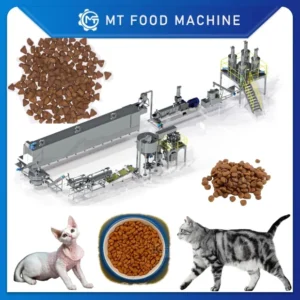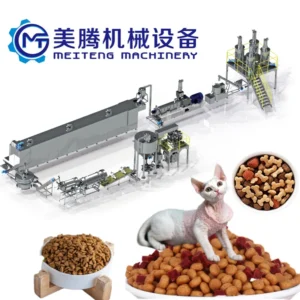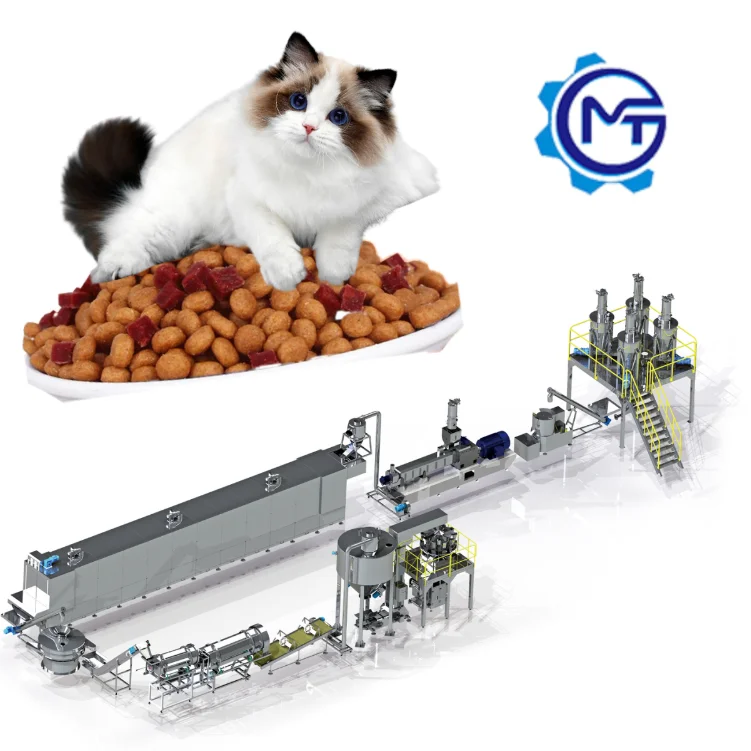
Balanced Station Throughput — Every mixer, dryer and packer is sized against the MT70 extruder output so no single stage chokes the line.
Technical Specifications
| Parameter | Value |
|---|---|
| Model | MT70 |
| Product Type | Dog Cat Pet Food Processing Line |
| Output Capacity | 200–250 kg/h (basis not stated in source — confirm raw material, moisture and kibble size) |
| Rated Power | 45 kW |
| Voltage & Frequency | 380V 50Hz Three Phase |
| Control System | Fully automated PLC and MCC (verify against manufacturer catalog) |
| Construction | Food-grade contact materials |
| Line Stations | Mixing, Extrusion, Drying, Packaging |
| Product Range | Dry kibble, semi-moist, treats |
| Recipe Adaptability | Wide range of pet food formulas |
| Standards | FDA, CE |
Application Suitability
| Application | Material or Output |
|---|---|
| Dry kibble production | Corn, meat meal, rice flour and vitamin premix blends |
| Semi-moist pet food | High-moisture dough with glycerin and protein concentrates |
| Treats and bite-size snacks | Starch-protein mixes shaped through interchangeable dies |
| Prescription diet batches | Low-volume runs with strict ingredient traceability |
Why Matching Dryer Capacity Matters More Than Extruder Speed
A pet food making machine full equipment range only performs when every station keeps pace.
When sourcing extrusion lines, buyers often fixate on the extruder’s nominal output and assume downstream equipment will follow. In practice, a high-output barrel pushing product into an undersized dryer creates a bottleneck that forces the entire line to slow down or stop. I have watched facilities in Southeast Asia lose entire shifts because the dryer could not handle the moisture load coming off the extruder, leaving trays of kibble sitting too long before entering the drying chamber [NEED_CITE: common bottlenecks in extruded pet food lines]. The MT70 line addresses this by calculating the thermal load at the drying stage based on the extruder’s actual throughput and the moisture content of the target recipe, ensuring the dryer has sufficient belt length and air volume to bring the product to shelf-stable moisture levels without backlog.
From Raw Ingredient Bins to Sealed Bags
This pet food making machine full equipment range covers the entire production sequence under one supplier responsibility. The batching and mixing stage meters dry and liquid ingredients into a homogeneous blend before feeding the extruder barrel. After extrusion, product moves directly onto the dryer belt, then through cooling and into the packaging station. Because a single engineering team designs the layout, the transfer points between stations are specified for the actual product flow rather than left to the buyer to reconcile from separate vendor manuals.
Recipe Flexibility Without Line Reconfiguration
Switching from a standard adult dog kibble to a grain-free cat formula or a soft semi-moist treat typically demands changes in screw speed, barrel temperature profile, die geometry and drying time. The MT70 line supports these changeovers through adjustable PLC parameters and interchangeable die plates. Operators load the new recipe from the control panel, swap the die if the kibble shape changes, and the system adjusts screw configuration and barrel heating zones accordingly. This flexibility allows producers to serve multiple market segments — premium, economy, life-stage specific — from a single installation [NEED_CITE: recipe changeover practices in twin-screw pet food extrusion].
Reading the Specifications That Actually Affect Output
The 45 kW rated power determines the mechanical and thermal energy available at the extruder barrel, which directly influences how much starch gelatinisation occurs per hour and therefore the expansion and density of the final kibble. A higher power rating allows denser recipes with more protein and fat to be processed without stalling the screws. The 380V 50Hz three-phase supply must match the facility’s electrical infrastructure; running this equipment on a different voltage or frequency alters motor speed and heating element output, which shifts the entire extrusion profile. Food-grade contact materials throughout the wetted path — barrel, screws, die and product conveyance — are not optional in markets where FDA compliance is enforced, and they also resist corrosion from the salts and acids common in meat-based pet food recipes. The fully automated control system centralises monitoring of barrel temperature zones, screw speed and feeder rates, reducing the chance of operator error during long production runs.
The Hidden Cost of Mismatched Station Sizing
Procuring the extruder from one vendor and the dryer from another often means neither party guarantees the interface between them. When throughput falls short, each supplier points to the other’s equipment as the cause, and the buyer is left troubleshooting alone. I have seen this scenario delay commissioning by weeks, with raw material sitting in the warehouse while engineers from different companies argue over responsibility [NEED_CITE: multi-vendor integration disputes in food processing lines]. A line configured as a single package eliminates this gap because one supplier owns the capacity calculation from mixer inlet to bagger outlet.
Why Buyers Source This Line From Meiteng
Meiteng engineers specify screw configuration and die design to the buyer’s actual raw material and target kibble density, rather than copying a generic build. The in-house testing workshop runs customer-supplied ingredients before shipment, generating a trial run report that confirms product texture and line throughput. Complete lines from batching through packing are designed under one roof, so station capacities are matched rather than assembled from disconnected vendors. Pre-sales consultation covers line layout, utility planning and phased installation scheduling. Documentation packages include electrical schematics, CE declarations and factory test records prepared for the destination market. Twin-screw extrusion expertise spans pet food, aquatic feed, snacks and cereal applications, allowing cross-industry process knowledge to inform each build.
Documentation & Verification
- Line layout drawing showing throughput matching across mixing, extrusion, drying and packaging stations
- Screw and die configuration record matched to your raw material and target kibble specification
- Trial run report produced on your actual ingredients before the line leaves the factory
- Electrical schematic with confirmed voltage, frequency and control language for your facility
- CE declaration of conformity and FDA compliance documentation for customs clearance
Installation, Commissioning & Support
- Foundation plan detailing floor load requirements for the 45 kW extruder and connected dryer section
- Dedicated three-phase 380V 50Hz circuit sizing for the full line connected load
- Modular station delivery allowing sequential assembly in facilities with limited overhead clearance
- First-run parameter setting covering barrel temperatures, screw speed and dryer belt speed for your recipe
- Operator training on PLC interface, recipe loading and die changeover procedures
- Wear parts list identifying screws, dies and dryer belt sections with recommended replacement intervals
Preparing Your Line Inquiry
To move from general interest to a firm configuration, share your target product format — dry kibble, semi-moist or treats — along with the primary raw materials and their approximate proportions. Provide your facility’s available floor area, ceiling height and existing electrical supply specifications including voltage and frequency. If you already operate upstream milling or downstream bagging equipment, include their throughput rates so the new line can integrate without bottlenecks.
Frequently Asked Questions
Q: How is the 200–250 kg/h capacity verified for my specific recipe?
A: The stated capacity range depends on raw material composition, moisture content and kibble size. Before shipment, Meiteng runs a trial on your actual ingredients in the testing workshop, documenting the achievable output and product quality. The trial run report becomes part of your documentation package, so you know the confirmed throughput before the line arrives at your facility.
Q: Will the dryer and packaging stations keep up with the extruder at full output?
A: Each station in the pet food making machine full equipment range is sized based on the extruder’s verified throughput and the moisture reduction required for your recipe. The line layout calculation documents the capacity of every station, ensuring no single point creates a bottleneck during continuous production runs.
Q: What voltage and frequency options are available for my market?
A: The standard configuration is 380V 50Hz three-phase, but the electrical system can be built to match your facility’s supply. Voltage, frequency and control panel language are confirmed during the specification stage before production begins, preventing commissioning delays caused by mismatched electrical standards.
Q: Can I see the line run my raw material before it ships?
A: Yes. You send a representative sample of your ingredients to the testing workshop, where engineers configure the screw and die setup and run a production trial. The resulting trial run report records throughput, product density, texture and moisture levels, giving you confidence in the line’s performance before it leaves the factory.
Q: Which supporting stations are included and how is throughput matched?
A: The line covers mixing, extrusion, drying and packaging as standard, with optional conveying and flavouring stations. Throughput at each station is calculated from the extruder’s confirmed output and the processing time your recipe requires, so material flows continuously without accumulation or starvation at any transfer point.