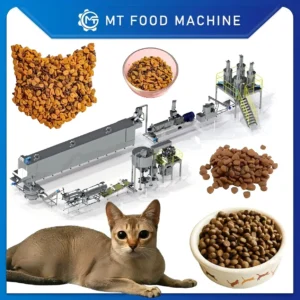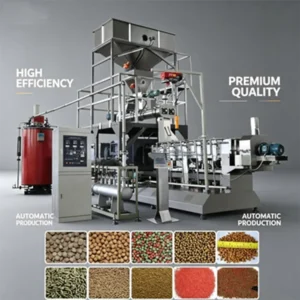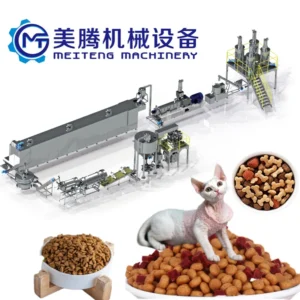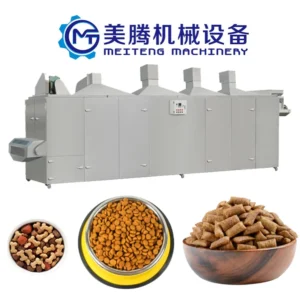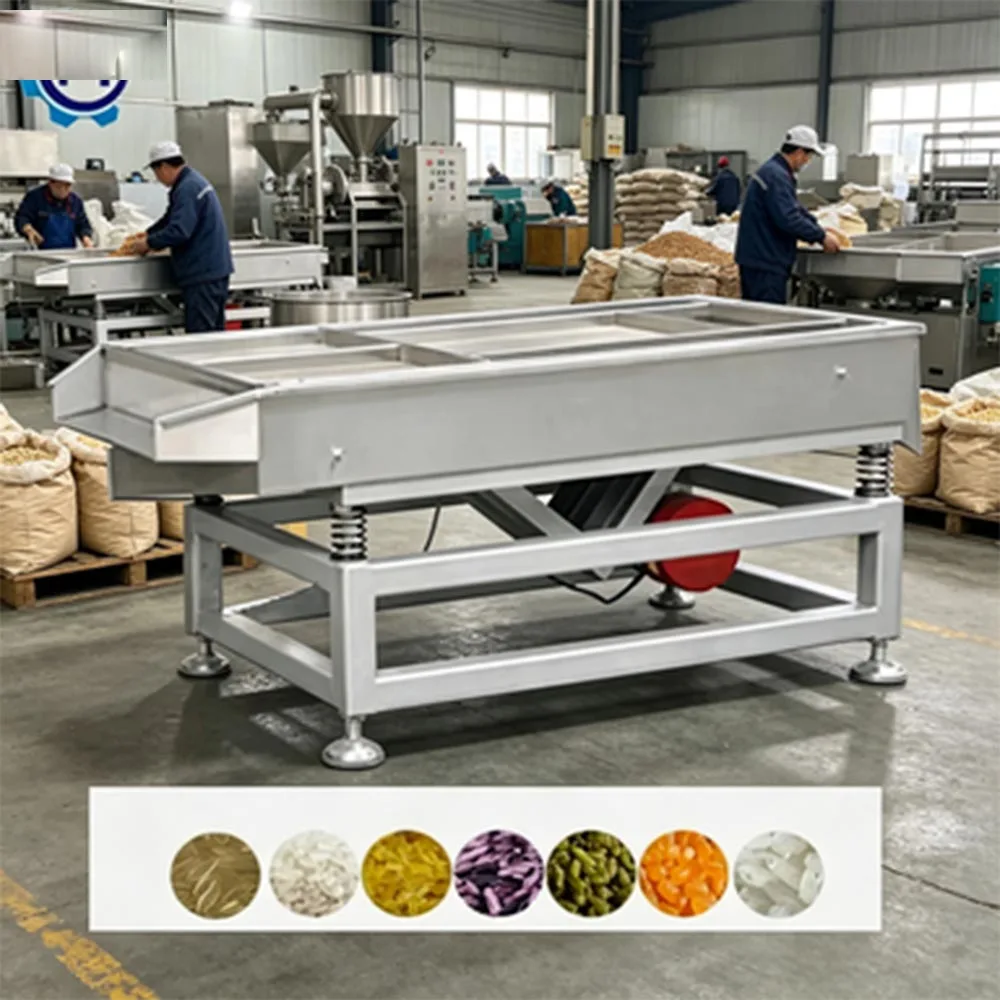
Matching Line Stations — Every machine from mixer to packer is sized to the same throughput target so the extruder never waits on the dryer or the coater.
Technical Specifications
| Parameter | Value |
|---|---|
| Product Type | Twin Screw Extruder Production Line for Fish Feed and Pet Feed |
| Screw Type | Twin screw |
| Control System | PLC automatic control system |
| Machine Body | Food grade 304 stainless steel |
| Material Contact Parts | Food grade 304 stainless steel |
| Pellet Output Types | Floating and sinking fish feed pellets |
| Pellet Adjustability | Pellet size, hardness, buoyancy adjustable |
| Supported Raw Materials | Fish meal, soybean meal, corn powder, compound additives |
| Target Species | Koi, goldfish, tropical fish, freshwater fish |
| Assembly State | Complete matched production configuration |
| Operation Interface | Humanized operation interface |
| Output Capacity | (basis to be confirmed based on raw material and pellet specification) |
| Rated Power (kW) | (basis to be confirmed per station) |
| Voltage & Frequency | (basis to be confirmed per target market) |
| Overall Dimensions (L×W×H) | (basis to be confirmed per line layout) |
| Net Weight | (basis to be confirmed per station) |
| Screw Diameter | (basis to be confirmed per extruder model) |
| L:D Ratio | (basis to be confirmed per extruder model) |
| Barrel Zones | (basis to be confirmed per extruder model) |
| Die Configuration | (basis to be confirmed per target product) |
| Moisture Range | (basis to be confirmed per raw material specification) |
Application Suitability
| Application | Material or Output |
|---|---|
| Floating fish feed for koi and goldfish | Fish meal, soybean meal, corn powder, compound additives |
| Sinking pellets for freshwater species | High-protein fish meal blends with starch binders |
| Tropical ornamental fish feed | Compound additives with vitamin and mineral premixes |
| Dry pet kibble | Corn powder, meat meal, soybean meal blends |
| Aquatic feed for shrimp and catfish | Plant protein and fish meal mixtures |
Why an Extruder Without a Matched Dryer Becomes a Bottleneck
A twin screw fish feed pet feed extruder full equipment range is only as productive as its slowest station — and the dryer is usually where the line chokes.
Buyers often fixate on extruder throughput while the downstream dryer, coater, and cooler are specified at a lower capacity. I have walked into plants where the extruder ran three hours and then sat idle for one while the dryer caught up. The line’s nominal output drops, energy per kilogram climbs, and the operator spends half the shift babysitting moisture levels. Sizing every station to the same hourly target eliminates that mismatch from day one [NEED_CITE: dryer-to-extruder capacity ratio in feed extrusion lines].
Mapping Every Station in the Twin Screw Fish Feed Pet Feed Extruder Full Equipment Range
A complete line begins with the raw material mixer, where fish meal, soybean meal, corn powder, and compound additives are blended to a uniform particle size. The mixed feed enters the twin screw extruder barrel where temperature, shear, and moisture gelatinise the starch matrix. From there the extrudate moves through the dryer, which removes moisture to the target shelf-stable level, then into the seasoning coating machine where fats and flavour agents are applied. The vibrating sieve removes fines and broken pellets before the conveyor equipment delivers finished product to packing.
How Pellet Buoyancy and Hardness Are Controlled Across Stations
Buoyancy is determined inside the extruder — screw speed, barrel temperature, and die pressure decide whether the pellet traps enough gas to float or stays dense enough to sink. However, the dryer station finalises that density. If drying temperature is too high or residence time too long, even a floating pellet can collapse and sink. The PLC automatic control system tracks barrel zones and dryer temperature together, so the operator adjusts one parameter and the line compensates downstream. This coordination is what keeps floating feed floating and sinking feed sinking across a full production run [NEED_CITE: starch gelatinisation and expansion behaviour in twin screw extrusion].
Reading the Specs That Actually Matter
The twin screw configuration gives this line its material flexibility. Single screw extruders rely on friction to push material forward and struggle with high-fat or high-moisture blends; the intermeshing twin screws provide positive conveying, handling sticky fish meal formulations that would stall a single screw machine. The screw diameter and L:D ratio together set the residence time inside the barrel — a longer L:D gives more cooking time for tough starches but increases energy draw. Die configuration determines pellet cross-section; round, ring, and bone-shaped dies each require a different pressure profile, and that profile must be matched to the barrel temperature zones. The food grade 304 stainless steel contact surfaces resist corrosion from fish meal acids and salt additives, which is critical when switching between aquatic and pet feed formulations on the same line.
The Hidden Cost of Undersized Downstream Equipment
When the seasoning coating machine is too small for the extruder output, pellets pile up in the buffer hopper and break from their own weight. I have seen lines where fines from the coating drum overwhelmed the vibrating sieve, sending broken pellets into finished bags. These are not extruder failures — they are line-balancing failures. The buyer paid for a high-output extruder but never matched the rest of the stations, so the effective throughput never reached the quoted figure [NEED_CITE: downstream bottlenecks in feed processing lines].
Why Sourcing the Full Range from One Supplier Changes the Equation
Every station on this line — mixer, extruder, dryer, coater, sieve, conveyor — is specified against the same throughput calculation, so no single machine waits on another. Screw and die configurations are selected to the buyer’s actual raw material blend, not copied from a generic template. The in-house testing workshop runs the buyer’s formulation on the twin screw extruder before shipment, producing a trial run report that confirms pellet density and buoyancy. Electrical schematics are drawn with the target market’s voltage and frequency already locked in, so the PLC panel powers up in the correct language on commissioning day. Wear parts lists cover screws, dies, and seals specific to the chosen configuration, and spare sets ship with the line.
Documentation & Verification
- Line layout and capacity calculation matching every station to the same hourly throughput target
- Screw and die configuration record built around your specific fish meal and corn powder blend
- Trial run report from the testing workshop run on your actual raw material before dispatch
- Electrical schematic with voltage, frequency, and PLC language confirmed for your market
- Factory test record documenting pellet buoyancy and moisture at each production checkpoint
- CE declaration of conformity and ISO certificate for customs and regulatory clearance
Installation, Commissioning & Support
- Foundation plan and utility map sized to the PLC-controlled twin screw extruder and dryer footprint
- Dedicated power circuit specification matching the confirmed voltage and frequency per station
- Assembly sequence for matched line stations from mixer through conveyor equipment
- First-run parameter setting for screw speed, barrel zones, and dryer temperature on your raw material
- Operator training covering the humanized operation interface and PLC alarm response
- Spare wear parts inventory — screws, dies, seals — supplied with lead time for reorder
Starting Your Line Specification
To size this twin screw fish feed pet feed extruder full equipment range accurately, we need your raw material formulation with moisture and fat percentages, the target pellet diameter and buoyancy type, and your daily output goal. Share your workshop dimensions and ceiling height so the line layout fits, along with local voltage and frequency. If you have existing upstream milling or downstream packing equipment, tell us the interface points so the conveyor equipment bridges correctly.
Frequently Asked Questions
Q: How is output capacity verified and what raw material and pellet specification is it based on?
A: Output capacity is calculated against your specific raw material blend and target pellet size, not a generic starch formula. We run your actual fish meal, soybean meal, and corn powder mix in the testing workshop, measure throughput at the extruder discharge, and confirm that the dryer and coater handle the same volume without bottlenecking before the quotation is finalised.
Q: How is screw and die configuration selected for my specific raw material blend and target pellet density?
A: Screw elements are arranged along the barrel to control shear and residence time for your formulation’s fat and moisture content. Die geometry is matched to the pellet cross-section and buoyancy requirement — floating pellets need a different pressure drop than sinking ones. Both are recorded in the configuration document you receive before shipment.
Q: What voltage, frequency, and control language options are confirmed before shipment?
A: The electrical schematic is drawn with your site’s voltage and frequency locked in, and the PLC interface language is set to your operator’s preference. These are confirmed during the specification stage, not at commissioning, so the control panel is ready the day the line is powered up.
Q: How are dryer and coating stations sized to avoid bottlenecking the extruder throughput?
A: Dryer residence time and coating drum volume are calculated from the extruder’s confirmed discharge rate. If the extruder delivers a set mass per hour, the dryer must remove the required moisture within that same window. We document this balance in the line layout and capacity calculation.
Q: What spare wear parts are supplied and what is the replacement lead time?
A: A first set of spare screws, dies, and seals specific to your configuration ships with the line. The wear parts list identifies each item by part number, and reorder lead times are confirmed at commissioning so you can plan inventory before the first replacement is due.