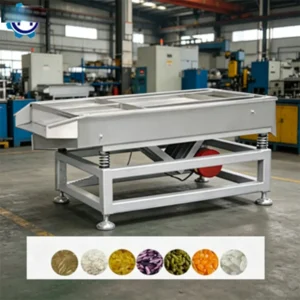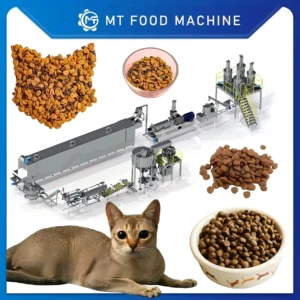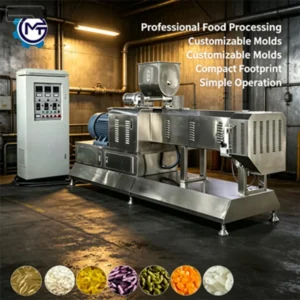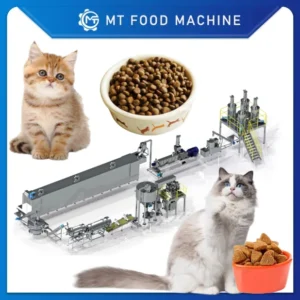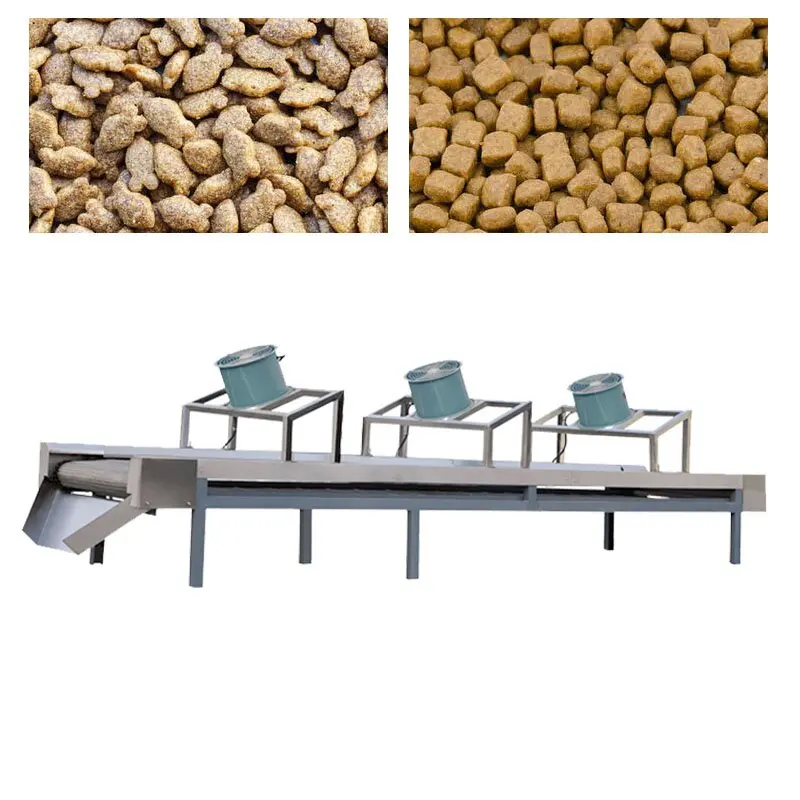
Complete Equipment Mapping — Every station from batching to packing is specified to match the target throughput of your kibble or pellet line, preventing the downstream bottlenecks that plague pieced-together setups.
Technical Specifications
| Parameter | Value |
|---|---|
| Product Type | Twin Screw Pet Food Extrusion Line |
| Screw Type | Twin Screw |
| Output Capacity | Up to 3 tons per hour (basis not stated in source — confirm raw material, moisture content, and kibble size) |
| Applications | Dry dog food, cat food, and fish feed production |
| Control System | PLC or MCC control (configurable) |
| Voltage & Frequency | Configurable to buyer’s local supply standard |
| Line Stations | Mixing, extrusion, conveying, drying, flavouring, coating, cooling, packing |
| Process Documentation | Process flow drawing included |
| Warranty | 1-year |
Application Suitability
| Application | Material or Output |
|---|---|
| Dry dog kibble production | Corn, meat meal, bone meal, poultry by-product, vitamin premix |
| Dry cat kibble production | Fish meal, chicken meal, starch binders, taurine supplement |
| Floating and sinking fish feed | Soybean meal, fish meal, wheat flour, mineral additives |
| Puppy and kitten starter diets | Fine-ground protein sources with controlled expansion density |
Why a Pet Food Making Machine Catalogue Must Show Every Station
A line is only as fast as its weakest downstream station.
I spent years commissioning extrusion lines across Southeast Asia and the Middle East, and the most common failure I witnessed was not the extruder itself — it was the dryer or coating drum that could not keep up. One buyer in Thailand purchased a high-output twin screw unit, then paired it with a dryer rated for half the volume. The result was wet, unstable kibble piling up on the cooling belt, forcing the entire line to run at a fraction of its design speed. A complete pet food making machine full equipment range lets you survey every station before committing, so throughput is calculated across the entire flow rather than just at the extruder die [NEED_CITE: throughput matching principles in continuous food processing lines].
Station Sequence and Material Flow Logic
The production flow begins with a batching and mixing station where raw ingredients are blended to a target moisture and particle size before entering the extruder barrel. The twin screw extruder then subjects the mix to controlled shear, heat, and pressure, forcing it through a die plate that determines kibble shape and size. Understanding where each pet food making machine station sits in this sequence helps buyers identify which upgrades deliver the most practical return.
Matching Dryer and Coater Capacity to Extruder Output
Once kibble exits the die and is cut to length, it carries significant surface moisture that must be removed in a multi-pass dryer before flavouring. If the dryer residence time is too short, the coating drum receives product that is still releasing steam, causing fat and palatant to adhere unevenly. Specifying the dryer belt length and air volume alongside the extruder output prevents this mismatch and keeps the coating station operating within its designed parameters [NEED_CITE: moisture migration and fat absorption in extruded kibble drying].
Reading the Specifications That Matter Most
The screw configuration and L:D ratio determine how long material stays inside the barrel, which directly affects starch gelatinisation and the final expansion density of the kibble. A higher L:D ratio provides a longer residence time, suitable for recipes with heavy meat meal content that need thorough cooking. The die configuration — number of apertures, land length, and face geometry — controls the cut weight and shape consistency of each piece. Barrel zone count and individual temperature control allow operators to build a precise heat profile, essential when switching between a high-starch dog food recipe and a high-protein cat food formula. Control system selection between PLC and MCC influences how repeatable these settings are across production shifts, with PLC offering recipe storage and automated ramp sequences that reduce operator error.
What Happens When Stations Are Mismatched
I once troubleshot a cat food line where the extruder was producing well-formed kibble, but the cooling conveyor was too short for the ambient humidity in the factory. Product reached the packing station still warm and slightly tacky, leading to clumping inside sealed bags within days of shipment. The buyer blamed the extruder recipe, but the real problem was a cooling station that had been selected on price rather than matched to the line’s actual output and local climate conditions. These hidden mismatches cost more in wasted product and customer complaints than any single station upgrade [NEED_CITE: post-extrusion cooling requirements for shelf-stable pet food].
What Sets This Equipment Range Apart
The full line is configured under one supplier, meaning the mixer batch size, extruder throughput, dryer belt speed, and packing scale increment are all calculated against the same target output rather than sourced independently. Screw configuration and die design are specified to the buyer’s actual raw material formulation, not copied from a generic template. An in-house testing workshop runs trial extrusion on customer-supplied ingredients before shipment, so product density, expansion, and texture are verified in advance. Twin screw expertise spans dry pet food, aquatic feed, and snack applications, allowing the same platform to serve multiple product categories. Pre-sales engineering covers line layout, utility planning, and phased installation scheduling, reducing on-site surprises during commissioning.
Documentation & Verification
- Line layout drawing showing station placement and throughput balance for your kibble target
- Machine specification sheet for every individual station in the pet food line
- Screw and die configuration record matched to your raw material formulation
- Electrical schematic with voltage and frequency confirmed for your local supply
- Trial run report on your actual ingredients before equipment leaves the factory
- Operation and maintenance manual covering every station from mixer to packer
Installation, Commissioning & Support
- Foundation and floor space plan based on the full line footprint and station spacing
- Dedicated power circuit sizing for the extruder main drive and dryer heating banks
- Pre-assembled station modules shipped with labelled connections for faster on-site assembly
- First-run parameter tuning on your raw material with screw speed and barrel temperature mapping
- Operator training covering PLC recipe storage, die changes, and dryer belt speed adjustment
- Wear parts list with reorder codes for screws, die plates, and cutter blades
- Scheduled maintenance intervals for gearbox oil, barrel liner inspection, and bearing lubrication
What to Share When Requesting a Quote
To configure the right line, provide your target kibble type, the primary protein and starch sources in your recipe, and the daily output volume you need to meet. Include your factory’s available floor space and ceiling height, along with local voltage and frequency standards so that motors and control panels arrive ready to connect. If you have existing upstream grinders or downstream packing equipment, note their capacity so the new stations can be matched accordingly.
Frequently Asked Questions
Q: What stations are included in the full pet food making machine range and where does each fit?
A: The range covers mixing and batching, twin screw extrusion, conveying, multi-pass drying, flavouring and coating drums, cooling conveyors, and weighing and packing stations. Each station is positioned in a process flow drawing that shows material movement from raw ingredient intake through to sealed bag output, helping buyers visualise the complete production sequence before placing an order.
Q: How do I match extruder output with dryer and coating capacity to avoid bottlenecks?
A: Start with the extruder output based on your specific raw material and kibble size, then specify a dryer with sufficient belt length and air volume to handle that volume at the required moisture reduction. The coating drum must accommodate the dried throughput rate while allowing enough tumble time for even fat and palatant coverage across every piece.
Q: Which station specifications should I compare first when surveying equipment options?
A: Focus on the extruder screw type and L:D ratio for your recipe compatibility, then verify dryer residence time and cooling conveyor length against the extruder output. Control system type — PLC versus MCC — should also be compared early, as it affects recipe repeatability and the ease of switching between different kibble formulations.
Q: Can individual stations be ordered separately or only as a complete line?
A: Individual stations such as a dryer upgrade or a replacement coating drum can be ordered separately, provided their throughput rating is matched to your existing extruder output. However, ordering the full line together ensures every station is calculated against the same capacity target and eliminates interface mismatches between independently sourced equipment.