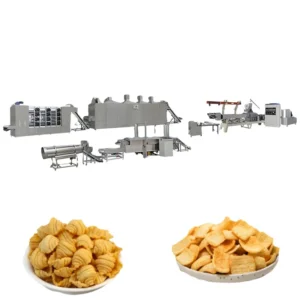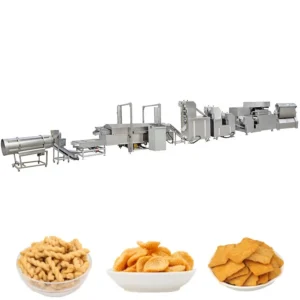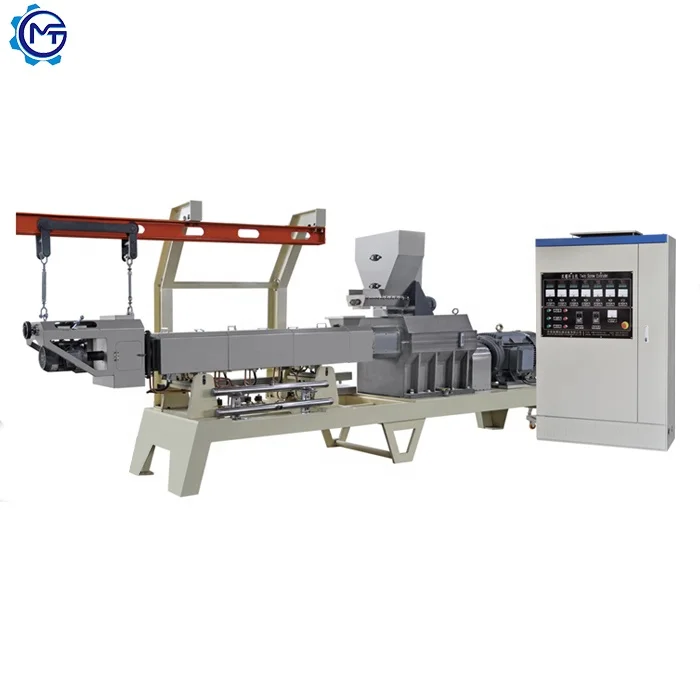
Balanced Line Throughput — Every station from the mixer to the cooler is sized against the single screw extruder output so no segment bottlenecks the frying chips making machine manufacturer line.
Technical Specifications
| Parameter | Value |
|---|---|
| Product Type | Single Screw Extruder Deep Fried Snack Production Line |
| Model | MT100/MT120 |
| Extruder Type | Single screw extruder |
| Screw Configuration | High and low pressure screw |
| Rated Power | 50-70 kW (electricity); 50-60 kW (gas/diesel) |
| Voltage & Frequency | Three phases 380V/50Hz; Single phase 220V/50Hz (customizable to local voltage) |
| Output Capacity | 120 kg/h (basis not stated in source — confirm raw material / moisture / product format) |
| Overall Dimensions (L×W×H) | 12000-26000 × 1200 × 2200 mm |
| Material | Food grade stainless steel 201/304 |
| Energy Options | Electricity / gas / diesel / steam |
| Motor & Inverter | Siemens (made in China) or China top brand motor; Delixi or Delta inverter |
| Die Configuration | Adjustable dies for multiple shapes (screw shell, round tube, square tube, ring, cartoon shapes) |
| Raw Materials | Wheat flour, corn starch, potato starch |
| Assembly State | Complete line |
| Standards | CE, ISO 9001 |
Application Suitability
| Application | Material or Output |
|---|---|
| Secondary puffing snacks (golgappa / pani puri) | Wheat flour and corn starch dough extruded into hollow shells, deep fried to crispness |
| Tube and ring chips | Potato starch and corn starch blends formed into round tubes, square tubes, and rings before frying |
| Cartoon-shaped fried snacks | Multi-grain flour mixes extruded through custom die profiles for novelty snack formats |
| Miscellaneous grain processing | Blends of wheat, corn, and potato starches converted into shelf-stable fried snack products |
Why Voltage Confirmation Must Precede the Line Layout
A 380V/50Hz extruder motor wired to a 60Hz supply runs 20% faster, overheats, and trips the inverter before the first batch finishes.
I watched a snack line stall on commissioning day because the buyer’s local grid was 220V/60Hz and the quotation assumed 380V/50Hz. Every motor on the frying chips making machine manufacturer line ran hot, the PLC threw faults, and we flew in a replacement VFD set at considerable cost. That was a lesson in why I now ask for the electrical single-line diagram before I draw a layout. Voltage and frequency affect the extruder screw speed, the fryer circulation pump, and the cooling conveyor drive — every station depends on it [NEED_CITE: voltage and frequency standards by export market]. Getting this right at the specification stage avoids weeks of delay once the equipment is already bolted to the floor.
How the Extruder Screw Profile Shapes the Final Chip
The MT100/MT120 uses a high and low pressure screw arrangement rather than a single constant-pitch flight. The initial low pressure zone feeds wheat flour or corn starch gently into the barrel without surging, while the downstream high pressure section builds the shear needed to gelatinise starch before it exits the die. This two-stage profile means the same extruder can handle a high-amylose corn starch blend for crisp pani puri shells and a softer potato starch mix for tube chips, simply by adjusting moisture and barrel temperature. A single screw frying chips making machine manufacturer line configured this way avoids the need for separate extruders when a factory adds a second product format to its range.
What the Adjustable Die Set Actually Covers on the Floor
Each die plate bolts to the extruder face and can be swapped during a changeover in under thirty minutes once operators are trained. The standard set produces screw shells, round tubes, square tubes, and rings — the four shapes that account for most secondary puffing snack demand in South and Southeast Asian markets. Cartoon or novelty profiles are cut from additional die plates on request, so a snack factory launching a seasonal range does not need to buy a new extruder, only a new die and a matching cutter guide. The pulling and cutting machine downstream adjusts its blade speed and pull rate to match whichever die is mounted, keeping chip length consistent across formats [NEED_CITE: extrusion die design principles for snack foods].
Reading the Power and Capacity Numbers in Context
The 50-70 kW electricity rating covers the extruder main drive, the screw conveyor, and the fryer circulation pump running together; the 50-60 kW gas or diesel figure applies when the fryer burner switches from electric elements to a gas train. Output is listed at 120 kg/h, but that number shifts depending on whether you are running a thin pani puri shell or a thick square tube — thinner products exit the die faster but spend less time in the fryer, so the bottleneck moves between stations. The 12,000 to 26,000 mm line length reflects whether the buyer chooses a straight layout or an L-shaped arrangement to fit a narrow workshop. Food grade stainless steel 201 or 304 contact surfaces are specified to meet hygiene audits in export markets, with 304 recommended where the workshop environment is humid or salty [NEED_CITE: food grade stainless steel standards for processing equipment].
The Cost of Mismatching the Fryer to the Extruder Output
An extruder running at full screw speed can push more dough through the die than a small batch fryer can handle, which means product piles up on the conveyor, cools unevenly, and enters the oil at the wrong temperature. The result is a batch of half-expanded chips that absorb too much oil and go soft on the shelf. I have seen factories try to solve this by slowing the extruder down, which then starves the flavouring drum and throws off seasoning coverage. When throughput is not matched station by station, the operator ends up running the line at three-quarter speed just to keep quality acceptable, and the rated output becomes a theoretical number on paper rather than a daily reality [NEED_CITE: throughput balancing in snack food production lines].
Why Buyers Survey the Full Catalogue Before Committing
The MT100/MT120 is one line in a broader equipment range, and a buyer evaluating a snack factory build-out needs to see where each station sits relative to upstream batching and downstream packing. Sourcing the mixer, extruder, fryer, flavouring drum, and cooler from one supplier means throughput is calculated across all stations rather than assembled from individual vendor quotes that each assume someone else is handling the bottleneck. Screw configuration and die design are matched to the buyer’s actual flour blend and target chip density, not copied from a generic build. In-house trial runs on the customer’s raw material confirm expansion, oil absorption, and final texture before the line ships, so product development begins at the factory test rather than after installation. Pre-sales engineering, on-site commissioning, and operator training are delivered by the same team that built the line, so questions during ramp-up go back to people who have seen the machine run.
Documentation & Verification
- Machine specification sheet listing MT100/MT120 motor brand, inverter brand, and energy source per station
- Line layout showing throughput calculation between extruder die output, fryer belt speed, and flavouring drum residence time
- Electrical schematic with confirmed voltage, frequency, and control language matching local grid supply
- Factory test record documenting a trial run on buyer-supplied wheat flour or starch blend before dispatch
- CE declaration of conformity covering machinery directive requirements for the complete line assembly
- Wear parts list with screw flight, die plate, and fryer belt specifications for first-year replacements
Installation, Commissioning & Support
- Foundation must support the 12,000-26,000 mm line length on level concrete with anchor points at each station base
- Dedicated three-phase circuit sized for the 50-70 kW peak load with isolator within reach of the MCC panel
- Line ships in sectional modules; on-site assembly aligns the conveyor transfers between extruder, fryer, and cooler
- First run sets screw speed, barrel temperature zones, and fryer oil temperature against the buyer’s target chip density
- Operators trained on die changeover, fryer oil filtration, and PLC fault code response during the commissioning week
- Spare screw flights and die plates shipped with the line so replacements are on hand before first wear occurs
What to Prepare Before Requesting a Quotation
Send the flour or starch blend recipe along with moisture content and any lab-scale extrusion data you already have, so the screw configuration can be set before the trial run. Confirm your workshop length and ceiling height — the line spans up to 26 metres and the cooling conveyor may need overhead clearance. Specify your local three-phase voltage, frequency, and whether the control panel labels and PLC screens should be in English or another language. If you already run upstream batching or downstream packing equipment, share the conveyor heights and throughput so the new line ties in without manual transfer points.
Frequently Asked Questions
Q: How is the 120 kg/h output capacity measured on the MT100/MT120 line?
A: That figure depends on the raw material blend, moisture content, and die shape in use. A thin pani puri shell made from wheat flour at the right moisture may reach that rate, while a thicker square tube from a high-potato-starch blend will run slower. We confirm actual throughput during a trial run on your material before the quotation is finalised.
Q: Which stations run on electricity versus gas, diesel, or steam?
A: The extruder main drive, conveyors, and cooling fan use electricity. The fryer can be configured with electric heating elements or a gas, diesel, or steam burner depending on your site utilities. We list the energy source per station in the specification sheet so you can calculate total connected load accurately.
Q: What die shapes are included as standard, and how are custom profiles added?
A: The standard set covers screw shell, round tube, square tube, and ring profiles. Additional cartoon or novelty shapes are produced from custom die plates that bolt onto the same extruder face. The pulling and cutting machine adjusts to match whichever die is mounted, so changeover requires only the new plate and a cutter guide swap.
Q: How do I confirm voltage, frequency, and control language before shipment?
A: We request your site electrical single-line diagram during the layout stage. The motor nameplates, inverter settings, and PLC screen language are all configured in the factory and verified on the test run. The electrical schematic in your documentation pack confirms every setting before the line is crated.