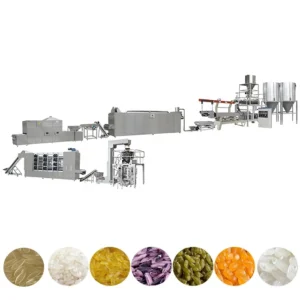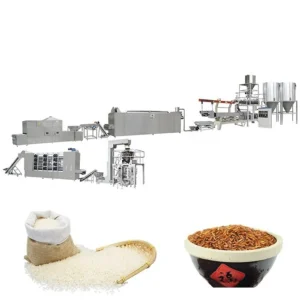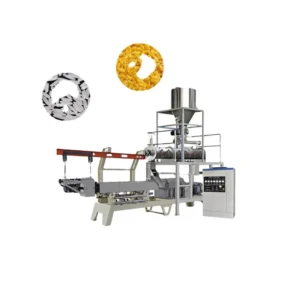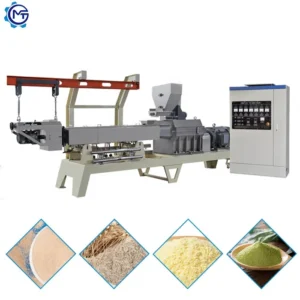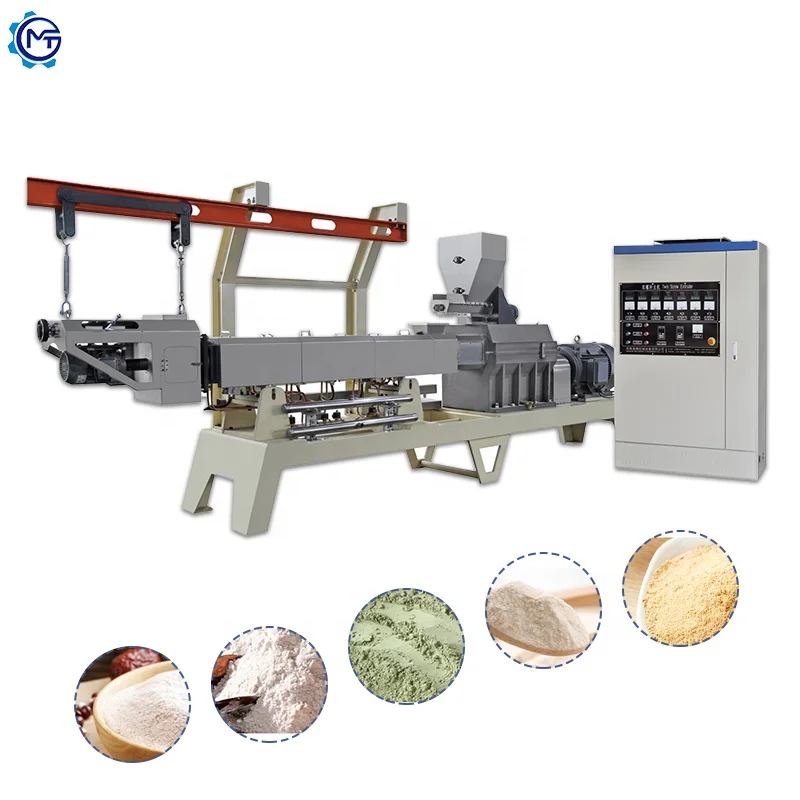
Throughput Matching — Every station in the nutritional powder processing line is specified as a system, so the dryer, mixer and packer are sized to the extruder’s real output rather than ordered from separate vendors.
Technical Specifications
| Parameter | Value |
|---|---|
| Product Type | Instant Baby Food Porridge Production Line |
| Model Options | MT-65 / MT-70 / MT-85 |
| Extruder Type | Twin-screw |
| Control System | PLC and MCC control |
| Rated Power (MT-65) | 81.5 kW |
| Actual Consumed Power (MT-65) | 53 kW |
| Output Capacity (MT-65) | 100–150 kg/h (basis not stated in source — confirm raw material / moisture / recipe) |
| Overall Dimensions (MT-65) | 21000 × 1200 × 2200 mm |
| Rated Power (MT-70) | 115 kW |
| Actual Consumed Power (MT-70) | 76 kW |
| Output Capacity (MT-70) | 200–240 kg/h (basis not stated in source — confirm raw material / moisture / recipe) |
| Overall Dimensions (MT-70) | 23000 × 1500 × 2200 mm |
| Rated Power (MT-85) | 181 kW |
| Actual Consumed Power (MT-85) | 117 kW |
| Output Capacity (MT-85) | 400–500 kg/h (basis not stated in source — confirm raw material / moisture / recipe) |
| Overall Dimensions (MT-85) | 28000 × 3500 × 4300 mm |
| Process Flow | Mixing → crushing → extrusion expansion → drying → cooling → secondary crushing → secondary mixing → packaging → finished product warehousing |
| Manual Language | English version available |
| Certification | CE |
Application Suitability
| Application | Material or Output |
|---|---|
| Infant nutrition powder (Cerelac-style instant porridge) | Corn, rice, millet, wheat, oats blended with milk powder, maltodextrin and vitamin C |
| Health care grain nutrition powder | Highland barley, Coix seed, yam, konjac, red beans, black beans with supplementary sugar powder |
| Grain expanded powder as beverage thickener | Corn and rice base processed for instant dispersion in liquid |
| Edible fungus solid beverage base | Black sesame, red jujube, peanut blended with expanded grain carrier |
What a Nutritional Powder Processing Line Full Equipment Range Actually Covers
The catalogue shows every station so you can see whether the dryer can keep up with the extruder before any metal is cut.
When a buyer assembles a nutritional powder processing line full equipment range from different vendors, the extruder often outpaces the dryer or the secondary mixer cannot handle the throughput. The result is a bottleneck that shows up on the first production week, with operators feeding material back into holding bins while downstream stations sit idle. [NEED_CITE: throughput matching across extrusion line stations]. I once walked a North American client through exactly this failure mode after their previous supplier quoted the extruder on nominal capacity without confirming the actual grain blend and moisture content. The expansion density missed specification entirely, and the line shut down within days.
Mapping Each Station to Its Neighbour
A nutritional powder processing line full equipment range starts at the batching and mixing station, where raw grains and supplements are blended to recipe before entering the crusher. The crusher reduces particle size so the twin-screw extruder receives a uniform feed, which directly affects expansion consistency. After extrusion, the product moves into a multi-pass dryer whose belt length and airflow are calculated against the moisture removed during expansion. Skipping this calculation is the most common reason downstream packing falls behind.
Control Architecture Across the Line
The PLC and MCC control architecture ties every motor, heater and sensor across all nine stations into a single interface. Operators adjust barrel temperature profiles and screw speed from one panel rather than walking between isolated cabinets. [NEED_CITE: PLC integration standards for food extrusion lines]. MCC distribution ensures each station has its own motor protection and isolation, so a fault in the cooling conveyor does not force the extruder into an unplanned stop. Language options on the HMI can be set before shipment, eliminating the commissioning delays that arise when labels and alarms appear in a language the local team cannot read.
Why Screw Configuration Decides Product Density
The twin-screw extruder in this line uses a screw configuration and die design matched to the buyer’s grain blend and target expansion ratio. High-fibre materials such as konjac and Coix seed demand a different compression ratio and kneading block arrangement than a corn-dominant recipe. Barrel temperature zones are set in sequence so that starch gelatinisation completes before the die, preventing post-die collapse. The die aperture and face-cut system shape the expanded strand, and the downstream crusher then reduces it to the powder particle size the market expects. Moisture addition at the preconditioner is held within a tight band because even a small deviation shifts bulk density and alters how the powder behaves when the end consumer adds water or milk.
The Cost of a Mismatched Dryer or Mixer
When the dryer capacity lags behind extruder output, product accumulates on the belt in thick layers and exits with uneven residual moisture, causing clumping in the secondary mixing stage. [NEED_CITE: residual moisture limits for shelf-stable nutrition powder]. A secondary mixer sized for a lower throughput than the crusher delivers means batches queue up, extending hold time and risking microbial growth in warm, humid plant environments. These mismatches do not appear on a spec sheet comparison, which is why a complete line survey matters before committing to purchase.
Why Buyers Specify the Full Range Here
Every station from raw material mixing to finished product warehousing is configured under one supplier, so throughput calculations are cross-checked internally rather than left to the buyer’s project engineer. The screw and die configuration is specified against your actual grain blend, not copied from a generic build. An in-house testing workshop runs your raw material before shipment, producing a trial run report that confirms expansion density and powder texture. Voltage, frequency and control language are confirmed at the order stage so the electrical package matches the destination market. Support covers on-site installation, commissioning and operator training, with a documented wear parts list so the first screw or die replacement does not arrive as a surprise.
Documentation & Verification
- Line layout drawing with throughput calculation for each station in the nutritional powder line
- Screw and die configuration record matched to your grain blend and target bulk density
- Trial run report on your raw material conducted in the testing workshop before dispatch
- Electrical schematic confirming voltage, frequency and motor protection for the destination market
- Factory test record showing each station operating under load prior to crating
- Operation and maintenance manual with English language text and illustrated safety interlocks
Installation, Commissioning & Support
- Floor space from 21 m to 28 m length depending on model, with 1.2 m to 3.5 m width clearance for maintenance access
- Dedicated power circuit rated for the selected model’s actual consumed load of 53 kW to 117 kW
- Stations shipped in sectional assemblies for re-alignment on poured concrete pads
- PLC and MCC panels energised and I/O verified before extruder barrel heat-up begins
- Operator training covers screw speed, barrel temperature zones and dryer belt adjustment for each recipe
- Wear parts list with lead times for screws, dies and crusher blades included at handover
Preparing Your Line Specification
Share your target product format, the grain and supplement blend you intend to run, and the daily throughput your market demands. Confirm the available voltage and frequency at the installation site, along with the control language your operators need. If you have existing upstream batching or downstream packing equipment, note the interface dimensions so the new line connects without re-engineering the surrounding plant.
Frequently Asked Questions
Q: How is throughput matched between the extruder, dryer and packing stations?
A: Each station is sized from the extruder’s confirmed output on your specific grain blend and moisture level. The dryer belt length and airflow, the secondary mixer volume and the packing scale speed are all calculated from that baseline, so no station becomes a bottleneck when the line runs continuously.
Q: Which extruder model fits my target capacity and raw material recipe?
A: The MT-65, MT-70 and MT-85 cover ascending output ranges. Selection depends on the grain blend, the supplement ratio and the bulk density your packaging format requires. A trial run on your raw material in the testing workshop confirms which model reaches the target specification before the order is placed.
Q: What supporting equipment sits between extrusion and final packaging?
A: After the extruder, the line includes a multi-pass dryer, a cooling conveyor, a secondary crusher to reduce expanded strands to powder, and a secondary mixing station where heat-sensitive supplements such as vitamins and milk powder are blended in. Each unit is specified to match the extruder throughput.
Q: Can the line handle different grain blends and supplementary ingredients?
A: Yes. The screw configuration and barrel temperature profile are adjusted to suit high-fibre grains like konjac, starchy bases like corn and rice, or blends with oilseed supplements. Heat-sensitive ingredients are added at the secondary mixing stage after cooling, preserving their nutritional value.
Q: What utility requirements apply to each model tier?
A: Power consumption ranges from 53 kW for the MT-65 to 117 kW for the MT-85, with floor length from 21 m to 28 m and width from 1.2 m to 3.5 m. Voltage and frequency are confirmed at the order stage to match the destination market’s electrical standard.