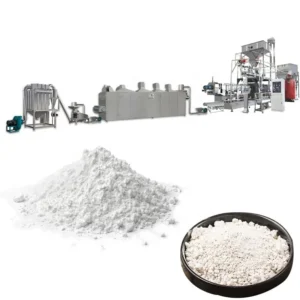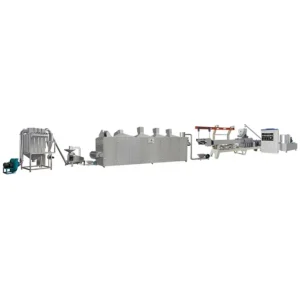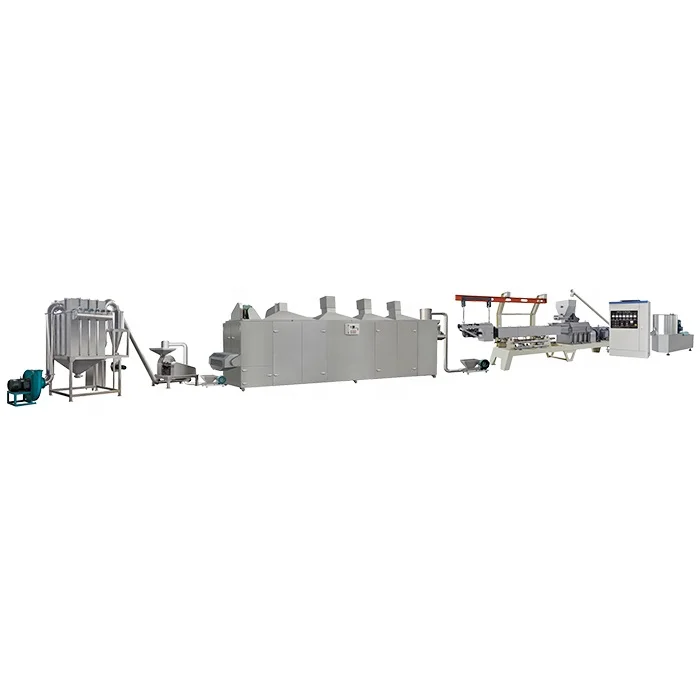
Integrated Throughput Matching — Every station in the modified starch extrusion line is sized to the upstream and downstream equipment, so the mixer, twin-screw extruder, dryer, and grinder run at balanced rates without idle time or material backlog.
Technical Specifications
| Parameter | Value |
|---|---|
| Product Type | Modified Starch Twin-Screw Extrusion Line |
| Model Options | MT70 / MT85 / MT75 |
| Installed Power | 160 kW (MT70) / 190 kW (MT85) / 210 kW (MT75) |
| Power Consumption | 120 kW (MT70) / 140 kW (MT85) / 150 kW (MT75) |
| Output Capacity | 150–200 kg/h (MT70) / 300–400 kg/h (MT85) / 300–500 kg/h (MT75) (basis not stated in source — confirm raw material type, moisture content and modification degree) |
| Overall Dimensions | 41000×1500×2200 mm (MT70) / 43000×1500×3200 mm (MT85) / 45000×1500×3500 mm (MT75) |
| Screw Type | Twin-screw |
| Screw Material | 38CrMoAlA alloy steel |
| Screw Diameter | 70 mm (MT70) |
| Barrel Cooling | Integrated water/oil cooling circuit |
| Voltage & Frequency | 380 V / 50 Hz, 3-phase (custom configurations available: 380 V 60 Hz, 415 V 60 Hz, 220 V 60 Hz) |
| Control System | PLC + MCC automated control |
| Contact Material | Food-grade stainless steel (304 SS option; 201 SS standard) |
| Line Stations | Mixer → Twin-screw extruder → Multi-layer dryer → Pulse grinder |
| Dryer Configuration | 5-layer baking oven, gas/diesel/electricity/steam fuel options, inverter speed control |
| Mixer Batch Capacity | 20–30 kg (MT70) / 70–80 kg (MT85) / 170–180 kg (MT75) |
| Assembly State | Complete line |
| Warranty | 1 year with lifetime maintenance support |
| Certification | CE (since 2014), ISO certified |
Application Suitability
| Application | Material or Output |
|---|---|
| Food-grade modified starch | Potato and cassava starch for bakery dough conditioning, meat processing binders, and sauce thickening agents |
| Industrial modified starch | Corn and wheat starch for textile warp sizing, paper surface coating, and corrugated board adhesives |
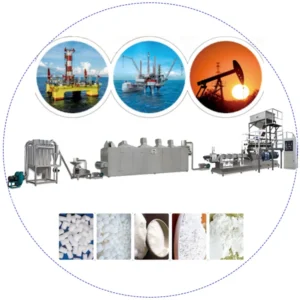
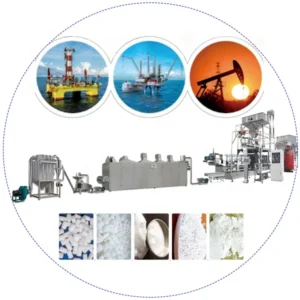
| Cross-industry starch derivatives | Potato and corn starch for building material additives, foundry core binders, and oil drilling fluid viscosifiers |
| Multi-source raw material runs | Cassava, potato, corn, and wheat starch processed on the same line with screw configuration changes |
What "Rated Capacity" Means When Your Raw Material Changes
A starch line rated at a given output on one feedstock may deliver considerably less when the buyer switches to a different crop source or blends in cheaper filler.
I spent years in the test workshop before moving to the field office in Southeast Asia. Last year an Indonesian buyer commissioned a modified starch processing line full equipment range setup using a clean cassava starch recipe during trials. Everything ran within spec — gelatinisation temperature, expansion, final moisture. Then production started, and the plant began cutting costs by blending substantial corn starch into the feed. The gelatinisation window shifted, throughput dropped noticeably, and the midnight phone call from that site is one I still remember. The extruder and dryer had been configured for one material; running a different blend required a different screw profile and barrel temperature curve. [NEED_CITE: gelatinisation temperature differences between cassava and corn starch]
Matching Every Station to the Modified Starch Process
A modified starch processing line full equipment range layout must account for the fact that each stage — blending, extrusion, drying, and fine grinding — has its own throughput ceiling. If the mixer batches at a rate the extruder cannot accept continuously, material sits and degrades. If the dryer cannot remove moisture fast enough from the extrudate, the downstream grinder receives product that clogs its screens. The MT70, MT85, and MT75 models are paired with dryers and grinders whose capacities correspond to each extruder model’s output, so material flows through without accumulation at any transfer point.
Why Screw Configuration Matters More Than Motor Size
The twin-screw design gives operators control over residence time, shear intensity, and mixing completeness inside the barrel — all of which determine the degree of starch modification. A screw profile built for potato starch, which gelatinises at a lower temperature, will not deliver the same modification quality when the feedstock switches to corn starch without reconfiguration. The barrel cooling circuit, using water or oil depending on the model zone, maintains the temperature profile that the specific screw arrangement demands. This is where a generic build copied from a catalogue falls short: the configuration must reflect the buyer’s actual raw material and target modification degree.
Reading the Specs for Real Production Conditions
The installed power figures — ranging from 160 kW to 210 kW depending on model — indicate the mechanical and thermal energy available for shear and gelatinisation inside the barrel, not the running cost. Actual power consumption sits lower, between 120 kW and 150 kW, depending on load and raw material resistance. The 38CrMoAlA alloy steel screws resist the abrasive wear that raw starch causes over extended campaigns, extending the interval between screw element replacements. Voltage and frequency must be confirmed before production: a 415 V 60 Hz market cannot run a standard 380 V 50 Hz machine without transformer losses or motor derating. [NEED_CITE: voltage and frequency standards by export market] The PLC + MCC control system coordinates mixer timing, extruder screw speed, dryer belt speed, and grinder feed rate from a single interface, reducing the chance that one operator error at a single station disrupts the entire campaign.
The Cost of Skipping the Dryer-Grinder Balance Check
Buyers who focus solely on extruder output often discover that the dryer becomes the constraint once production ramps up. A 5-layer dryer with inverter speed control can adjust belt residence time, but its total evaporation capacity is fixed by its heating surface and fuel input. When extrudate enters faster than moisture can be driven off, the pulse grinder receives product above its target moisture, leading to screen blinding and inconsistent particle size in the final starch powder. This forces unplanned stops for screen cleaning and reduces the usable yield from each batch. [NEED_CITE: impact of residual moisture on starch grinding efficiency]
Why Buyers Source the Complete Line from One Supplier
The modified starch processing line full equipment range is supplied as a coordinated system rather than assembled from separate vendors. Every station is throughput-matched during the design phase, which eliminates the mismatch problems that arise when an extruder from one maker feeds a dryer from another. Screw configuration and die design are specified to the buyer’s raw material and target product, not copied from a generic build. An in-house testing workshop runs trials on the buyer’s actual starch source before shipment, producing a trial report that confirms output and product quality on real feedstock. Pre-sales consultation covers line layout and utility planning, while on-site installation, commissioning, and operator training ensure the PLC control parameters are set correctly for the local electrical supply.
Documentation & Verification
- Line layout and capacity calculation showing throughput balance across mixer, extruder, dryer, and grinder
- Screw and die configuration record matched to your starch source and modification target
- Trial run report on your actual raw material performed before shipment
- Electrical schematic with confirmed voltage, frequency, and control language
- CE declaration of conformity and ISO certificate included with dispatch documents
Installation, Commissioning & Support
- Foundation must support the MT85 line’s 43-metre length and 190 kW total installed load
- Dedicated electrical circuit sized to the confirmed voltage and 3-phase frequency for your market
- Line arrives in modular sections for on-site assembly aligned to the provided layout drawing
- First-run commissioning includes barrel temperature profiling and screw speed calibration on your starch
- Operator training covers PLC interface navigation, MCC fault diagnosis, and safety interlocks
- Wear parts list identifies screw elements, die plates, and grinder screens with replacement intervals
Planning Your Modified Starch Line Enquiry
To configure the right modified starch processing line full equipment range for your facility, share the specific starch source you intend to process — cassava, potato, corn, or a blend — along with the target modification degree and final particle size specification. Include your local voltage and frequency so the motor and control system can be specified correctly from the outset. If your workshop has ceiling height or length restrictions, provide those dimensions so the dryer configuration and line layout can be adapted accordingly. Indicating whether a pre-shipment trial run on your raw material is required will help us schedule the testing workshop slot within the production timeline.
Frequently Asked Questions
Q: How is output capacity verified before the line ships?
A: Each model’s output figure is confirmed through a trial run in the in-house testing workshop using the buyer’s actual raw material. The trial report records throughput, product moisture, and modification quality under documented conditions, so the capacity claim reflects your specific starch source rather than a generic benchmark.
Q: Can the line be configured for 415 V 60 Hz or other non-standard supply?
A: Yes. The motor, heating elements, and PLC + MCC control panel can be specified for 380 V 60 Hz, 415 V 60 Hz, or 220 V 60 Hz configurations. Voltage and frequency are confirmed during the specification stage, and the electrical schematic reflects the chosen supply before production begins.
Q: How are the extruder, dryer, and grinder matched to prevent bottlenecks?
A: Each model pairing is calculated during the line design phase. The mixer batch cycle, extruder throughput, dryer evaporation capacity, and grinder feed rate are balanced so no single station limits the others. The capacity calculation document provided with the quotation shows these matched figures.
Q: What screw configuration is used for cassava versus corn starch?
A: Cassava starch gelatinises at a lower temperature than corn starch, so the screw profile and barrel heating zones are adjusted accordingly. The configuration record documents the element arrangement and die design selected for your specific raw material, and this is validated during the pre-shipment trial run.
Q: Is a trial run on my raw material possible before shipment?
A: The in-house testing workshop runs your starch through the configured extruder, dryer, and grinder before the line ships. The resulting trial report confirms output, product specification, and process parameters, reducing the commissioning time needed once the line is installed at your site.