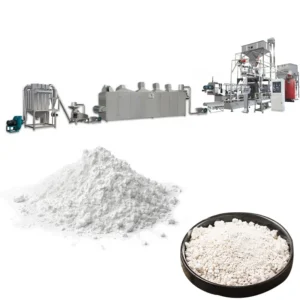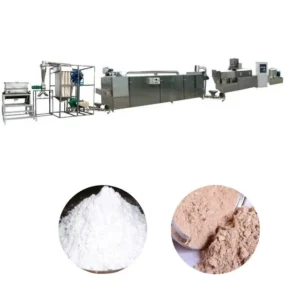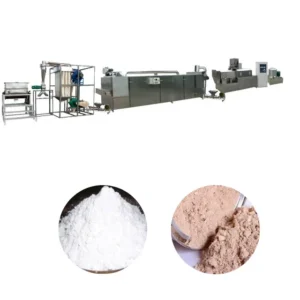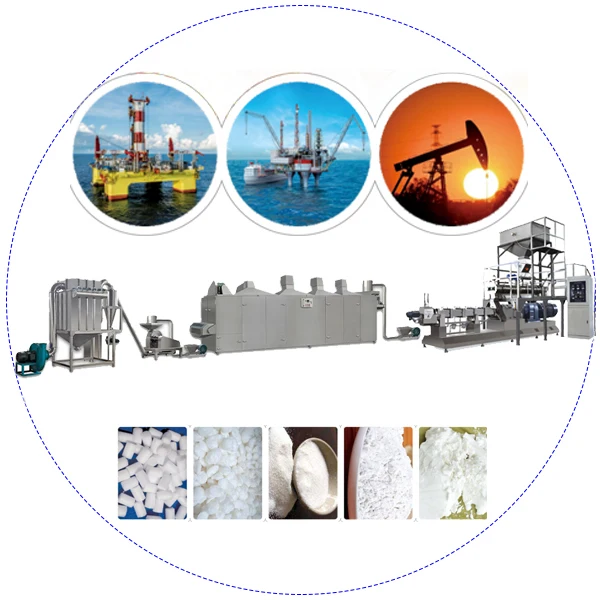
Integrated line configuration — every station from mixing to drying is throughput-matched so the extruder never starves or overfeeds the downstream dryer on starch runs.
Technical Specifications
| Parameter | Value |
|---|---|
| Model | MT65 / MT70 / MT85 |
| Product Type | Modified Starch Extrusion Production Line |
| Installed Power | 72 kW (MT65) / 92 kW (MT70) / 108 kW (MT85) |
| Power Consumption | 50 kW (MT65) / 65 kW (MT70) / 75 kW (MT85) |
| Output Capacity | 140–160 kg/h (MT65) / 240–260 kg/h (MT70) / 500–600 kg/h (MT85) (basis not stated in source — confirm raw material type and moisture content) |
| Overall Dimensions | 2200×1000×2300 mm (MT65) / 2600×1000×2300 mm (MT70) / 4500×1000×2600 mm (MT85) |
| Screw Type | Twin screw, co-rotating, sectional modules |
| Line Stations | Mixer, Double Screw Extruder, Dryer with controllable belt speed and temperature |
| System Configuration | 6 systems — feeding, extruding, cutting, heating, conveying, cooling |
| Standards | CE certified, ISO certified |
| Warranty | 24 months, lifetime service |
Application Suitability
| Application | Material or Output |
|---|---|
| Pre-gelatinized starch for food-grade binders and thickeners | Corn starch, cassava starch, tapioca starch |
| Denatured starch for textile sizing and warp yarn treatment | Wheat starch, corn starch |
| Multi-functional modified starch for paper coating and corrugating | Tapioca starch, cassava starch |
| Modified starch for building material additives and gypsum board | Wheat starch, corn starch |
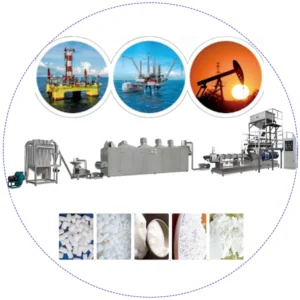
| Pre-gelatinized starch for oil drilling fluid viscosity control | Corn starch, cassava starch |
What "Rated Output" Means When Your Starch Arrives at the Hopper
Capacity figures only hold when raw material moisture and feed rate match the trial conditions.
I have watched starch processors take delivery of an extruder that ran fine on the supplier’s test flour, then lose hours every shift dialing in screw speed and barrel temperature for their own cassava or wheat starch. The output drops, the dryer cannot keep pace, and the line bottlenecks within the first week. Modified starch extrusion equipment for sale rarely ships with a trial report on the buyer’s actual raw material, so the gap between quoted throughput and real throughput stays hidden until commissioning day [NEED_CITE: starch gelatinisation temperature variance across raw material sources].
How the Six Systems Keep Starch Modification Continuous
The feeding, extruding, cutting, heating, conveying, and cooling systems are engineered as one circuit rather than six independent machines. Co-rotating twin screws with sectional modules handle forward transport, mixing, additive injection, de-gassing, cooking, and forming in sequence, so the starch sees a controlled shear and temperature profile from hopper to die. This matters because pre-gelatinized starch demands precise residence time — too short and the granules remain partly raw, too long and the paste burns at the barrel wall.
Barrel Zone Control and the Gelatinisation Window
Starch gelatinisation happens inside a narrow temperature band that shifts depending on whether you run corn, cassava, or wheat starch. Each barrel zone can be set independently, letting operators build a ramp that brings the starch through hydration, gelatinisation, and expansion without overshooting. When a processor switches from corn starch to tapioca starch for a different modified starch extrusion equipment for sale order, the zone profile is adjusted rather than the entire screw assembly being replaced. That flexibility keeps changeover downtime measured in hours instead of shifts [NEED_CITE: barrel temperature profiling for starch gelatinisation control].
Reading the Spec Sheet Against Your Raw Material
The installed power spread — 72 kW on the MT65, 92 kW on the MT70, 108 kW on the MT85 — tells you how much mechanical and thermal energy the screws can deliver to the starch mass. Higher installed power means the extruder can handle higher-moisture feeds or more viscous pastes without stalling the main drive. The twin co-rotating screw design with sectional modules lets the screw configuration be rebuilt for different L:D ratios and compression stages, which directly controls how completely the starch granules rupture. If your target is a low-viscosity pre-gelatinized starch for drilling mud, the screw profile will look very different from a high-viscosity paper coating grade, and the spec sheet should record that configuration before the machine ships.
When Mismatched Dryer Capacity Stops the Line
An extruder pushing starch paste at full rate into a dryer that cannot evaporate moisture fast enough means wet product piles up on the belt, clumps form, and the downstream cooler receives material still above safe packing moisture. I have seen starch lines where the extruder was sized correctly but the dryer belt speed and temperature range were not matched to the extrusion rate, forcing the operator to slow the extruder and lose throughput every shift. That mismatch is exactly the kind of detail that never appears in a single-machine quote [NEED_CITE: dryer belt speed and moisture removal rate correlation in starch processing].
Why Buy the Full Equipment Range Here
Every station — mixer, extruder, dryer, cooler, conveyors — is sourced from one manufacturer, so throughput calculations are done across the entire line rather than per machine. Screw configuration and die design are recorded against the buyer’s specific starch type and target modification, not pulled from a generic build. An in-house testing workshop runs trial batches on the buyer’s raw material before shipment, confirming gelatinisation degree and output rate. The electrical schematic, voltage, and frequency are confirmed before production starts, so commissioning does not stall over a transformer swap. Post-installation support covers operator training, wear parts supply, and ongoing maintenance rather than ending at the factory gate.
Documentation & Verification
- Line layout drawing showing every station footprint and utility connection point for your starch plant
- Screw and die configuration record matched to your corn, cassava, or wheat starch target
- Trial run report on your raw material confirming gelatinisation degree before dispatch
- Electrical schematic with voltage and frequency locked to your site supply
- CE declaration of conformity and ISO certificate for customs and local compliance
- Wear parts list with part numbers for screws, dies, and barrel liners
Installation, Commissioning & Support
- Foundation plan accounts for the MT85’s 4500 mm length and dynamic load from twin-screw torque
- Dedicated power circuit sized for 108 kW installed capacity on the MT85 frame
- Extruder ships with barrel and screw modules separated for container loading and on-site reassembly
- First run includes barrel zone temperature mapping on your starch to set the gelatinisation profile
- Operator training covers screw module swaps for switching between pre-gelatinized and denatured starch
- Spare screw elements and die plates dispatched with the line so first replacement does not halt production
What to Include in Your Inquiry
Tell us which starch you process — corn, cassava, tapioca, or wheat — along with the moisture content as it arrives at your hopper. Share your target modification (pre-gelatinized, denatured, or multi-functional), the daily output in kilograms, and your site voltage and frequency. If your workshop has height or length constraints, include those dimensions so the line layout fits before the equipment ships.
Frequently Asked Questions
Q: How is output capacity verified on my specific starch raw material and moisture level?
A: Before shipment, your raw material is run through our in-house testing workshop. We record extruder screw speed, barrel zone temperatures, and dryer belt speed needed to hit the target gelatinisation degree and moisture content. The trial run report accompanies the machine, so you know the verified output rate on your starch before installation day.
Q: What voltage, frequency, and control language options are confirmed before shipment?
A: We request your site electrical specifications during the proposal stage. The motor, heating elements, and control panel are built to match your voltage and frequency. Control language and interface labels are set before wiring, so operators can read the HMI in their working language from the first shift.
Q: How is screw configuration and die design selected for my target modified starch product?
A: The sectional twin-screw modules are arranged based on your starch type and target modification — pre-gelatinized, denatured, or multi-functional. Screw element sequence, compression ratio, and die opening are documented in the configuration record and validated during the trial run on your raw material.
Q: Which supporting stations are included to prevent bottlenecks across the full line?
A: The line includes a mixer, twin-screw extruder, dryer with adjustable belt speed and temperature, and cooling conveyor. Each station’s capacity is calculated against the extruder’s verified output on your starch, so no single unit throttles the others during continuous production.